
You are filling out a form, writing to your doctor’s office, or finishing a school paper, and your fingers type “pacient.” Something looks off, but you cannot say why. That small doubt is exactly why people search Patient or Pacient before they hit send.
One wrong letter in a medical note or work email can make you look careless. The good news is that the answer is short, and this guide will help it stick for good.
Is “Pacient” a Word in English?
No. English dictionaries do not list pacient as a valid word, and spell checkers will flag it right away.
The mix-up makes sense, though. Many English words use a “c” to make a soft “sh” sound, like “special,” “social,” and “ancient.” So a “c” in this spot feels natural. The word patient breaks that pattern. It uses “ti” for the same sound, just like “nation,” “motion,” and “caution.”
If you see “pacient” on a sign, a form, or a social media post, it is a spelling error unless the text is written in another language.
What Does Patient Mean?
Patient works as both a noun and an adjective. Knowing which one you need makes the word easier to use.
As a noun, a patient is a person who receives medical care or treatment.
- The nurse checked the patient’s blood pressure.
- Each patient signed in at the front desk.
As an adjective, patient describes someone who stays calm while waiting, or who can handle delays and difficulty without getting upset.
- She is a patient teacher who explains things twice.
- Please be patient while the page loads.
You can often tell the two apart by looking at the sentence. If the word names a person getting care, it is a noun. If it describes how someone behaves, it is an adjective.
How to Pronounce Patient
Patient is pronounced PAY-shent (/ˈpeɪʃənt/). It has two syllables. The first rhymes with “day,” and the second sounds like “shent.” That “sh” sound is the reason many people reach for a “c” when they write it.
Where the Word Patient Comes From
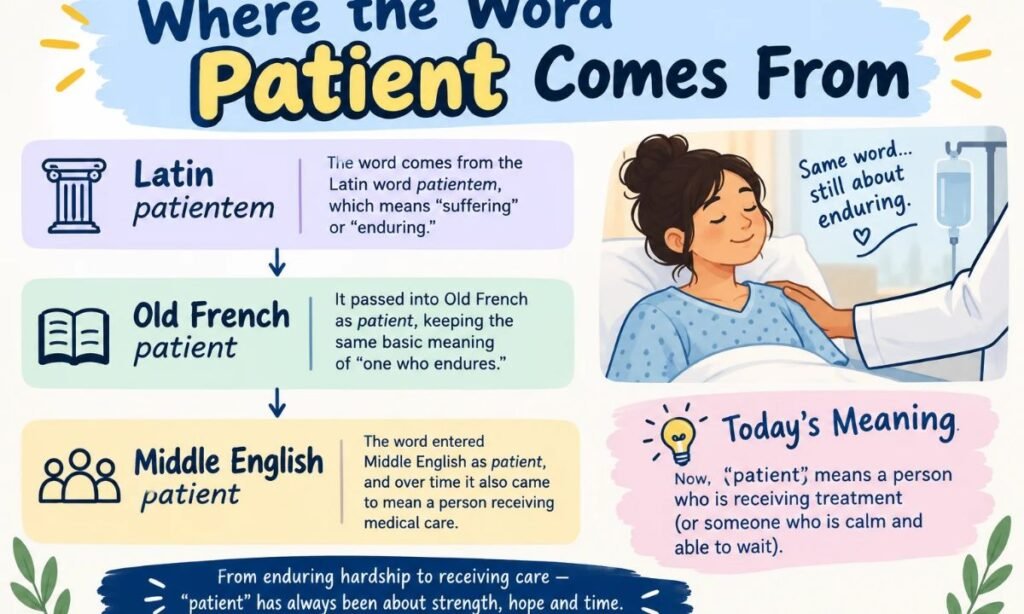
Patient traces back to the Latin word patiens, which comes from the verb pati, meaning “to suffer” or “to endure.” The word passed through Old French before settling into English.
This history explains the two meanings. A person who endures discomfort or delay is patient in the everyday sense. A person who is going through an illness and enduring it is a patient in the medical sense. Both ideas grew from the same root: putting up with something hard.
Since both meanings share one origin, they also share one spelling. There is no separate version for the medical meaning.
Why People Type “Pacient”
A few simple reasons explain the typo:
- Sound matching. The “sh” sound is often spelled with “c” in English, as in “official” and “racial.”
- Other languages. Spanish “paciente,” Portuguese “paciente,” and Italian “paziente” are close cousins. Czech, Romanian, and Catalan use “pacient.” Speakers of these languages may carry the spelling over into English.
- Fast typing. On a phone, “t” and “c” are not far apart in a rushed message. Autocorrect does not always catch it.
- Rare use of the “ti” pattern. Because “ti” is a less obvious spelling for “sh,” the brain defaults to the more familiar “c.”
None of these reasons are a sign of poor writing. They are normal side effects of how English spelling works.
Is There a British vs American Spelling?
No. Unlike words such as “color” and “colour,” patient is spelled the same way in the United States, the United Kingdom, Canada, and Australia. There is only one correct spelling in all of them.
| Word | American English | British English |
| Person receiving care | patient | patient |
| Calm while waiting | patient | patient |
| Plural | patients | patients |
| Quality of staying calm | patience | patience |
If you ever see “pacient” in a British or American text, it is not a regional variation. It is a mistake.
Patient vs Patience: Do Not Mix Them Up
Once you have the right spelling, there is another word that trips people up. Patience is a noun that names the ability to stay calm. Patient is the word for the person or the describing word.
| Word | Part of speech | Meaning | Example |
| Patient | Noun | A person receiving medical care | The patient waited for the results. |
| Patient | Adjective | Calm and able to wait | He stayed patient in traffic. |
| Patience | Noun | The ability to wait calmly | She has a lot of patience. |
A simple test helps: if you can swap in “the ability to stay calm,” use patience. If you are describing a person or naming someone in a clinic, use patient.
- Correct: You need patience to learn a new language.
- Correct: You need to be patient to learn a new language.
- Incorrect: You need patient to learn a new language.
Patient in Real Sentences

Seeing the word in context is the fastest way to lock it in. Here are examples from different settings.
Medical writing
- The patient reported mild pain in the left knee.
- Every patient received a printed care plan.
Emails
- Thank you for being patient while we fixed the issue.
- Our team will reach every patient by Friday.
News
- Hospitals asked each patient to arrive early for the new check-in system.
Everyday speech
- Be patient with him, he is still learning.
- A patient mind solves more problems than an angry one.
Formal writing
- The study followed 40 patients over six months. (Example format only. Always use your own data.)
Common Mistakes With Patient
Even careful writers slip on this word. Here are the mistakes to watch for.
- Writing “pacient.” This is the most frequent error and the main reason for this guide.
- Writing “patiant” or “patent.” “Patent” is a real word, but it means a legal right to an invention. It has nothing to do with care or waiting.
- Using “patient” when you mean “patience.” For example, “Thank you for your patient” should be “Thank you for your patience.”
- Using the wrong plural. The plural is patients, not “patience” or “patientes.” The possessive is patient’s (one patient) or patients’ (many patients).
- Mixing languages. Writing “paciente” or “pacient” in an English sentence because it feels familiar from another language.
- Trusting autocorrect blindly. Some tools do not change “pacient” at all, especially in names or mixed-language text.
Easy Ways to Remember the Spelling
A few small tricks can fix the habit quickly.
- Link it to patience. Both words share “ti” in the middle. A patient needs patience, so the two spellings match.
- Think “ti” for “sh.” Compare it with “nation,” “station,” and “caution.” Same sound, same spelling pattern.
- Break it into parts. Say it as “pa-tient” and picture the word “ti” sitting in the middle.
- Add it to your dictionary. If you often mistype it, save “patient” as a text shortcut so it never comes out wrong again.
Spelling Patient in Medical and Formal Documents
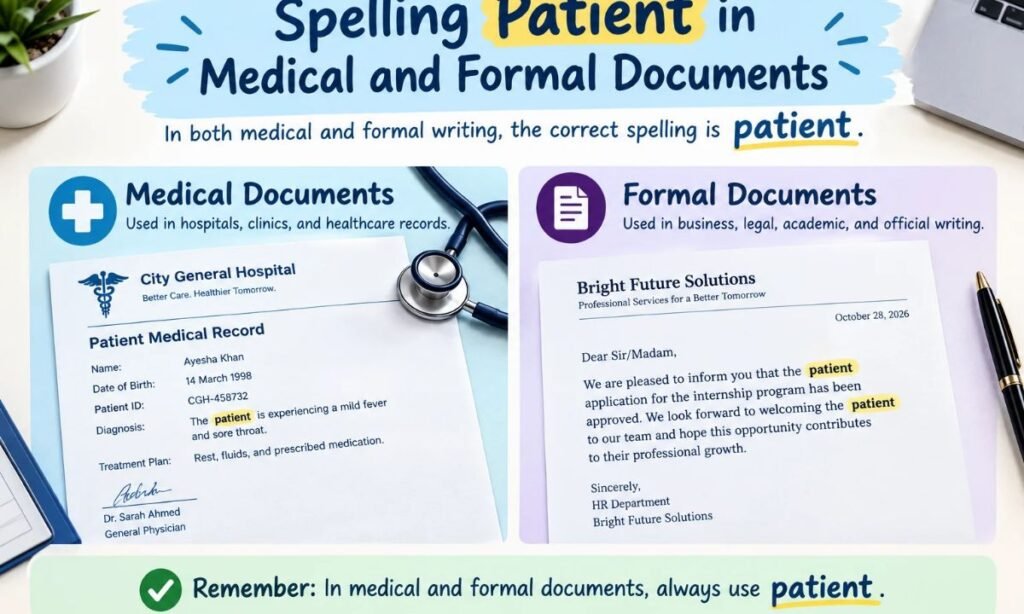
In clinics, hospitals, and schools, spelling matters more than usual. Records are read by many people, and a typo can look unprofessional or cause confusion in searches. If a file is labeled “pacient,” a staff member may not find it when they search for “patient.”
A few good habits help:
- Turn on spell check in any system used for records or forms.
- Read the word aloud once when you proofread. It is easy to catch “pacient” when you slow down.
- Use consistent wording across a document. If you start with “patient,” do not switch to another term halfway through.
- Check names carefully. A person’s name may be spelled differently from the common word, and that is fine, but the general word should still be patient.
Frequently Asked Questions
Is “pacient” a word in English?
No. Pacient is not an English word and is not listed in standard English dictionaries. It is either a typo or the correct spelling in languages like Czech, Romanian, and Catalan. In English, the right spelling is patient.
Why is “pacient” incorrect in English?
English uses “ti” in words like patient, nation, and caution to make the “sh” sound. Because patient follows this pattern, replacing “ti” with “c” breaks the spelling rule. The word has always been written with “ti” in English.
What is the difference between patient and patience?
Patient is a person receiving care, or an adjective meaning calm and able to wait. Patience is a noun that names the ability to stay calm. For example: “She is a patient teacher” uses the adjective, while “She has great patience” uses the noun.
Is patient spelled differently in British and American English?
No. Patient is spelled the same way in American, British, Canadian, and Australian English. Only a few related words, such as “color” and “colour,” change by region. This one does not.
Conclusion
When you wonder about Patient or Pacient, the answer is simple: patient is correct in English, in every region, and in every setting. “Pacient” belongs to other languages or to typos. Remember the “ti” in the middle, link it to patience, and say it out loud once when proofreading. Do that, and you will not stumble on this word again.

Alexander John grammar content writer with 4 years of experience creating accurate, engaging, and SEO-friendly content. I specialize in spelling differences, commonly confused words, vocabulary, grammar rules, and writing tips. My goal is to simplify English for learners through clear explanations, practical examples, and helpful articles.
Pingback: Realest or Realist: Which Word Is Correct? Meaning & Examples
Pingback: Barrel vs Barrell: Which Spelling Is Correct?
Pingback: Opening vs Openning: Which Spelling Is Correct?
Pingback: Foward vs Forward: Which Spelling Is Correct?
Pingback: 13rd vs 13th: Which Is Correct? Spelling, Rules & Examples
Pingback: Therefore or Therefor: Which Spelling Is Correct? Meaning & Examples
Pingback: Using or Useing: Which Spelling Is Correct? Meaning & Examples
Pingback: Devide or Divide: Which Spelling Is Correct?
Pingback: Authorized or Authorised: Which Spelling Is Correct?
Pingback: Curtesy or Courtesy: Which Spelling Is Correct?
Pingback: Todays or Today’s: Which Spelling Is Correct?
Pingback: Sweeped or Swept: Which Spelling Is Correct?
Pingback: Split or Splitted: Which Is Correct? (Easy Grammar Guide)
Pingback: Privilege: Meaning, Definition, Examples, and Correct Usage
Pingback: Long Term or Longterm: Which Spelling Is Correct?
Pingback: Fairing or Faring: Meaning, Difference & Correct Usage
Pingback: Wifes or Wives: Which Spelling Is Correct?
Pingback: Chonies vs Chones: Which Spelling Is Correct?
Pingback: Outting or Outing: Which Spelling Is Correct?
Pingback: Requester vs. Requestor: Which Spelling Is Correct?
Pingback: Resignate or Resonate: Which Word Is Correct?
Pingback: Run or Ran: Which Spelling Is Correct?
Pingback: Transferred vs Transfered: Which Spelling Is Correct?
Pingback: You Too or You To: Which Is Correct? Meaning and Examples
Pingback: Kaylee McGhee White Measurements, Height & Biography (2026)