
You’ve just finished a product page, and a UK colleague says your spelling is wrong. Your US colleague says it’s right. So who’s right on customize or customise?
Both of them, as it turns out, and that’s the problem: use the wrong one for the wrong audience and your page can feel off to the readers you’re trying to win. The answer depends on where your readers live. Here’s how to choose, and how to stay consistent.
What Does “Customize” Mean?
To customize something is to change or build it so it suits a specific person, purpose, or preference. It works as a verb, and it often implies that the options are chosen by the user or the maker.
- You can customize your phone’s home screen.
- The bakery will customize a cake for any event.
- She customized her resume for each job application.
The word grows out of custom, which in this sense means “made to order.” A custom suit, a custom order, and a customized order all share the same idea: made or adjusted for one person’s needs.
Which Spelling Goes With Which Country?
The choice comes down to your audience. Here is a practical guide.
| Region | Preferred spelling | Notes |
| United States | customize | Standard in all American writing |
| Canada | customize | Canadian English generally uses the -ize ending |
| United Kingdom | customise | Standard in most British publishing |
| Australia | customise | Follows British spelling |
| New Zealand | customise | Follows British spelling |
| Ireland | customise | Follows British spelling |
| International or global | Pick one and stay consistent | Match your main reader group |
If you write for a mixed audience, choose the spelling used by the largest group of your readers, then apply it everywhere.
Why Do Both Spellings Exist?

The split comes from a bigger pattern in English: words ending in -ize (American) versus -ise (British).
The -ize ending traces back to a Greek verb ending that passed into Latin and then French. Over time, British writers began to favor -ise, partly because of the influence of French spellings. American English kept -ize and made it the standard, a choice that was reinforced by early American dictionary makers who aimed for spelling that was simple and consistent.
Neither form is older in a way that makes it “more correct.” They are two accepted conventions that grew apart.
Is “Customise” Wrong in American English?
It is not wrong in the sense of being a mistake, but it will look out of place. American readers see customise as a British spelling, and spell checkers set to US English will underline it.
The reverse also applies. Customize is not wrong in British writing, because a British style known as Oxford spelling uses -ize endings in many words. Oxford University Press and some academic publishers follow it. Most British newspapers, businesses, and websites, however, use customise.
So the rule is not “right versus wrong.” The rule is match your audience.
All the Word Forms, in Both Spellings
Writers often check the base verb and then forget the related words. Here they are side by side.
| Form | American | British |
| Base verb | customize | customise |
| Third person | customizes | customises |
| Past tense | customized | customised |
| Present participle | customizing | customising |
| Noun | customization | customisation |
| Adjective | customizable | customisable |
| Person or tool | customizer | customiser |
Keep every form in the same system. If you write customise, then use customisation and customisable, not customization.
Customize vs Personalize
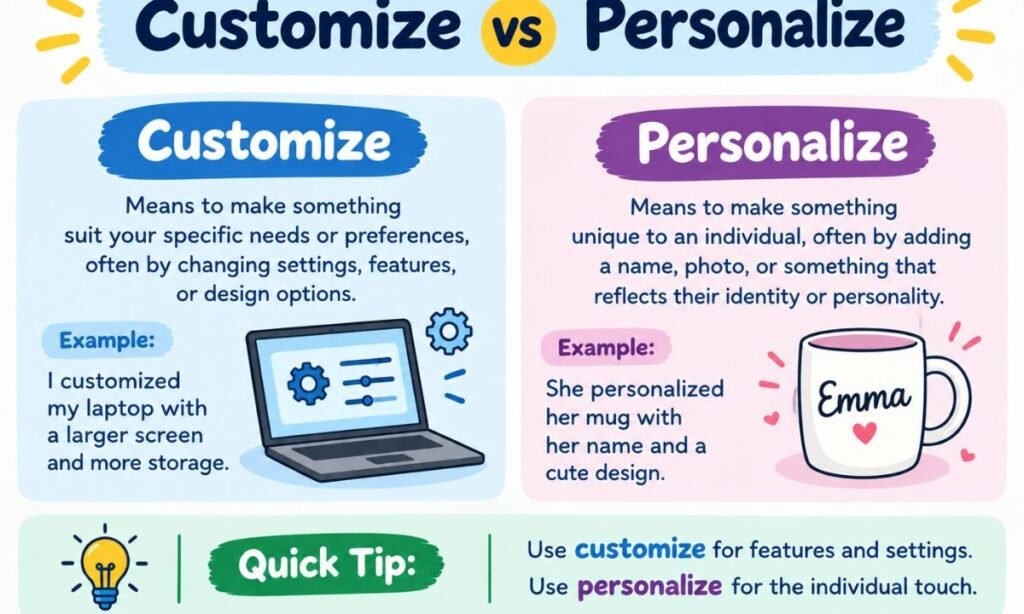
These words overlap, and people often swap them. They are not exact twins.
Customize means to adjust something to meet needs or preferences, often by choosing options. Personalize means to make something specific to one individual, often by adding their name, details, or data.
| Word | Typical focus | Example |
| Customize | Settings, features, options | Customize the layout of your dashboard. |
| Personalize | An individual’s identity or details | Personalize the mug with her initials. |
A quick test: if you are changing how something works or looks, customize fits. If you are adding a name or a personal touch, personalize fits. Both words use the same US and UK spelling split: personalise is the British form.
Useful Synonyms
When you need variety, these words can replace customize in many cases:
- Tailor: We tailor each plan to the client.
- Adapt: She adapted the speech for a younger crowd.
- Modify: You can modify the template.
- Tweak: He tweaked the settings to speed things up.
- Personalize: The tool personalizes your feed.
- Build to order: The shop builds bikes to order.
Choose the one that matches your meaning. Tweak sounds casual, while tailor sounds more careful.
A Detail Most Guides Skip: Some Words Never Change
Not every word ending in “ize” can swap to “ise.” A handful of words end in -ise in both American and British English, and a few end in -ize everywhere.
Always -ise in both: advertise, revise, supervise, surprise, exercise, compromise, improvise, disguise, televise
Always -ize in both: size, capsize, prize (as in a reward)
So a blanket rule like “British English uses -ise for everything” is not accurate. The pattern applies only to verbs where the ending comes from the Greek -izo root, and customize is one of them.
How to Choose for a Website or Business

Spelling matters most when your words represent a brand. These steps keep you consistent.
- Identify your main audience. Look at where most of your customers live.
- Pick one spelling system. Do not mix customize and customise on the same site.
- Set your tools to match. Change your word processor and website language setting to US or UK English so spell check helps you instead of fighting you.
- Check your own data. Your analytics and search reports show which spelling your visitors actually use. Mirror it in headings and product copy.
- Write a short style note. One line such as “We use American spelling” saves arguments later.
If you serve both markets, you can make separate pages for each, or choose one spelling and accept that some readers will see a small regional difference. Most readers understand both.
Common Mistakes With Customize and Customise
- Mixing spellings in one document: “customize” in a heading and “customisation” in the body. Fix: choose one system.
- Mixing UK and US words by accident: writing “customise” next to “color.” Fix: if you use British customise, also use colour.
- Using the wrong noun form: writing “customizeation.” Fix: customization or customisation.
- Confusing it with “costumize”: this is a typo that swaps in “costume.” Fix: custom is the root.
- Treating one spelling as a typo in someone else’s text: both are accepted. Fix: only correct it when your style guide requires a specific form.
Customize and Customise in Real Sentences
Website or app (US): Customize your notification settings in the menu.
Website or app (UK): Customise your notification settings in the menu.
Email: We can customise the package to fit your budget.
Social media: Just customized my keyboard and it looks amazing!
Business document: The proposal customizes our standard service for each client.
Product listing: Customizable cases available in six sizes.
How to Remember Which Spelling to Use

Try these simple anchors:
- Z for the USA: American English likes the z sound. Think “Zee,” the American name for the letter.
- S for Sterling: British English uses s in this ending. Think of the UK pound.
- Match the rest of the text: if the document spells “colour” and “favourite,” go with customise. If it spells “color” and “favorite,” go with customize.
Frequently Asked Questions
Is it customize or customise?
Both are correct. Customize is American English, and customise is British English. Pick the one that fits your audience.
What is meant by customise?
Customise means to change something so it suits a particular person, need, or purpose. It is the British spelling of customize, and the meaning is identical.
Is customise the correct spelling in the UK?
Yes. Customise is the standard spelling in the UK, as well as in Australia, New Zealand, and Ireland. Some British academic publishers follow Oxford spelling, which uses customize.
Can I use customize in the UK?
You can. It is understood and accepted, and Oxford spelling uses it. For general British audiences, customise will feel more natural, so use it if you want your writing to match local habits.
Final Verdict: Customize or Customise?
Neither spelling is a mistake. Customize belongs to American (and Canadian) English, and customise belongs to British, Australian, New Zealand, and Irish English. Choose based on who will read your work, use that spelling in every related word, and keep it consistent from the first heading to the last.
Pick one, stick with it, and your writing will read as polished in any market.

Alexander John grammar content writer with 4 years of experience creating accurate, engaging, and SEO-friendly content. I specialize in spelling differences, commonly confused words, vocabulary, grammar rules, and writing tips. My goal is to simplify English for learners through clear explanations, practical examples, and helpful articles.