
Your invitation is ready. The party is on the 13, and you pause: does the date take “rd,” like 3rd and 23rd, or something else? The 13rd vs 13th question catches careful writers because every nearby number seems to follow a pattern.
Pick the wrong ending and a flyer, a form, or a school paper looks sloppy. The fix is a short rule with only three exceptions to remember. Here it is, with examples you can copy.
Why Is It 13th and Not 13rd?
The answer comes down to how English builds ordinal numbers. Ordinals show position or order, like first, second, and third.
The three basic endings work like this:
- Numbers ending in 1 use st (1st, 21st, 101st)
- Numbers ending in 2 use nd (2nd, 22nd, 102nd)
- Numbers ending in 3 use rd (3rd, 23rd, 103rd)
- Everything else uses th (4th, 10th, 25th)
Then comes the catch. Numbers ending in 11, 12, or 13 are the exception. They take “th” every time. That is why we say 11th, 12th, and 13th, never 11st, 12nd, or 13rd.
Where the “th” Comes From
The teens have their own history. The words eleventh, twelfth, and thirteenth are spoken and spelled with a “th” ending, and the written numerals simply copy the spoken word.
Compare it with the numbers that really do use “rd.” The word third is an irregular form that stands apart from the usual pattern. The word thirteenth, on the other hand, is built from “thirteen” plus the “th” ending, just like fourteenth, fifteenth, and the rest of the teens.
So 13th does not follow the “third” pattern because it is not built from “third.” It is built from “thirteen.”
Why Do People Write 13rd?
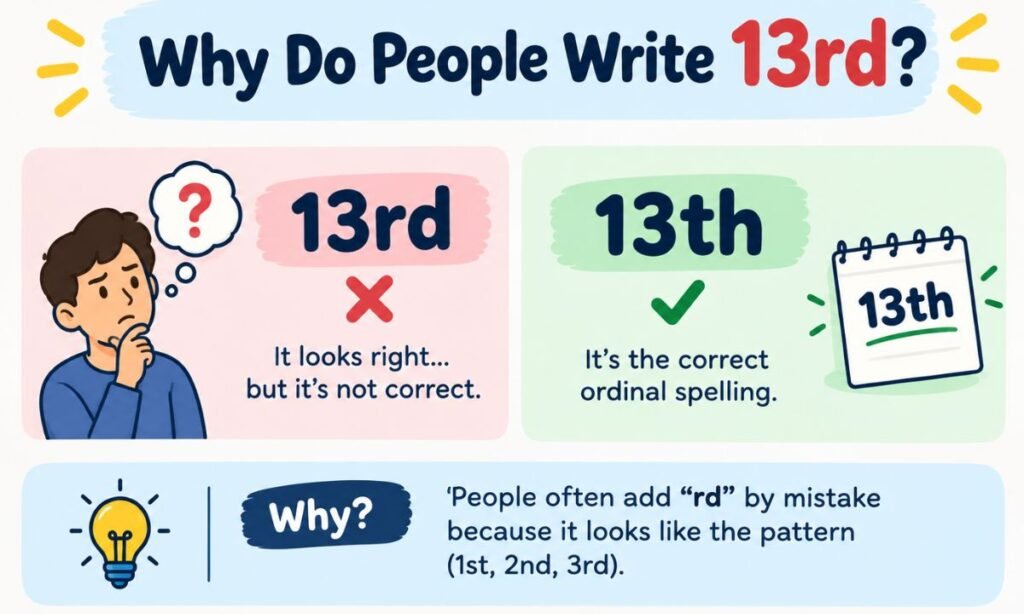
It is an easy mistake, and there are good reasons for it.
The pattern looks logical. If 3rd, 23rd, 33rd, and 43rd all work, then 13rd feels like it should too. The brain fills in the gap.
Only the last digit seems to matter. Most of the time, it does. Teens are the one place where the last two digits count.
Typing on autopilot. Many people write dates quickly, and the “rd” habit from 3rd carries over.
Few people are ever taught the exception. Schools cover 1st, 2nd, and 3rd. The teen rule often gets one quick mention, if any.
Quick Comparison Table
This table shows how the rule works across many numbers.
| Number | Correct form | Why |
| 3 | 3rd | Ends in 3, not a teen |
| 13 | 13th | Teen exception |
| 23 | 23rd | Ends in 3, not a teen |
| 33 | 33rd | Ends in 3, not a teen |
| 103 | 103rd | Last two digits are 03 |
| 111 | 111th | Last two digits are 11 |
| 112 | 112th | Last two digits are 12 |
| 113 | 113th | Last two digits are 13 |
| 213 | 213th | Last two digits are 13 |
| 1,013 | 1,013th | Last two digits are 13 |
The pattern is simple. Look at the last two digits. If they are 11, 12, or 13, use “th.”
Does the Rule Apply to 113th, 213th, and Larger Numbers?
Yes. The teen rule applies no matter how large the number gets. The last two digits decide the ending.
- 113 becomes 113th
- 213 becomes 213th
- 1,013 becomes 1,013th
- 10,013 becomes 10,013th
Numbers like 103 and 123 are different, because their last two digits are 03 and 23, not 13. So you write 103rd and 123rd.
How to Say and Spell “Thirteenth”

Spelling out the word causes its own trouble. The correct spelling is thirteenth, with a “th” in the middle and again at the end.
Pronunciation: thur-TEENTH, with the stress on the second syllable.
Common misspellings include:
- thirteeth
- thirtheenth
- thirdteenth
- thirteenth with a missing second “th”
A trick that helps: the word contains “teen.” You can see thir + teen + th. Break it into three parts and the spelling follows.
How to Write Dates With 13th
Dates are where most people use this word, so the format matters.
American style: Month first. October 13 or October 13th.
British style: Day first. 13 October or 13th October.
Style guides differ on the ending. The Associated Press and the Chicago Manual of Style both prefer plain numbers in dates, as in “October 13,” while ordinals are normal in speech and in many informal settings. When you do use an ordinal, 13th is the only correct form.
A few tips:
- In running text, write the 13th of October, not the 13rd of October.
- Superscript is fine in print and design, as in 13<sup>th</sup>, but plain text works everywhere.
- Never mix styles in one document. Pick one and keep it.
When to Use Numerals vs Words
A quick rule of thumb for ordinals in writing:
- Journalism (AP style): Spell out first through ninth. Use figures for 10th and above, so 13th appears as numerals.
- Book publishing (Chicago style): Spell out ordinals in running text, so write thirteenth.
- Casual and digital writing: Numerals are common and perfectly fine.
Whichever style you choose, the ending stays “th.” Only the format changes.
Real-Life Examples of 13th

Seeing the word in use makes it easier to remember.
Birthdays: My daughter turns thirteen soon, and her 13th birthday party is on Saturday.
Dates: The meeting is scheduled for the 13th.
Rankings: She finished 13th in the regional spelling bee.
History and law: The 13th Amendment to the U.S. Constitution abolished slavery. It was ratified in 1865.
Buildings: Some hotels and apartment buildings skip the 13th floor and number it as 14. The fear of the number 13 even has a name, triskaidekaphobia.
Calendar curiosity: Friday the 13th is a well known date that people sometimes treat as unlucky.
Common Mistakes With 13th
- Writing 13rd: the main error. Fix: use 13th.
- Writing 13nd or 13st: a worse version of the same mistake. Fix: 13th.
- Writing 23th: the reverse mistake. Fix: 23rd, because 23 is not a teen.
- Spelling the word wrong: “thirteeth” or “thirtheenth.” Fix: thirteenth.
- Using different endings inconsistently: “12th, 13rd, 14th” in one list. Fix: 12th, 13th, 14th.
How to Remember the Rule Forever
Here are a few simple memory aids.
- The teen trick: every teen number from 11 to 19 ends in “th.” The numbers 11, 12, and 13 just look like they should be different.
- The last two digits test: check the final pair. If it is 11, 12, or 13, write “th.”
- Say the word out loud: you can hear thirteenth, not “thirdteen.” The sound gives it away.
- Group the exceptions: think “eleventh, twelfth, thirteenth.” Each spoken word ends in “th,” so the number does too.
Frequently Asked Questions
Is it 13th or 13rd?
It is 13th. The form “13rd” is never correct. Numbers ending in 11, 12, and 13 always take “th.”
Is “13 th” or “13 rd” the correct way to write it?
Neither with a space. Write 13th as one unit, with no space between the number and the ending.
Why do 11th, 12th, and 13th all use “th”?
They follow the spoken words eleventh, twelfth, and thirteenth, which all end in “th.” Because the written ordinals mirror the spoken ones, the teens use “th” even though they end in 1, 2, or 3.
Is “13rd” ever acceptable in any context?
No. It does not appear in standard dictionaries or major style guides, and it is not a regional variant. It is a plain error in American, British, and Australian English.
Final Verdict: 13rd vs 13th
The answer is 13th. English gives “th” to the teens, so 11th, 12th, and 13th are exceptions to the normal 1st, 2nd, and 3rd pattern. Check the last two digits, and when they are 11, 12, or 13, add “th.”
Next time the date is the 13th, you will write it with confidence.

Alexander John grammar content writer with 4 years of experience creating accurate, engaging, and SEO-friendly content. I specialize in spelling differences, commonly confused words, vocabulary, grammar rules, and writing tips. My goal is to simplify English for learners through clear explanations, practical examples, and helpful articles.
Pingback: Niece or Neice: Which Spelling Is Correct?