
You’re proofreading an email that has to sound sharp, and one tiny word stops you cold. Is it therefor or therefore? Both look right, and both exist, which makes the doubt worse.
Choose the wrong one and your sentence can sound strange or even change meaning, especially in a report or contract. The good news is that the two words have clear, separate jobs. Once you see the difference, you will pick the right one in seconds.
What Does “Therefore” Mean?
Therefore is an adverb that links one idea to the result that follows from it. It tells the reader: because of what I just said, this comes next.
Think of it as a signpost between a reason and a conclusion.
- The road was icy. Therefore, the school opened two hours late.
- She trained every morning, and she therefore finished the race strong.
Words that do the same job include thus, hence, consequently, as a result, and so. You can swap many of them in, but each has a slightly different tone, which is covered later.
What Does “Therefor” Mean?
Therefor is a real word, although you will rarely need it. It means “for that,” “for it,” or “in exchange for that.” It points back to a thing already named and says something was given, paid, or done for it.
You will usually find it in contracts, court documents, and official forms.
- The company will pay a fee therefor. (a fee for that service)
- The reward offered therefor was never claimed. (the reward offered for it)
If you can replace the word with “for it” or “for that” and the sentence still makes sense, therefor fits. If you are explaining a result, it does not.
Therefor vs Therefore: The Core Difference
One word links a reason to a result. The other points back to a thing and what it is for.
| Feature | Therefore | Therefor |
| Meaning | For that reason, as a result | For that, for it |
| Job in a sentence | Shows cause and effect | Refers back to an item or service |
| How common | Very common | Rare and formal |
| Where you see it | Essays, emails, news, speech | Legal and official documents |
| Pronunciation | THAIR-for | thair-FOR |
| Safe for everyday writing | Yes | Usually no |
The spelling difference is just one letter, but the meaning shifts completely. That is why the mix-up matters.
Is “Therefor” a Real Word or a Typo?
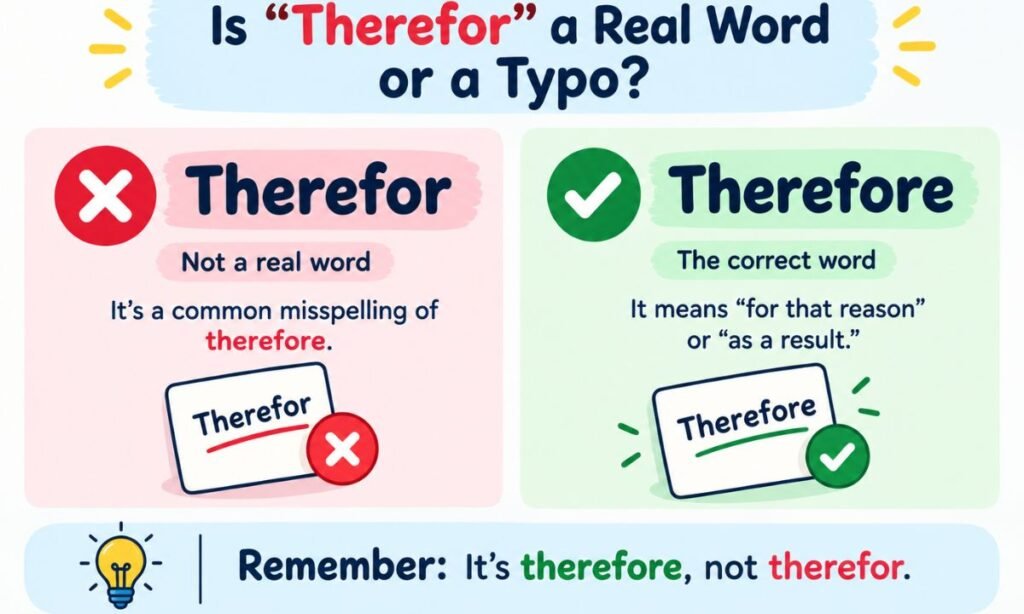
It is a real word. Major dictionaries list it, and lawyers still use it. That surprises people who assume it is only a misspelling of “therefore.”
Still, in general writing, “therefor” is usually a typo. A reader who sees it in a school essay, blog post, or casual email will assume you forgot the final E. Unless you are drafting legal text and mean “for that,” choose therefore.
Where the Words Come From
Both words are built from the same two pieces: there and an old form of for. Older English used “fore” in the sense of “for,” which explains the extra E in “therefore.”
Over time the longer form took on the meaning of “for that reason,” while the shorter one kept the older, more literal sense of “for that.” That is why they look nearly the same but do different work. The history is a good reminder that English often keeps old forms alive in specialized fields such as law.
How to Use “Therefore” Correctly in a Sentence
You can place therefore in a few spots, and punctuation changes slightly in each.
At the start of a sentence: add a comma after it. We missed the deadline. Therefore, we will resubmit next week.
After a semicolon: put a semicolon before and a comma after. The store was closed; therefore, we ordered online.
In the middle of a clause: no commas are needed, or use light commas for a pause. I therefore decided to stay home.
Avoid the comma splice
Therefore is not a conjunction like “and” or “but.” You cannot join two full sentences with only a comma and “therefore.”
- Incorrect: It rained all day, therefore the game was canceled.
- Correct: It rained all day; therefore, the game was canceled.
- Also correct: It rained all day. Therefore, the game was canceled.
How to Use “Therefor” Correctly in a Sentence

You will use therefor at the end of a phrase or clause, usually after a noun it refers to.
- The tenant shall pay all charges incurred therefor.
- The seller issued a receipt therefor.
- The city requires a permit and a fee therefor.
A simple test works well: replace therefor with “for it.” If the sentence still reads smoothly, you have the right word. In everyday writing, plain wording such as “for it” or “for that” is clearer and friendlier.
Therefore vs Thus, Hence, and So
These words overlap, but they do not always feel the same.
| Word | Tone | Example |
| Therefore | Neutral, clear | The test failed; therefore, we changed the design. |
| Thus | Slightly formal | Thus, the plan was approved. |
| Hence | Formal, short | The road is closed; hence the detour. |
| Consequently | Formal, emphasizes the outcome | Sales dropped; consequently, we cut costs. |
| As a result | Plain and direct | As a result, the team left early. |
| So | Casual | It was late, so we went home. |
For emails and reports, therefore is a safe middle ground. Use so when you want a relaxed tone.
Common Mistakes With Therefor and Therefore
- Dropping the final E: writing “therefor” when you mean “for that reason.” This is the most common error.
- Adding a space: writing “there fore.” It is always one word.
- Misspelling by sound: “therfore” or “thearfore.” Remember the pieces: there + fore.
- Creating a comma splice: using only a comma between two full sentences.
- Overusing it: stacking “therefore” in every paragraph makes writing sound stiff. Use it when there is a real cause and effect.
- Forcing “therefor” into plain writing: it can look overly formal or like a typo.
Real Examples You Can Copy
Email: The report is not ready. Therefore, I would like to move our meeting to Thursday.
News style: Heavy snow closed several highways; therefore, drivers were urged to stay home.
Social media: Coffee is life, therefore I need a refill. (Informal use is common here, though a semicolon would be more formal.)
Academic writing: The sample size was small. Therefore, the results should be treated with caution.
Legal writing: The landlord may charge a deposit and a reasonable fee therefor.
Logic and math: In proofs, the symbol ∴ stands for “therefore,” and it is read that way.
How to Remember Which One to Choose
Try this quick rule: if the sentence explains a result, add the E.
Another trick is to think of the extra E as the “end result.” The longer word, therefore, leads to the end result of an argument. The shorter word, therefor, stays tied to the object.
If you still hesitate, ask yourself one question: Can I replace it with “for that reason”? If yes, use therefore. If you can replace it with “for it,” you are in rare therefor territory.
British English vs American English
There is no spelling split. Both varieties use therefore for the common meaning, and both use therefor in the same narrow legal sense. Pronunciation also lines up, with therefore stressed on the first syllable and therefor on the second.
Frequently Asked Questions
Is it spelled therefor or therefore?
For nearly all writing, the correct spelling is therefore. It means “for that reason.” Therefor is a separate, rarer word meaning “for that” and appears mostly in legal documents.
How do you use therefor in a sentence?
Place it after the thing it refers to: The company charges a fee therefor. It means “for that” or “for it,” so it works best in formal or legal text.
What is the difference between therefor and therefore?
Therefore shows a result or conclusion, as in “I was tired; therefore, I left.” Therefor points back to an item and means “for it,” as in “the permit and the fee therefor.”
Is “therefore” grammatically correct at the start of a sentence?
Yes. Starting a sentence with Therefore is correct and common in essays and reports. Follow it with a comma for a natural pause.
Final Verdict: Therefor or Therefore?
Choose therefore when you want to say “as a result” or “for that reason,” which covers nearly every situation. Keep therefor for legal-style writing where “for it” is what you mean. When in doubt, add the E.
One small letter, one big difference in meaning.

Alexander John grammar content writer with 4 years of experience creating accurate, engaging, and SEO-friendly content. I specialize in spelling differences, commonly confused words, vocabulary, grammar rules, and writing tips. My goal is to simplify English for learners through clear explanations, practical examples, and helpful articles.