
You cut a pizza, a budget, or a long essay right down the middle, and now you need to write about the pieces. Your hand hovers over the keyboard.
Is it two “halfs” or something else? That tiny pause catches plenty of writers, and the wrong choice can slip into a menu, a report, or a school paper. Sorting out Halves or Halfs takes about two minutes, and the rule behind it fixes a whole group of tricky words at once.
What Does “Halves” Mean?
Halves is the plural of the noun half, which means one of two equal parts of something. When you have two of those parts, or when you talk about more than one whole split this way, you use halves.
- Cut the sandwich into halves.
- The game has two halves of 45 minutes each.
- The two halves of the brain work together.
Halves also works as a verb form. When someone cuts something in two, they halve it, and the sentence “she halves the recipe” uses halves as the present tense. More on this later, because it is where most of the confusion hides.
Why “Halfs” Is Wrong
English dictionaries list half as a noun with the plural halves. They do not treat “halfs” as the regular plural of that noun. Writers who type “halfs” are usually applying the most common plural rule in the language: just add an “s.”
That rule works for most words. Cat becomes cats, and book becomes books. But half belongs to a smaller group of nouns that follow a different pattern, and spell checkers will flag “halfs” for that reason.
If you see “halfs” in a text message or on a handwritten sign, it is almost always a slip, not an accepted spelling.
The F to VES Rule Explained
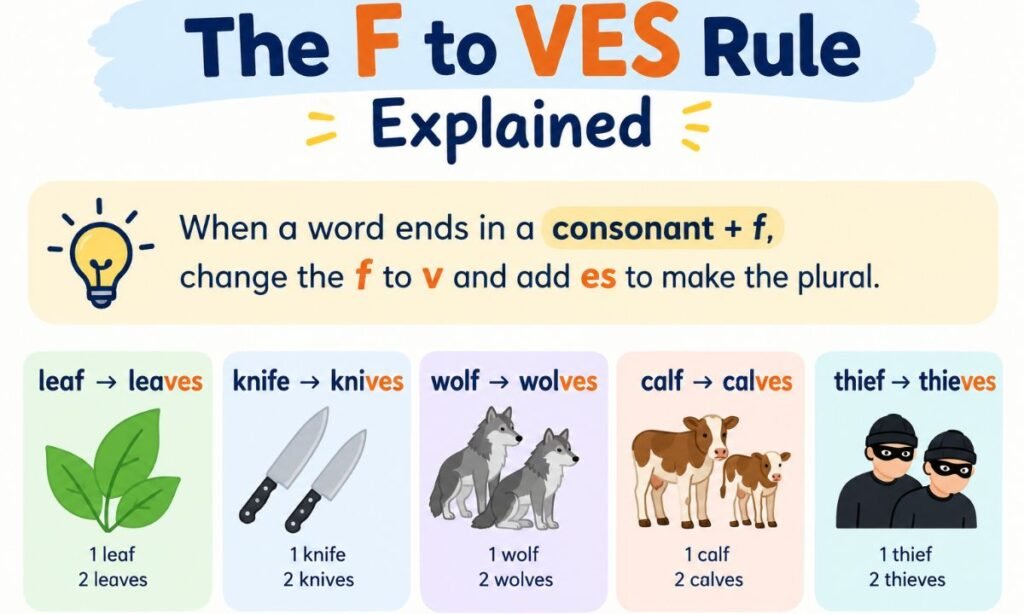
Many English nouns that end in f or fe change that ending to ves in the plural. The sound changes too. The “f” sound at the end becomes a “v” sound when you say it.
Try saying them out loud:
- half (haf) becomes halves (havz)
- leaf (leef) becomes leaves (leevz)
- knife (nyf) becomes knives (nyvz)
The spelling follows the sound. That is why “halves” looks the way it does. It is not a random exception. It is part of a pattern that covers many everyday words.
Words That Follow the Same Pattern
If you can spell halves, you can spell a long list of other plurals. Here are common ones.
| Singular | Plural |
| half | halves |
| knife | knives |
| leaf | leaves |
| wolf | wolves |
| shelf | shelves |
| loaf | loaves |
| calf | calves |
| life | lives |
| self | selves |
| thief | thieves |
| wife | wives |
This list is useful because it turns one rule into many easy wins. Once you know that half behaves like shelf and wolf, the plural stops feeling strange.
Exceptions Worth Knowing
Not every noun ending in f follows this rule. Some just take an “s.”
- roof becomes roofs
- chief becomes chiefs
- belief becomes beliefs
- cliff becomes cliffs
- chef becomes chefs
A few words accept both forms. Scarf can be scarfs or scarves, and hoof can be hoofs or hooves. Dictionaries list both.
Half is not one of these flexible words. The standard plural is halves. If you are unsure about another word, a quick dictionary check will settle it.
Half vs Halve vs Halves
This is the part that confuses even confident writers. Three similar words share one root, but each has its own job.
| Word | Part of speech | Meaning | Example |
| half | Noun, adjective, adverb | One of two equal parts | Eat half of the pie. |
| halves | Plural noun, or verb form | More than one half, or “cuts in two” | The two halves match. / She halves the cake. |
| halve | Verb | To divide into two equal parts | We need to halve the cost. |
The key difference: half names the part, and halve is the action of making that part. Think of it like this: you halve something to get halves.
- Correct: Please halve the onion.
- Incorrect: Please half the onion.
You may hear people say “half the onion” in casual speech, but writing it that way with a verb meaning is considered a mistake in formal English.
Where the Word Comes From, and How It Sounds
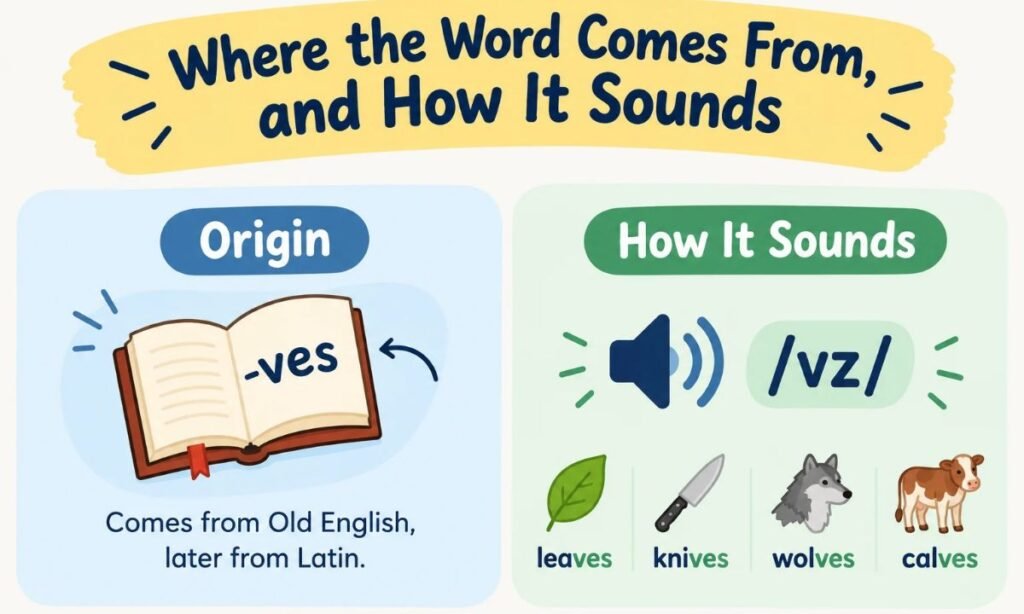
Half comes from the Old English word healf. The “ves” plural shows up because of an old sound change in English: an “f” sound between vowels often became a “v” sound in plural forms, and the spelling later followed the sound.
You do not need to memorize the history to write the word correctly. But it explains why this group of plurals feels so natural when spoken. In the singular, half ends with an “f” sound, as in “haf.” In the plural, the sound softens to “v,” as in “havz.” The “l” is silent in both.
Is There a British vs American Spelling?
No. Halves is the standard plural in American English, British English, Canadian English, and Australian English. There is no regional version with “halfs.”
British speakers do have a casual phrase, “going halves,” which means splitting a cost equally. It still uses the same spelling. Americans more often say “going fifty-fifty” or “splitting it,” but both groups spell the plural of half the same way.
Halves in Real Sentences
Examples make the rule stick. Here are common ways people use the word every day.
At home and in the kitchen
- Slice the avocados into halves and remove the pits.
- She cut the bread into two equal halves.
Sports and games
- Our team scored twice in both halves.
- The first and second halves each lasted 20 minutes.
School and math
- Two halves make a whole.
- Three halves is the same as one and a half.
Work and business
- The company split the project into two halves, one for each team.
- Both halves of the contract need a signature.
Everyday phrases
- Better halves is a playful way to refer to partners.
- Too clever by half is an idiom that means more clever than is wise.
Common Mistakes With Halves and Halfs
A few errors come up again and again. Watch for these.
- Writing “halfs” for the plural. The correct plural is halves.
- Using “half” as a verb. Write “halve the recipe,” not “half the recipe,” in formal text.
- Writing “halve” as a noun. The noun is half or halves.
- Saying “an half.” Use a half, because half starts with the “h” sound.
- Mixing up “halves” and “halve’s.” Halves does not need an apostrophe unless you are showing possession, as in “the halves’ edges.”
- Applying the f to ves rule to every word. Roofs and chiefs do not change.
Easy Ways to Remember Halves
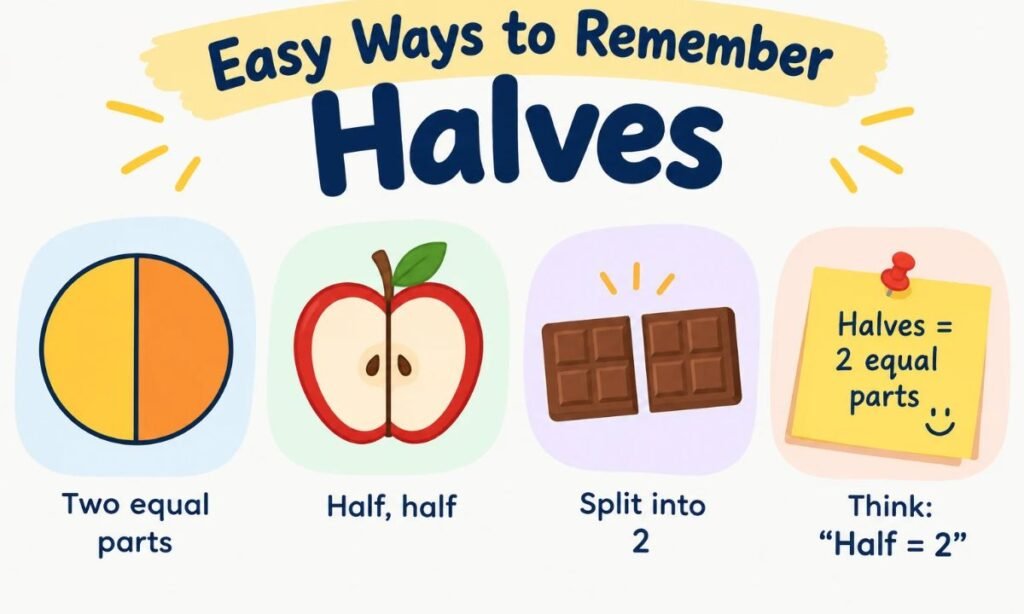
A few simple tricks help the spelling stay in your head.
- Say it out loud. If the plural has a “v” sound, write “ves.”
- Match it with familiar words. If you can write knives and leaves, you can write halves.
- Use the verb as a clue. To halve is to make halves. Both have a “v.”
- Picture a pizza. Two slices, two halves, never “halfs.”
Frequently Asked Questions
Is it “halves” or “halfs”?
It is halves. Half is one of a group of English nouns that change “f” to “ves” in the plural, along with knife, leaf, and shelf. “Halfs” is not the standard plural.
What is the plural of half?
The plural of half is halves. For example: “Cut the apple into two halves.” The rule works the same way in American and British English.
Is “halfs” a real English word?
Standard dictionaries do not list “halfs” as the plural of half. You may see it in casual typing or as a mistake, but it is not accepted in formal writing. Use halves instead.
What is the difference between half, halve, and halves?
Half names one of two equal parts. Halve is the verb that means to divide something into two equal parts. Halves is the plural of half, and it is also the present tense form of the verb halve, as in “she halves the recipe.”
Conclusion
The question of Halves or Halfs has a clear answer: halves. It follows the same pattern as knives, leaves, and shelves, where a final “f” changes to “ves” in the plural. Keep “halve” in mind for the verb, remember the small group of exceptions like roofs and chiefs, and say the word out loud when you doubt it. Once you see the pattern, your plurals will stay sharp.

Alexander John grammar content writer with 4 years of experience creating accurate, engaging, and SEO-friendly content. I specialize in spelling differences, commonly confused words, vocabulary, grammar rules, and writing tips. My goal is to simplify English for learners through clear explanations, practical examples, and helpful articles.
Pingback: Privilege or Priviledge: Which Spelling Is Correct?
Pingback: Many or Meny: Which Spelling Is Correct?
Pingback: Customize or Customise: Which Spelling Is Correct? Meaning & Examples
Pingback: Buoy or Bouy: Which Spelling Is Correct? Meaning & Examples
Pingback: Skis or Skiis: Which Spelling Is Correct?
Pingback: Realy or Really: Which Spelling Is Correct?
Pingback: Studder or Stutter: Which Spelling Is Correct?
Pingback: Congratulations or Congradulations: Which Spelling Is Correct?
Pingback: Speach or Speech: Which Spelling Is Correct?
Pingback: Brasil or Brazil: Which Spelling Is Correct?
Pingback: In Fact or Infact: Which Spelling Is Actually Correct?
Pingback: Eying or Eyeing: Which Spelling Is Correct?
Pingback: Studying or Studing: Which Spelling Is Correct?
Pingback: Volumn or Volume: Which Spelling Is Correct?
Pingback: Combating vs Combatting: Which Spelling Is Correct?
Pingback: Goodmorning or Good Morning: Which Spelling Is Correct?
Pingback: In-Person vs In Person: Which Is Correct?