
You are writing a quick email and type, “I’ve been eying that new laptop.” Then you pause. That looks off. Should there be another E?
Eying or eyeing is one of those small spelling puzzles that can make you doubt a word you use all the time. The fear is simple: pick wrong and look sloppy. Here is the relief. Both spellings exist, one is much safer, and the reason makes sense once you see it.
What Does Eyeing Mean?
Eyeing is the “-ing” form of the verb to eye. To eye something means to look at it carefully, often because you want it, doubt it, or are sizing it up.
The feeling behind the look changes the meaning a bit:
- Interest or desire: “She is eyeing the last slice of cake.”
- Suspicion: “The guard kept eyeing the stranger near the door.”
- Planning or ambition: “The company is eyeing a new market.”
- Careful checking: “He was eyeing the clock all afternoon.”
So it is more than plain seeing. When you eye something, your attention is on it for a reason.
Which Spelling Should You Use?
Use eyeing. It is the form that dictionaries list first, and it is what editors, teachers, and readers expect to see.
Eying is not wrong. Major dictionaries list it as an acceptable variant. But it appears far less often, so many readers will pause when they see it. In formal writing, school papers, and professional content, the smoother choice is eyeing.
If you work under a style guide, check it first. Otherwise, pick eyeing and use it every time. Consistency matters more than the tiny gap between the two.
Why Are There Two Spellings?
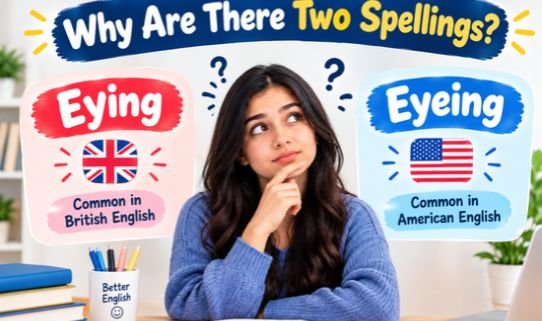
The answer comes from a common spelling rule. When a verb ends in a silent E, English usually drops the E before adding “-ing.”
- hope becomes hoping
- make becomes making
- love becomes loving
Following that rule, eye would become eying. That is where the shorter spelling comes from.
But English also has a habit of keeping the E in certain words so they stay easy to read. Look at “dye” and “singe.” If you dropped the E, you would get “dying” and “singing,” which are different words with different meanings. So the E stays: dyeing and singeing.
Eyeing follows that same pattern. Keeping the E also keeps the base word “eye” visible inside it, which helps the reader. Three letters in a row, “yin,” look awkward, and the extra E softens that.
The result: both spellings make rule-based sense, but eyeing is the one that stuck as the standard.
Eying vs Eyeing: Side-by-Side Comparison
| Feature | Eyeing | Eying |
| Spelling status | Standard | Accepted variant |
| How common it is | Much more common | Rare |
| Meaning | Looking at with interest or suspicion | Exactly the same |
| Pronunciation | EYE-ing | EYE-ing |
| US English | Preferred | Acceptable but uncommon |
| UK English | Preferred | Acceptable but uncommon |
| Best for formal writing | Yes | Avoid unless required |
The table shows the real story. This is not a case of right and wrong. It is a case of common and uncommon.
Is There a Difference Between American and British English?
Not in a way that affects your choice. Many spelling pairs split along regional lines, such as “color” and “colour.” This one does not.
Both American and British dictionaries list eyeing as the main spelling and eying as a variant. If you are writing for a US audience, use eyeing. If you are writing for a UK audience, use eyeing. You can keep one rule and move on.
How Do You Pronounce It?

Both spellings sound the same: EYE-ing, with two syllables. The first part rhymes with “eye,” and the ending is a soft “ing.”
This is why the spelling question comes up at all. When two spellings share one sound, your ear cannot help you. Only the written rule can.
Eyeing vs Seeing: Do Not Mix Them Up
These two words look alike in a quick glance, and they sometimes get swapped by mistake. They mean different things.
- Seeing is the general act of noticing with your eyes. “I am seeing a bird on the fence.”
- Eyeing is looking at something with a purpose, such as interest, doubt, or desire. “I am eyeing that bird because I want a photo.”
A helpful test: ask yourself if there is a reason or feeling behind the look. If yes, eyeing fits. If you are just noticing, use seeing or looking.
Eyeing in Real Sentences
Everyday life
- “The kids kept eyeing the cookie jar.”
- “She is eyeing a new apartment near work.”
Shopping
- “He has been eyeing those running shoes for weeks.”
- “I’m eyeing the sale on winter coats.”
Work and business
- “The team is eyeing a spring launch.”
- “The company is eyeing a partnership with a local brand.”
Sports and news
- “Several clubs are eyeing the young striker.”
- “Investors are eyeing next quarter’s report.”
Suspicion or caution
- “The cat eyed the vacuum warily.”
- “The cashier kept eyeing the line behind us.”
Notice how the word often pairs with something a person wants or doubts. That emotion is what separates eyeing from simple seeing.
Eyed, Eyes, and Eyeing: The Other Forms
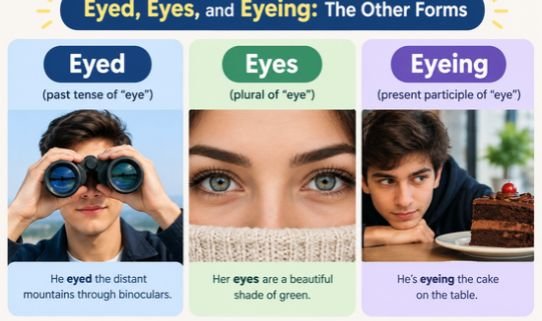
| Form | Example |
| eye (base) | “Don’t eye my sandwich.” |
| eyes (third person) | “He eyes every deal with caution.” |
| eyed (past) | “She eyed the menu for a long time.” |
| eyeing (present participle) | “They are eyeing the exit.” |
Once you know the verb, the other forms are easy.The base word keeps its E in all of these. Only the “-ing” form creates the old question, and now you know the answer.
Similar Words You Can Use
If “eyeing” shows up too often, mix in other words that carry a similar meaning. Pick the one that matches the feeling you want.
- Looking at: neutral and simple
- Watching: steady attention over time
- Studying: careful, detailed checking
- Scanning: quick looking over
- Considering: thinking about an option
- Targeting: aiming for something specific
- Coveting: wanting what someone else has
- Sizing up: judging a person or situation
For example, instead of “The company is eyeing a new market,” you could write, “The company is considering a new market.” The meaning shifts slightly, so choose with care.
What Does “Have Been Eyeing” Mean?
This phrase uses the present perfect continuous tense. It means someone started looking at or wanting something in the past and still does.
- “I have been eyeing that jacket since October.”
- “She has been eyeing a promotion for months.”
It suggests a longer period of interest, not a quick glance. It is a natural way to say you have wanted something for a while but have not acted on it yet.
Common Mistakes to Avoid

Most errors with this word are small, but they repeat.
- Thinking eying is wrong. It is a valid variant, just less common.
- Switching spellings in one document. If you use eyeing on page one, use it throughout.
- Misspelling it as “eyeng” or “eyieng.” The ending is simply “-ing” added to “eye.” Write eye, then add ing.
- Mixing it up with “seeing.” Remember that eyeing has purpose behind it.
- Using it for plain noticing. “I was eyeing the sky” sounds odd unless you are watching it for a reason, such as incoming rain.
A quick fix: when you are unsure, type the base word “eye,” then attach “-ing” without removing anything. That gives you eyeing every time.
An Easy Way to Remember It
Think of the word “dyeing.” Most people already know that “dying” and “dyeing” are different words. The extra E keeps them apart. Eyeing works the same way: the E stays, and the word stays clear.
Another trick: picture the word as eye + ing with nothing removed. Both parts stay whole, so the spelling looks like what it is.
Frequently Asked Questions
Which is correct, eyeing or eying?
Both are accepted, but eyeing is the standard and more common spelling. Eying is a less common variant that is still listed in dictionaries. For general writing, choose eyeing.
What does eying mean?
Eying means the same as eyeing. It is the “-ing” form of the verb “to eye,” meaning to look at something or someone with interest, desire, or suspicion. The only difference is the spelling.
What does “have been eyeing” mean?
It means you have been looking at or wanting something for a while. For example, “I have been eyeing that car” means you have been interested in it for some time, often without buying it yet.
What is another word for eyeing?
Good alternatives include looking at, watching, studying, scanning, considering, and sizing up. The best choice depends on the feeling you want to show, such as interest, suspicion, or careful thought.
Conclusion
Eying or eyeing? Both are accepted, but eyeing is the standard spelling and the safest choice in any setting. The word means looking at something with interest, desire, or suspicion, and the extra E keeps the base word “eye” easy to spot. Use eyeing, stay consistent, and you will never have to think about this again.