
You type a warm reply, hit send, and spot it a second too late: “Thanks, you to.” Now your boss, your crush, or your new client is reading a typo. The you to or you too question trips up confident writers every day, because both spellings sound identical out loud.
Left unchecked, the slip makes quick messages look careless. The good news is that the fix takes about ten seconds to learn, and this guide shows you exactly how.
Why “You To or You Too” Confuses So Many People
“To,” “too,” and “two” are homophones, which means they sound the same but have different spellings and meanings. When you speak, nobody hears the difference. When you type fast, your fingers pick the shorter, more familiar spelling.
“To” is also one of the most common words in English, so it becomes the default. Autocorrect rarely helps, since both “you to” and “you too” are real letter combinations. Your phone sees no error, so the mistake slips through.
“You Too” Meaning: What It Says and Why It Works
“You too” means “the same applies to you.” It mirrors a wish, a compliment, or a statement someone just directed at you. The word “too” here works like “also” or “as well.”
Here is how “you too” in a sentence usually looks:
- “Enjoy your weekend.” “You too!“
- “Nice to meet you.” “You too.“
- “Good luck on your exam.” “You too!“
- “I’m tired of Mondays.” “You too? I thought I was alone.”
In each case, “too” adds the idea of “also.” That is why it needs the extra o.
“You To” Meaning: When It Is Actually Correct
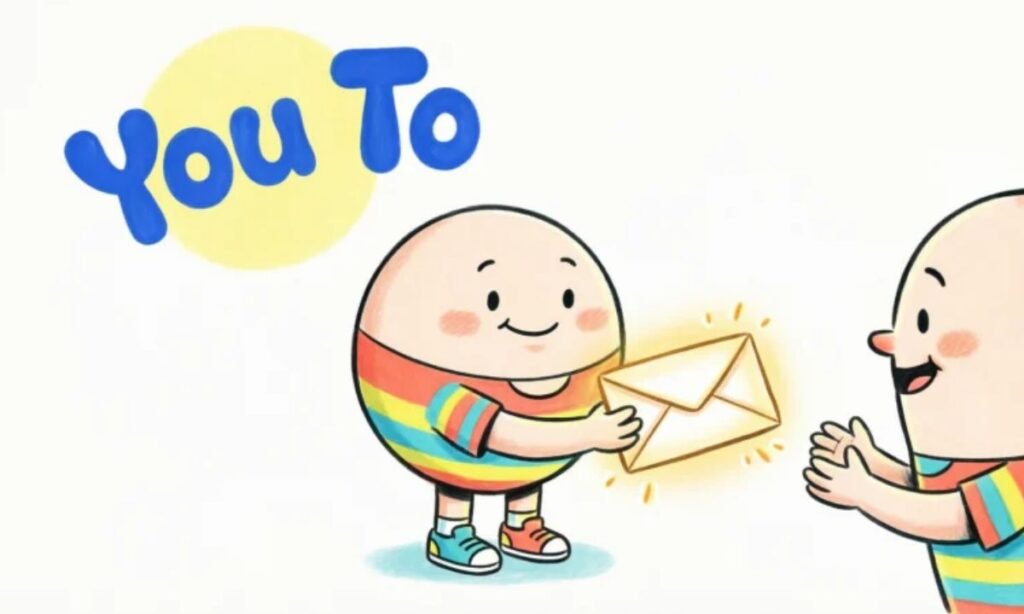
“You to” has no meaning by itself. It becomes correct only when “you” is the object of a verb and “to” starts an infinitive (like “to call”) right after it.
Here is how “you to” in a sentence looks when it is right:
- “I need you to sign this form.”
- “She asked you to join the meeting.”
- “We want you to feel at home.”
- “I love you to the moon and back.”
In every example, “to” connects to what comes next. The sentence keeps going after “you to.” That is the biggest clue.
To vs Too Difference at a Glance
| Feature | To | Too |
| Job in a sentence | Preposition or infinitive marker | Adverb |
| Main meaning | Direction, purpose, or verb form | Also, or excessively |
| Spelling clue | One “o” | Two “o”s |
| Can it end a reply? | Almost never | Yes |
| Swap test | Cannot swap with “also” | Can swap with “also” |
| Example | “I want you to stay.” | “I want you too.” |
Most “to vs too” confusion disappears once you see that one word points somewhere and the other adds something.
How to Use “To” Correctly
“To” does two main jobs.
1. It shows direction or relationship.
- “We drove to the beach.”
- “Give the keys to him.”
2. It forms the infinitive.
- “I want to learn Spanish.”
- “She asked you to wait.”
“To” can also show a range, such as “open from nine to five.” In nearly all cases, “to” needs something after it. A few rare exceptions exist, like “I didn’t want to, but I went,” where the verb is understood and left out.
How to Use “Too” Correctly
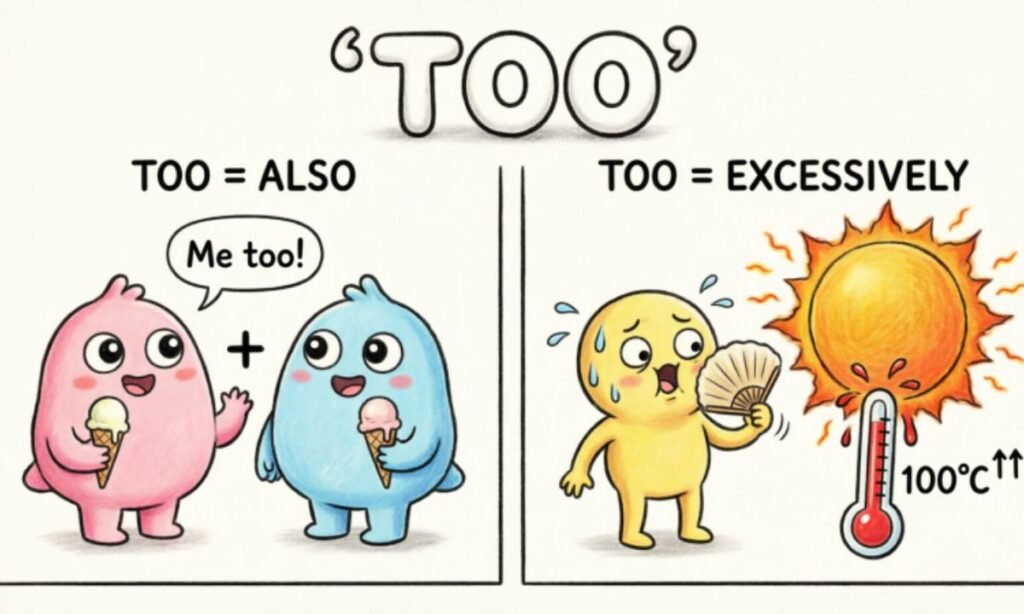
“Too” also does two jobs, and both are easy to test.
1. It means “also” or “as well.”
- “I’m hungry, too.”
- “You too.”
2. It means “excessively.”
- “This coffee is too hot.”
- “It’s too late to call.”
If you can replace it with “also” or “more than needed,” you have the right word.
When to Use “You Too” in Everyday Replies
A “you too” response works best when someone has just given you a wish, greeting, or compliment, and you want to return it.
| What they say | Your reply |
| “Have a safe trip.” | “You too!” |
| “Good luck on your exam.” | “You too!” |
| “Merry Christmas.” | “You too.” |
| “Nice to meet you.” | “You too.” |
| “I love you.” | “Love you too.” |
Notice that “Love you to” is wrong as a reply, but “I love you to pieces” is correct, because “to” continues into “pieces.” The same goes for “I want you to come” versus “I want you, too.”
Memory Tricks That Make It Stick
Try one of these the next time you hesitate.
- The extra “o” trick: “Too” has an extra “o,” so it adds something extra. Think “also.”
- The swap test: Replace the word with “also.” “You also” works, so write “you too.” “I want you also come” fails, so write “to.”
- The look-ahead test: If a verb or place follows, you need “to.” If the sentence ends or a comma follows, you need “too.”
- The excess test: If “too” feels like “more than needed,” the extra “o” is your reminder.
Pick whichever feels natural and use it for a week. It becomes automatic.
Common Mistakes and Quick Fixes
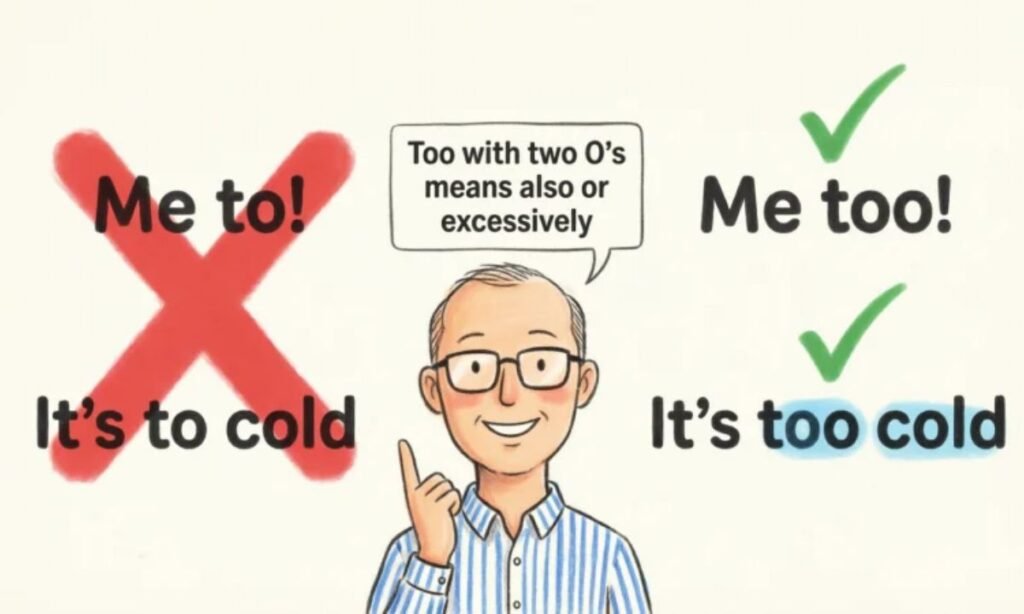
Most errors fall into three patterns.
Mistake 1: Ending a reply with “you to.”
- Wrong: “Have a nice day.” “You to!”
- Right: “You too!”
Mistake 2: Using “too” before a verb.
- Wrong: “I want you too leave.”
- Right: “I want you to leave.”
Mistake 3: Overcorrecting. Some writers learn the “too” rule and start using it everywhere. “I’m going too the store” is just as wrong as “you to” at the end of a reply. Use the look-ahead test every time.
Before sending, read the sentence aloud and ask: “Do I mean also, or does a verb or place come next?”
Where This Mistake Shows Up Most
The error appears where people write fast and rarely proofread.
- Text messages: Casual chats forgive small slips, but “you to” still stands out to many readers.
- Professional emails: A closing line like “Thanks, you to” can weaken an otherwise polished message.
- Social media: Public comments get screenshotted and shared, so a repeated “love you to” may draw side-eye.
- Job applications: Hiring managers read many messages, and clean writing helps you look careful.
Compare these two replies to an interviewer who says, “Have a great weekend.”
- Version 1: “Thank you. You to.”
- Version 2: “Thank you. You too.”
The second feels polished and effortless. The first leaves a tiny doubt.
Smart Alternatives and Tone Tips
“You too” is friendly but quick. Sometimes you want more warmth or more formality.
- Casual: “Same to you!” or “Right back at you!”
- Warm: “Thank you, and the same to you.”
- Formal: “Thank you. I wish you the same.”
- Playful: “Back at ya!”
Context matters too. If someone says, “I’m sorry for your loss,” replying “You too” feels off. In sensitive moments, a simple “Thank you” works better. “You too” suits mutual wishes, not every kind of statement.
One more nuance: “me too” and “you too” are not interchangeable. “Me too” agrees with something about the speaker (“I’m tired.” “Me too.”). “You too” returns something to the speaker (“Rest well.” “You too.”).
Quick Grammar Cheat Sheet
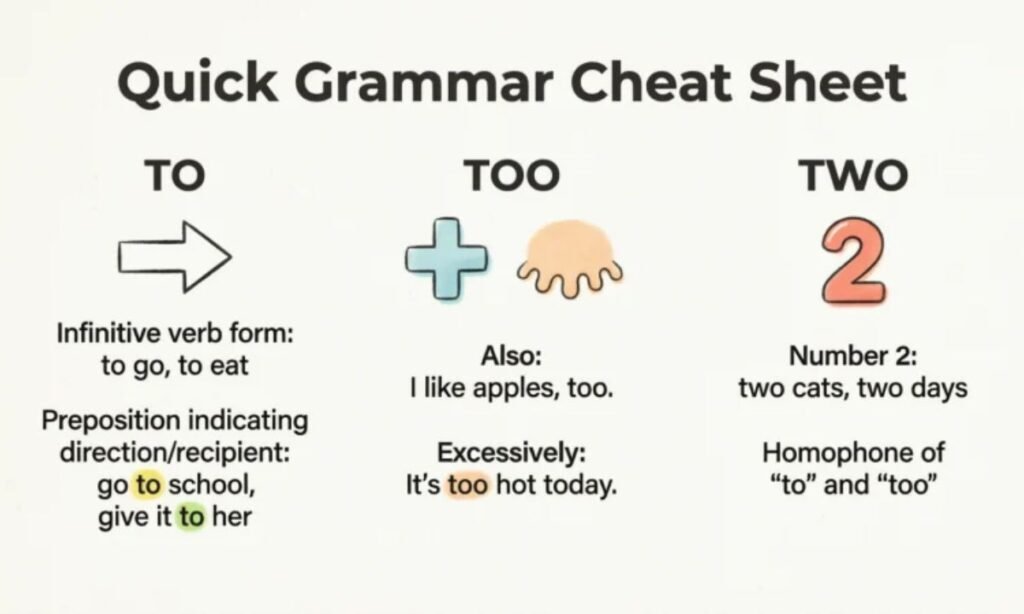
- You too means “you also.” It can end a reply.
- You to appears only before a verb or inside a phrase that continues.
- To points toward something.
- Too adds something or means “excessively.”
- Two is the number 2.
- When in doubt, try “also.” If it fits, add the extra “o.”
Treat this as your everyday you too grammar rule. It covers nearly every case you will meet.
FAQs
What is correct, “you too” or “you to”?
“You too” is correct when you mean “you also,” such as replying to “Have a great day.” “You to” is correct only inside longer phrases, like “I want you to call.” On its own, “you to” is a spelling mistake.
How do you use “to” or “too”?
Use “to” for direction, purpose, or verb forms, as in “go to school” or “I want to leave.” Use “too” for “also” or “excessively,” as in “me too” or “too loud.” Try replacing the word with “also.” If it fits, choose “too.”
Is it “love you too” or “love you to”?
“Love you too” is correct when you return the sentiment, meaning “I love you also.” “Love you to” is wrong unless it continues, as in “I love you to the moon and back.” If the sentence ends right after “you,” use “too.”
Is it “I want you to” or “I want you too”?
Both can be correct, but they mean different things. “I want you to stay” uses “to” as part of an infinitive. “I want him, and I want you too” uses “too” to mean “also.” Check whether a verb follows.
Conclusion
The you to or you too question has a simple answer once you know the pattern. Write “you too” when you mean “also” and the sentence ends or pauses. Write “you to” only when a verb or phrase follows and the sentence keeps moving. Use the swap test with “also,” check what comes next, and you will get it right almost every time.
Pingback: Sweetie vs. Sweety: Which Spelling Is Correct?
Pingback: Chonies vs Chones: Which Spelling Is Correct?
Pingback: Studying or Studing: Which Spelling Is Correct?
Pingback: Wifes or Wives: Which Spelling Is Correct?
Pingback: Fairing or Faring: Meaning, Difference & Correct Usage
Pingback: How Long Is Soon? Meaning, Timeframes, and Examples
Pingback: Annual: Meaning, Definition, Examples, and Correct Usage
Pingback: Combating vs Combatting: Which Spelling Is Correct?
Pingback: Good Morning vs Goodmorning: Which Spelling Is Correct?
Pingback: Career: Meaning, Definition, Examples, and Correct Usage
Pingback: Cocoon: Meaning, Definition, Examples, and Uses
Pingback: Eying or Eyeing: Which Spelling Is Correct?
Pingback: High School or Highschool: Which Spelling Is Correct?
Pingback: In Fact or Infact: Which Spelling Is Actually Correct?
Pingback: Long Term or Longterm: Which Spelling Is Correct?
Pingback: Niece or Neice: Which Spelling Is Correct?
Pingback: Occasion or Ocassion: Which Spelling Is Correct?
Pingback: Course or Ofcourse: Which Spelling Is Correct?
Pingback: Say vs Said: What's the Difference and When to Use Each?
Pingback: Privilege: Meaning, Definition, Examples, and Correct Usage
Pingback: Resignate or Resonate: Which Word Is Correct?
Pingback: Flier vs Flyer: Which Spelling Is Correct? Meaning & Examples
Pingback: Goodmorning or Good Morning: Which Spelling Is Correct?
Pingback: In-Person vs In Person: Which Is Correct?