
You are halfway through a text to a classmate, or an email to your manager, and your fingers stall. Studying or studing? Both look nearly right, and one wrong letter can make a careful sentence look rushed.
Plenty of people hit this same wall, because English spelling rules love to surprise us. The good news is that the fix takes about ten seconds to learn. Here is the answer, the reason behind it, and enough examples to make the spelling stick for good.
Why “Studying” Keeps the Y
The verb study ends in a consonant (d) followed by y. English has a clear pattern for words like this:
- Adding -ing: keep the y (studying)
- Adding -ed: change the y to i (studied)
- Adding -es: change the y to i (studies)
The y stays before -ing for a practical reason. If it changed to i, you would get “studiing,” with two i’s side by side. That looks awkward and is hard to read, so English leaves the y alone.
That is why the correct form is studying, not “studing,” “studiing,” or “studyng.” Letter by letter, it is S-T-U-D-Y-I-N-G.
The Same Rule With Other Verbs
“Studying” is not a special case. Every verb that ends in a consonant plus y follows the same pattern.
| Base Verb | + ING (keep the y) | + ED (y becomes i) |
| study | studying | studied |
| carry | carrying | carried |
| try | trying | tried |
| copy | copying | copied |
| apply | applying | applied |
| worry | worrying | worried |
| reply | replying | replied |
Verbs that end in a vowel plus y, like play and enjoy, also keep the y: playing, enjoying. So for -ing, the y almost always stays put.
If you have never doubted “trying” or “carrying,” you already know how to spell “studying.” It is the same move.
Where “Studing” Comes From
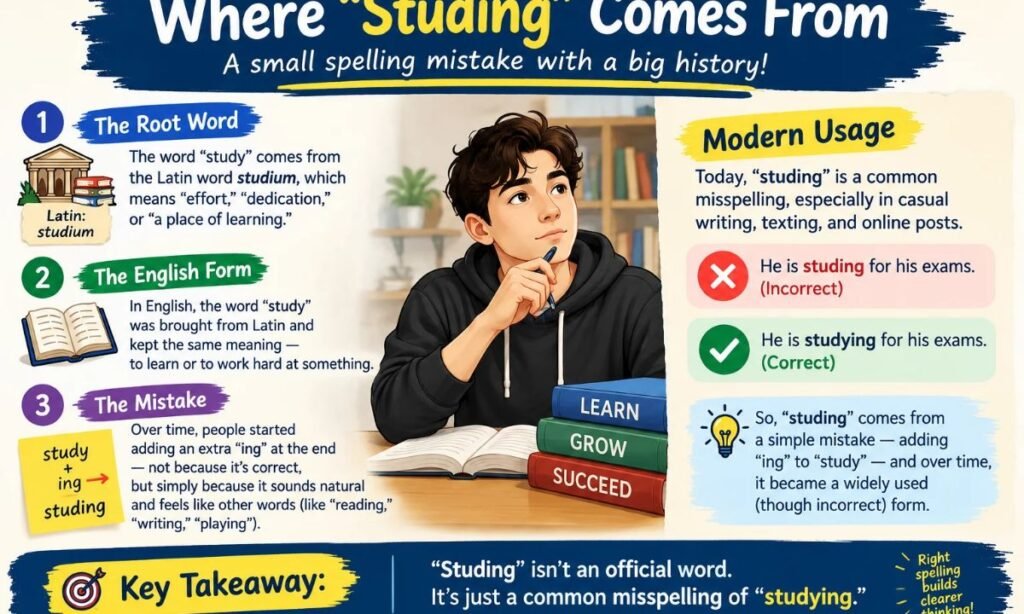
The mistake usually comes from a different spelling rule. Many verbs end in a silent e, and you drop that e before adding -ing:
- make becomes making
- write becomes writing
- use becomes using
Because “study” is a short word that ends in a soft sound, some writers assume a letter should drop off the end, so they delete the y. But “study” has no silent e. The y is a real part of the word, and nothing gets removed.
Pronunciation adds to the confusion. “Studing” would be read as “STOO-ding,” with a long u. The real word has a short u and a clear “dee” sound in the middle, and that sound is carried by the y.
Studying Meaning and Definition
Studying means learning about a subject by reading, practicing, reviewing, or examining it closely. It can also mean looking at something carefully to understand it.
Common uses include:
- Preparing for school or exams: “She is studying for her chemistry test.”
- Pursuing a subject or degree: “He is studying law at a university.”
- Examining something closely: “Scientists are studying how sleep affects memory.”
Grammatically, “studying” works in two ways. It can be the present participle of the verb, used in continuous tenses (“I am studying”). It can also be a gerund, a verb form that acts like a noun (“Studying takes patience”).
What Tense Is Studying?
“Studying” is not a tense by itself. It is the verb form that continuous tenses use, and the helper verb decides the time.
| Tense | Example |
| Present continuous | I am studying right now. |
| Past continuous | We were studying when the power went out. |
| Future continuous | I will be studying all weekend. |
| Present perfect continuous | She has been studying since noon. |
| Past perfect continuous | They had been studying for hours before the quiz. |
People also ask whether to write “studying” or “studied.” Use studying for an action in progress and studied for one that is finished:
- “I am studying for my test.” (still happening)
- “I studied for my test.” (finished)
How to Pronounce Studying
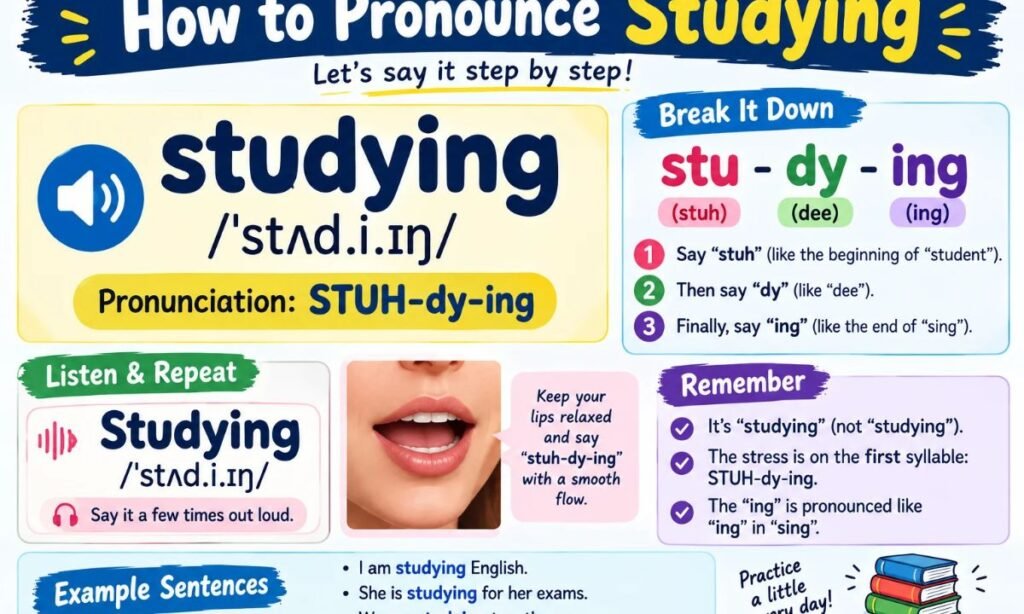
The stress falls on the first syllable. Break it into chunks: stud + y + ing. The y in the middle sounds like a quick “ee.”
Say it slowly a few times. That middle “dee” sound is your reminder that the y belongs in the word.
Studying Examples in Real Sentences
Seeing the word in context helps the spelling stick.
Everyday conversation
- “I can’t go out tonight. I’m studying for my driving test.”
- “What are you studying this semester?”
School and college
- “Maya is studying biology at a state university.”
- “Our class is studying the causes of the Civil War.”
Work and email
- “I am studying the new software before Monday’s training.”
- “Our team has been studying customer feedback to improve the app.”
Social media
- “Studying at the library until it closes. Send coffee.”
News style
- “Researchers are studying how sleep affects teenagers’ grades.”
Formal writing
- “The committee is studying the proposal and will issue a decision next month.”
Most of these use a form of “to be” (am, is, are, has been) right before “studying.” That is the most common pattern.
Common Mistakes With Studying
1. Dropping the y: “studing” Wrong: I am studing for my exam. Right: I am studying for my exam.
2. Doubling the i: “studiing” Wrong: She was studiing all night. Right: She was studying all night.
3. Skipping the helper verb Wrong: I studying English. Right: I am studying English.
4. Mixing up studying and studied Wrong: Yesterday I was studied for the test. Right: Yesterday I studied for the test, or I was studying for the test.
5. Picking the wrong preposition We study for a test or exam, at a school or university, and in a program or field.
Studying vs. Learning

The two words overlap, but they are not identical.
| Studying | Learning | |
| Focus | The effort and process | The result or knowledge gained |
| Example | “I studied for three hours.” | “I learned how fractions work.” |
| Without the other? | You can study and absorb little | You can learn without formal study |
Studying is what you do. Learning is what you gain. You can spend an hour studying and still learn very little if you are distracted, and you can learn a lot from a conversation without opening a book.
Is the Spelling Different in British and American English?
No. Studying is spelled the same in the US, UK, Canada, and Australia. This is not like “color” and “colour,” where the two varieties split. For this word, there is only one correct spelling anywhere English is used.
The word traces back through Old French to the Latin studium, which meant eagerness or zeal. That history explains the “stud” at the start of the word.
Quick Tips to Remember the Spelling
- Start with the base word. If you can spell “study,” just add -ing.
- Compare it with “trying.” You would never write “triing,” so apply the same logic here.
- Say it in three beats: stud, dee, ing. The middle beat is the y.
- Look for a silent e. If the verb has none, do not remove any letters.
If you keep only one thing from this guide, make it this: the y stays before -ing.
FAQs
Which is correct, studying or studing?
Studying is correct. “Studing” is a common misspelling. The verb “study” keeps its y when you add -ing.
Is it correct to say “I am studying”?
Yes. “I am studying” is correct and uses the present continuous tense. It describes something happening right now or during this period, such as “I am studying nursing this year.”
Is “studing” a word?
No. “Studing” is not listed as a word in standard English dictionaries. It is a spelling error caused by dropping the y.
Why does study become studying and not studiing?
English avoids placing two i’s together. If the y changed to i before -ing, you would get “studiing,” which looks awkward. So the y stays, and the word becomes “studying.”