
You are filling out a form, and one word stops you cold. Does the hospital want you to write “impatient” or “inpatient”? Or you are drafting an email about a restless coworker and your spell checker accepts both.
Impatient vs inpatient is a mix-up that looks small but can change your meaning completely. One word describes a feeling. The other describes a hospital stay. Here is how to keep them straight.
Impatient vs Inpatient at a Glance
| Feature | Impatient | Inpatient |
| Part of speech | Adjective (and rarely a noun) | Noun and adjective |
| Core meaning | Restless, unable to wait | Admitted to a hospital for care |
| Context | Emotions, behavior, personality | Healthcare, insurance, medical billing |
| Stress | im-PAY-shunt | IN-pay-shunt |
| Opposite | Patient (calm, tolerant) | Outpatient |
| Example | “He grew impatient in line.” | “She was an inpatient for three days.” |
What Does Impatient Mean?
Impatient describes someone who cannot wait calmly or tolerate delay, mistakes, or slow progress. It can also mean eager for something to happen.
It shows up in two main ways:
- Annoyance at delay: “The driver felt impatient in the traffic jam.”
- Eagerness: “The kids were impatient for summer break.”
You will also see the related forms impatience (the noun) and impatiently (the adverb). The word comes from the Latin impatiens, which combines a prefix meaning “not” with a root meaning “suffering” or “enduring.” So an impatient person is, in the original sense, someone who cannot endure.
Impatient is not a medical term. It describes personality or mood, not a condition or diagnosis.
What Does Inpatient Mean?
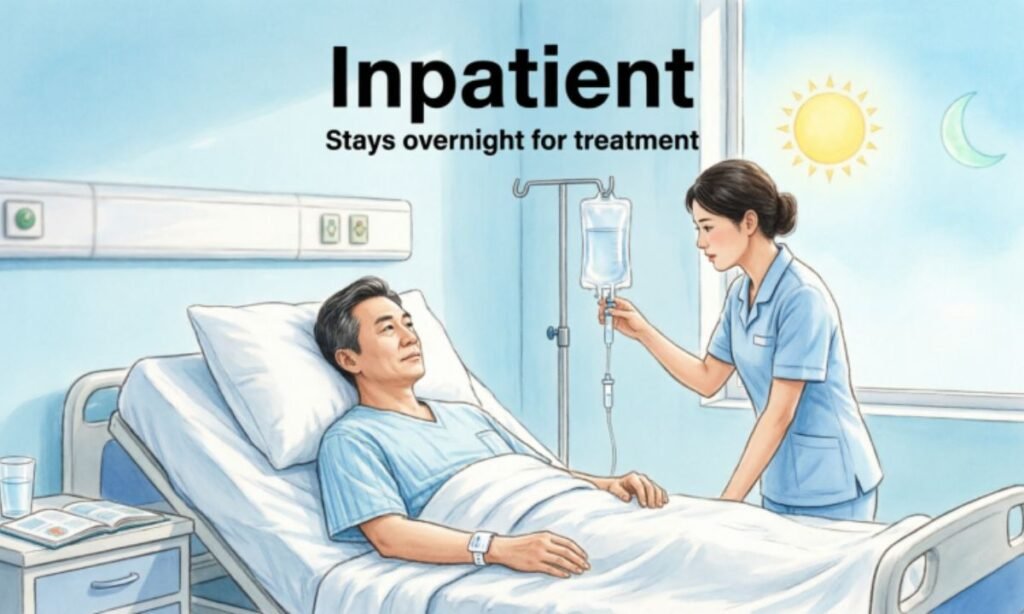
Inpatient refers to a patient who is formally admitted to a hospital and stays there while receiving care. It works in two ways:
- As a noun: “The hospital had 40 inpatients on the surgical floor.”
- As an adjective: “She needed inpatient treatment after the operation.”
Think of anything that happens inside the hospital as part of an admitted stay: surgery with recovery, a longer illness, or a mental health program that requires staying on site. The word is also common in billing, insurance, and medical records, which is where most people run into it.
How to Pronounce Each Word
The sounds are close, but the stress is different.
- Impatient: im-PAY-shunt, with stress on the second syllable
- Inpatient (noun or adjective): IN-pay-shunt, with stress on the first syllable
That stress shift is the quickest way to tell them apart when you hear them. Because the two sound similar in fast speech, many people lose track of which one they mean when they write.
Why the Two Words Get Mixed Up
Several things cause this confusion at once.
- Similar spelling. They differ by a single letter, the “m” in impatient.
- Similar sound. In casual speech the “m” and “n” blur together.
- Shared root. Both contain “patient,” so people assume the meanings are related. They are not related in everyday use.
- Autocorrect. Spell checkers treat both as correct words, so they will not flag the wrong one.
Here is the key relationship. Impatient is built from “im-” (meaning “not”) plus “patient” (meaning calm and tolerant). Inpatient is built from “in” (meaning inside) plus “patient” (a person receiving care). Same ending, different building blocks.
Impatient and Inpatient in Real Sentences
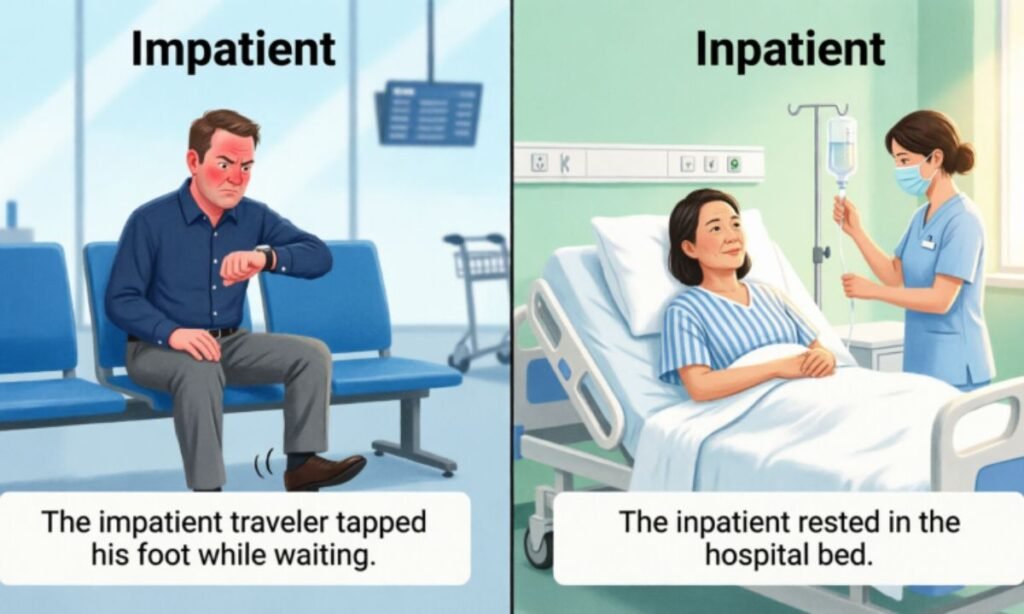
Seeing both words in context makes the difference obvious.
Impatient:
- “I get impatient when the wifi drops during a meeting.”
- “The customer tapped her foot, impatient for the line to move.”
- “He answered impatiently, cutting the speaker off.”
Inpatient:
- “My grandfather was an inpatient for a week after his surgery.”
- “Does your insurance cover inpatient rehab?”
- “The clinic offers both inpatient and outpatient services.”
Both in one sentence:
- “The impatient inpatient kept asking when he could go home.”
That last example is grammatically correct, and it is a good test. If you can explain which word describes the feeling and which describes the hospital status, you have it.
Inpatient vs Outpatient: The Pair That Matters in Healthcare
In medical settings, inpatient almost always appears next to its opposite, outpatient. The difference is whether you are formally admitted.
| Inpatient | Outpatient | |
| Admitted to hospital | Yes | No |
| Typical stay | At least overnight, often longer | Same day, then you go home |
| Examples | Major surgery, serious illness, childbirth | Blood tests, X-rays, minor procedures, clinic visits |
| Billing category | Inpatient services | Outpatient services |
Knowing this matters because insurance plans often cover inpatient and outpatient care differently, with different costs and rules.
When a Night in the Hospital Is Not Inpatient
Here is something many people miss. Staying overnight does not automatically make you an inpatient.
Hospitals sometimes place patients under observation status, which means doctors are monitoring you to decide whether you need to be admitted. Even if you sleep in a hospital bed, observation is typically classified as outpatient care. In the United States, Medicare, for example, treats these differently, and the classification can affect what you pay.
The deciding factor is usually a formal admission order from a doctor. If you or a family member are in the hospital, it is reasonable to ask the care team, “Am I admitted as an inpatient, or am I under observation?” Policies vary by insurer and country, so confirm the details with your provider.
Common Mistakes and Quick Fixes
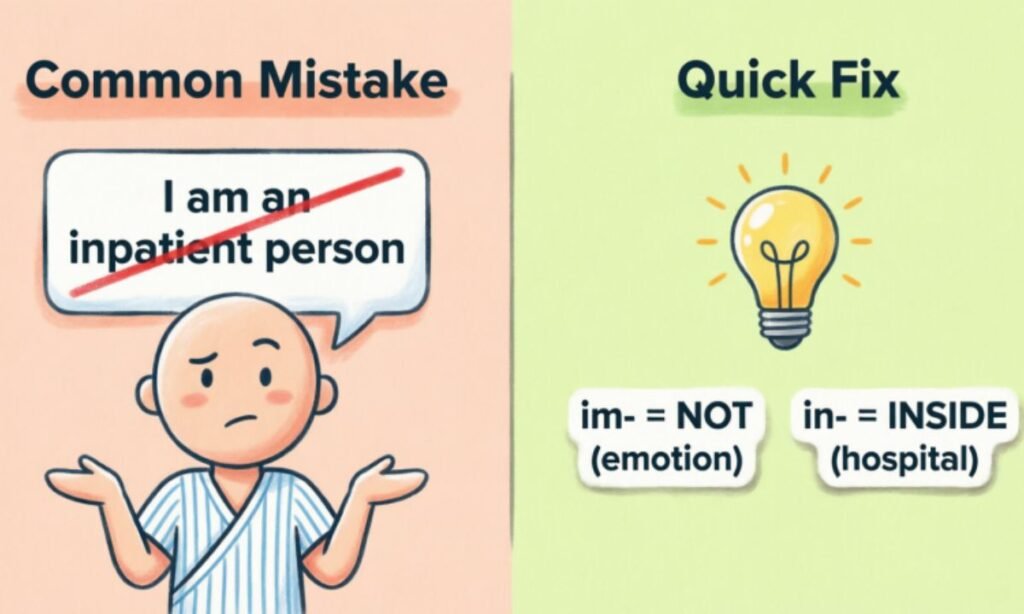
| Incorrect | Correct | Why |
| “The inpatient driver honked at the slow car.” | “The impatient driver honked at the slow car.” | Describes a mood, not a hospital stay |
| “She was impatient at St. Mary’s for two weeks.” | “She was an inpatient at St. Mary’s for two weeks.” | Describes hospital admission |
| “He needs impatient care.” | “He needs inpatient care.” | Medical setting |
| “Don’t be so inpatient!” | “Don’t be so impatient!” | Describes behavior |
Most of these are harmless typos in casual writing. In professional documents, though, they can look careless. A mix-up on a medical form, a resume, or an insurance claim can also create real confusion about what care was actually provided.
Easy Ways to Remember the Difference
Pick whichever trick sticks.
- The “M” for mood trick. Impatient has an m, and so does mood. Feelings get the m.
- The “IN” trick. Inpatient starts with in, as in in the hospital.
- The opposite test. If the opposite word is patient (calm), you want impatient. If the opposite is outpatient, you want inpatient.
- The swap test. Replace the word with “restless.” If the sentence still makes sense, use impatient. Replace it with “admitted to the hospital.” If that fits, use inpatient.
Patient, Patience, and Impatience: Related Words Sorted Out
Part of the confusion comes from the word family around them.
- Patient (adjective): calm and able to wait. “Please be patient.”
- Patient (noun): a person receiving medical care. “The patient is resting.”
- Patience: the ability to stay calm while waiting.
- Impatience: the lack of that ability.
- Impatiently: done in an impatient way.
Notice that “patient” itself has two meanings, which is part of why this family feels slippery. Impatient flips the adjective meaning (not calm). Inpatient builds on the noun meaning (a person receiving care, inside a hospital).
Frequently Asked Questions
What is the difference between inpatient and impatient?
Impatient is an adjective meaning unable to wait or easily annoyed by delay. Inpatient refers to a person admitted to a hospital, or to care that requires a hospital stay. One describes emotion, the other describes medical status.
Do you say inpatient or impatient?
It depends on the meaning. Say impatient for someone who is restless or frustrated: “She was impatient for the results.” Say inpatient for hospital admission: “He is an inpatient on the third floor.”
What is the difference between patient and impatient?
As an adjective, patient means calm and willing to wait, while impatient means the opposite. Patient can also be a noun for someone receiving medical care, which impatient never means.
What is the difference between patience and impatience?
Patience is the ability to stay calm during delay, difficulty, or frustration. Impatience is the lack of that ability, often showing up as irritation, restlessness, or rushing.
Conclusion
The difference comes down to one question: are you describing a feeling or a hospital stay? Impatient is about restlessness and trouble waiting. Inpatient is about being admitted for care.
Pay attention to the stress when you speak, use the “m for mood” trick when you write, and double-check any medical context. A quick read-through before you hit send is usually all it takes.
Pingback: You To or You Too: Which Is Correct?
Pingback: Sweetie vs. Sweety: Which Spelling Is Correct?
Pingback: Don’ts or Don ts: Which Spelling Is Correct?
Pingback: Studying or Studing: Which Spelling Is Correct?
Pingback: Wifes or Wives: Which Spelling Is Correct?
Pingback: Fairing or Faring: Meaning, Difference & Correct Usage
Pingback: How Long Is Soon? Meaning, Timeframes, and Examples
Pingback: Eying or Eyeing: Which Spelling Is Correct?
Pingback: Combating vs Combatting: Which Spelling Is Correct?