
You’re typing “How is your mom faring after surgery?” and suddenly freeze. Is it faring or fairing? Both look right, both sound the same, and autocorrect is no help.
Pick wrong and a kind message looks sloppy, or worse, sounds like you’re asking about a motorcycle part. The good news is that fairing or faring has a clear answer once you know what each word actually does. Here’s how to get it right every time.
What Does “Faring” Mean?
Faring is the -ing form of the verb fare, which means to get along or to experience something over time. It almost always shows up with an adverb or a “how” question.
- “How are you faring in your new job?”
- “The team is faring better this season.”
- “Small businesses are faring poorly this winter.”
The verb “fare” comes from an Old English word that originally meant to travel. That older sense survives in words like farewell (“may you travel well”) and wayfarer. Over time, “fare” shifted from “how a journey goes” to “how things go in general.”
Faring works as a verb, so you’ll rarely see it standing alone. It needs a subject and usually a word that describes the result: well, badly, better, poorly, or “so far.”
What Does “Fairing” Mean?
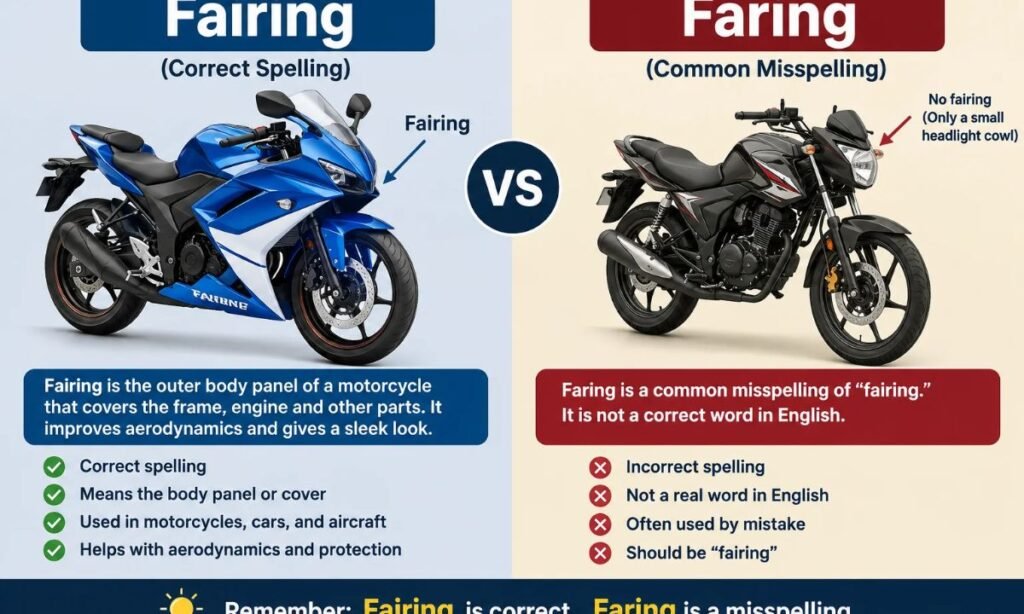
A fairing is a part that smooths airflow over a vehicle or structure. Its job is to cut drag, which is the resistance a body meets while moving through air or water. It can also tidy up the look of a machine by covering rough edges, wires, and gaps.
- “She cracked the fairing when her bike slid on gravel.”
- “The rocket’s payload fairing separated after launch.”
- “The mechanic replaced the left side fairing.”
Fairing is a noun. You can say “a fairing,” “the fairings,” or “a carbon fiber fairing.” You can’t say “is fairing” to mean how someone is doing.
Fairing vs Faring: Side-by-Side Comparison
| Faring | Fairing | |
| Part of speech | Verb form (from “fare”) | Noun |
| Basic meaning | Getting along or doing | A streamlined cover or smoothing structure |
| Typical context | Health, work, school, results | Motorcycles, aircraft, cars, boats, rockets |
| Common partners | well, poorly, better, how | motorcycle, aircraft, body, rocket, side |
| Example | “How is he faring?” | “The fairing reduced drag.” |
The words are homophones, meaning they sound alike but differ in spelling and meaning. Both are usually pronounced “FAIR-ing,” so you can’t rely on your ear.
Where Fairing Shows Up in Real Life
Fairings appear anywhere something moves fast and smooth airflow matters.
- Motorcycles: The plastic body panels around the front or sides. They protect the rider from wind and hide the engine parts.
- Aircraft: Smooth covers over joints, landing gear, and the places where wings meet the body.
- Rockets: The nose cone, often called a payload fairing, protects satellites during launch and splits away once the rocket reaches space.
- Cars and bicycles: Underbody panels, spoilers, and aerodynamic shells on some road and racing bikes.
- Boats: Streamlined covers that help water flow around a hull or fitting.
If your sentence involves a vehicle part, fairing is almost always right.
How to Use Faring in a Sentence
Faring tends to follow a few simple patterns. Learn them and you’ll rarely slip.
With “how” questions:
- “How is your sister faring at college?”
- “How are the roads faring after the storm?”
With positive or negative adverbs:
- “The new restaurant is faring well.”
- “Her plants are faring poorly in the heat.”
With comparisons:
- “He’s faring better than expected.”
- “Rural areas are faring worse than cities.”
With “so far”:
- “How’s the project faring so far?”
It also works for non-human subjects like businesses, markets, crops, and teams. If you can swap in “doing” and the sentence still makes sense, faring is your word.
Why These Two Words Get Mixed Up

Three things cause most of the confusion.
First, they’re homophones, so your ear can’t help. Second, they differ by only one letter, and the “ai” and “a” spellings are easy to swap in a hurry. Third, “fair” is a common word, so your brain tends to autofill “fairing” even when you mean “faring.” Spellcheck won’t flag either one, because both are real words. That’s why the mistake slips into emails, reviews, and even published articles.
An Easy Memory Trick
Look at what’s inside each word.
- Fairing contains air. Fairings guide air, so think “fAIRing.”
- Faring has no “air” in it, and it comes from “fare,” as in “How did you fare?”
If the sentence is about airflow, speed, or a vehicle, use the one with air. If it’s about how someone is getting along, use the shorter word.
Another quick test: replace the word with “doing.” “How is she doing?” works, so you want faring. “The doing was cracked” makes no sense, so that sentence needs fairing.
Common Mistakes (and the Fixes)
| Incorrect | Correct | Why |
| “How are you fairing?” | “How are you faring?” | You’re asking how someone is doing. |
| “The market is fairing well.” | “The market is faring well.” | This describes performance, not a part. |
| “He replaced the faring on his bike.” | “He replaced the fairing on his bike.” | A bike part is a fairing. |
| “She’s faring a lot of changes.” | “She’s facing a lot of changes.” | Different word entirely. |
That last row catches people off guard. “Faring” and “facing” are sometimes mixed up too, but they mean very different things. You face challenges, but you fare through them.
Does “faring well” need “fare” to be a verb? Yes. “Fare” as a verb means to get along, so “faring well” is simply the -ing version of “fare well.” The noun “fare,” as in bus fare or airfare, is a separate meaning with the same spelling.
Rare Meanings and Regional Notes
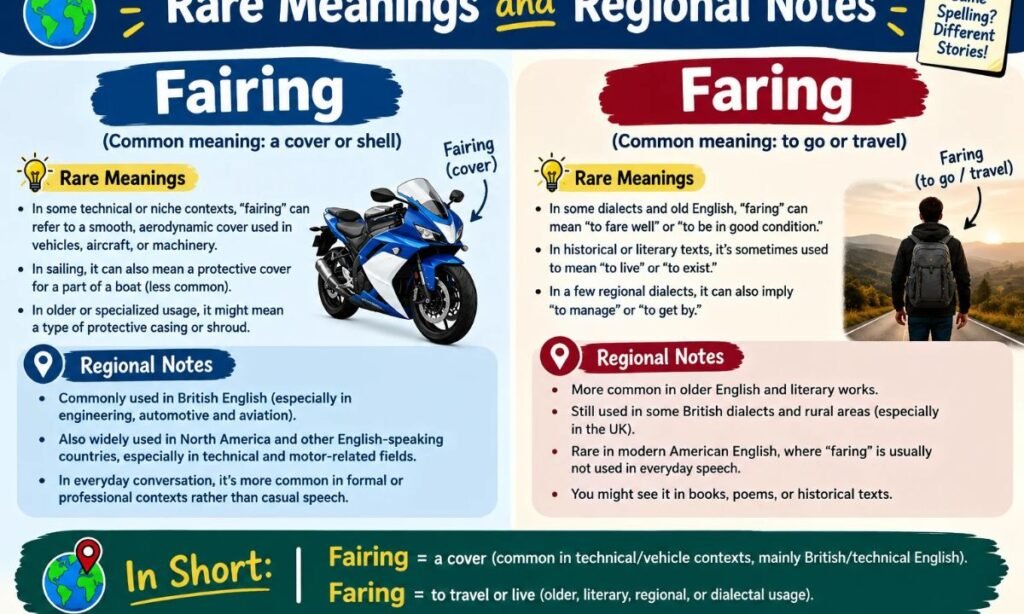
Most readers only need the two main meanings, but a few lesser-known uses explain why “fairing” sometimes shows up in unexpected places.
- A small gift from a fair. In older British usage, a fairing was a present bought at a market fair.
- Cornish fairings. This is a type of ginger biscuit sold in the UK, and it takes the name from that old tradition.
- A shipbuilding term. To “fair” a line or surface means to smooth it so curves look even. Fairing in this sense is that process.
As for American vs British English, there’s no spelling difference. Both countries spell the words the same way and use them in the same senses. The only variation is that the gift and biscuit meanings are far more familiar in the UK.
Quick Practice: Fill in the Blank
Try these. Answers are below.
- How is your grandfather ______ after his knee surgery?
- The rider’s cracked ______ needed a replacement.
- Local farmers are ______ better after the rain.
- The rocket’s payload ______ opened right on schedule.
Answers: 1. faring, 2. fairing, 3. faring, 4. fairing.
If you got all four, you’re set.
FAQs
What is the meaning of faring well?
Faring well means getting along nicely or doing well in a situation. For example, “The new store is faring well” says the business is doing fine. It works for people, companies, teams, and even plants.
Is “how are you faring” correct?
Yes. “How are you faring?” is correct and slightly more formal than “How are you doing?” It’s a polite way to ask about someone’s health, mood, or progress, especially during a hard time.
What does fairing mean?
A fairing is a streamlined cover that reduces drag and smooths airflow on vehicles like motorcycles, aircraft, and rockets. It also hides wires and mechanical parts. In older British usage, it can mean a small gift bought at a fair.
What does “faring” mean?
Faring is the -ing form of the verb “fare,” meaning to get along or to do. It usually appears with words like well, poorly, or better. It comes from an Old English word related to travel, which is also where “farewell” comes from.
Conclusion
So, fairing or faring? Use faring when you’re asking or saying how someone or something is getting along. Use fairing when you mean a streamlined cover on a vehicle. The words sound the same, which is why they trip up so many writers, but a quick “doing” swap or a look for the “air” in fairing settles it in seconds. Keep those two checks in mind and the confusion disappears.