
You are typing a quick message about the two women at your table, and your fingers freeze. Is it wifes or wives? Both look believable, and spellcheck is not always around to rescue you.
Guess wrong in a wedding toast, a school essay, or a work email, and the typo sits there for everyone to see. Good news: English gives a clear answer, and the rule behind it will fix many other words too.
What Do “Wife” and “Wives” Mean?
Wife is a singular noun. It means a married woman, seen in relation to her spouse. One woman, one wife.
Wives is the plural noun. It refers to two or more married women, usually in relation to their spouses.
Here is how the two look in everyday use:
- “My wife works nights.”
- “The wives of the team members attended the dinner.”
Pay attention to the number you mean. One person takes “wife.” Anything more takes “wives.”
Why Does “Wife” Change to “Wives”?
In Old English, the word was wīf. Over time, English speakers began pronouncing the final “f” sound as a “v” sound when a plural ending followed. Say “wives” out loud and you can hear it. It does not sound like “wifes.” It sounds like “wyvz.”
The spelling eventually followed the pronunciation. Written English kept the “f” in the singular and the “v” in the plural, and that pattern stuck.
Why “Wifes” Looks Right but Isn’t
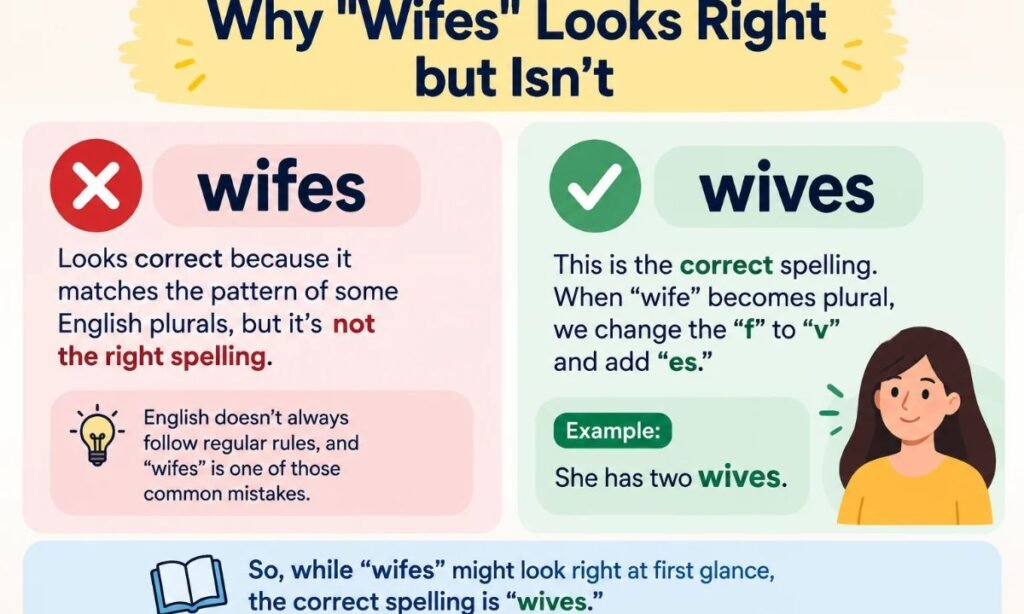
Most English plurals just add an “s.” Cat becomes cats, book becomes books. Your brain wants to do the same thing here.
The catch is that “wife” belongs to a small group of nouns with a different pattern. Adding “s” would make you pronounce a hard “f” at the end, and nobody says it that way.
So “wifes” is not a rare variant or a regional spelling. It is simply a mistake. Dictionaries and style guides list “wives” as the only standard plural.
Wife vs. Wives at a Glance
| Feature | Wife | Wives | Wifes |
| Number | Singular | Plural | None |
| Standard English | Yes | Yes | No |
| Pronunciation | /waɪf/ | /waɪvz/ | Not used |
| Example | “She is his wife.” | “They are wives.” | Incorrect |
| Possessive form | wife’s | wives’ | Not applicable |
If you only remember one row, remember this: plural means “wives,” every time.
Other Words That Follow the Same Pattern
“Wife” is not alone. Many English nouns that end in -f or -fe change to -ves in the plural. Seeing the pattern makes the rule easier to trust.
| Singular | Plural |
| knife | knives |
| life | lives |
| leaf | leaves |
| wolf | wolves |
| half | halves |
| shelf | shelves |
| thief | thieves |
| loaf | loaves |
| calf | calves |
| self | selves |
If you would never write “knifes” for more than one knife, you already know the right answer for “wives.”
Exceptions: When the F Stays
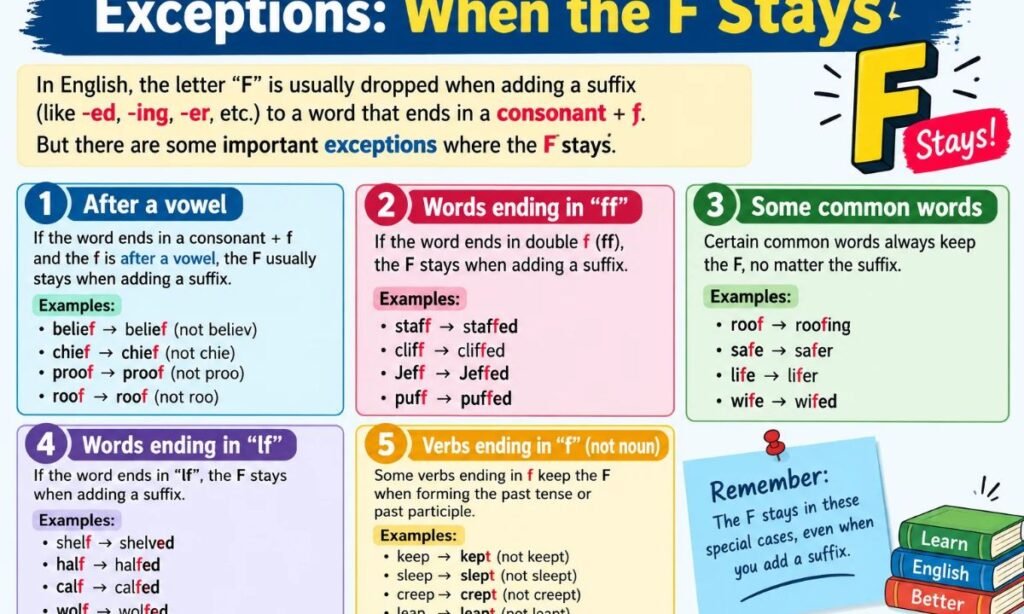
Not every word ending in f or fe switches to ves. Some simply add “s.” This is where learners get tripped up and start overcorrecting.
These words keep the “f”:
- roof, roofs
- chief, chiefs
- belief, beliefs
- cliff, cliffs
- chef, chefs
- giraffe, giraffes
- safe, safes
A few words accept both forms: scarfs and scarves, dwarfs and dwarves, hoofs and hooves. Usage varies, and either can be fine depending on context or the style guide you follow.
The f to ves change is common, but it is not universal. “Wife” is not one of the flexible words. It always becomes “wives.”
How to Spell and Pronounce Wives
Pronunciation helps too. Say the singular first: “wife,” with a crisp “f” at the end. Then say the plural: “wives,” with a buzzing “v” and a “z” sound at the end. The mouth movement changes, which tells you the spelling has to change too.
Here are a few quick memory tricks:
- Match the sound. If you hear a “v,” write a “v.”
- Compare with “life.” If you can write “lives,” you can write “wives.”
- Try the knife test. You would never write “knifes” for several knives, so skip “wifes” as well.
- Think “more than one.” More wives, more letters: the plural adds ves.
Example Sentences With Wives
Seeing the word in context locks it in.
Everyday conversation
- “Both of their wives are coming to the picnic.”
- “The wives talked for hours while the kids played.”
Work and email
- “Please let employees know that spouses and wives are welcome at the annual dinner.”
News and history
- “The six wives of Henry VIII are among the most studied figures in English history.”
Compound words
- “Housewives, midwives, and fishwives all use the same plural form.”
- “His ex-wives remain on friendly terms.”
Social media
- “Date night with my wife. Double date with our friends and their wives.”
Each sentence uses “wives” because it refers to more than one married woman.
Wife’s vs. Wives’: Getting the Possessive Right
This is a gap many guides skip, and it causes plenty of confusion. The apostrophe changes depending on whether you mean one wife or several.
- Wife’s shows that something belongs to one wife. “My wife’s car is in the shop.”
- Wives’ shows that something belongs to more than one wife. “The wives’ book club meets on Thursdays.”
“Wife’s” is a real, correct word. It is just not a plural. It is a possessive, or sometimes a contraction of “wife is,” as in “My wife’s coming over later.”
A quick test: if you can replace the word with “of the wife” or “of the wives,” you are dealing with a possessive. If you are just counting, you want the plain plural.
Common Mistakes People Make
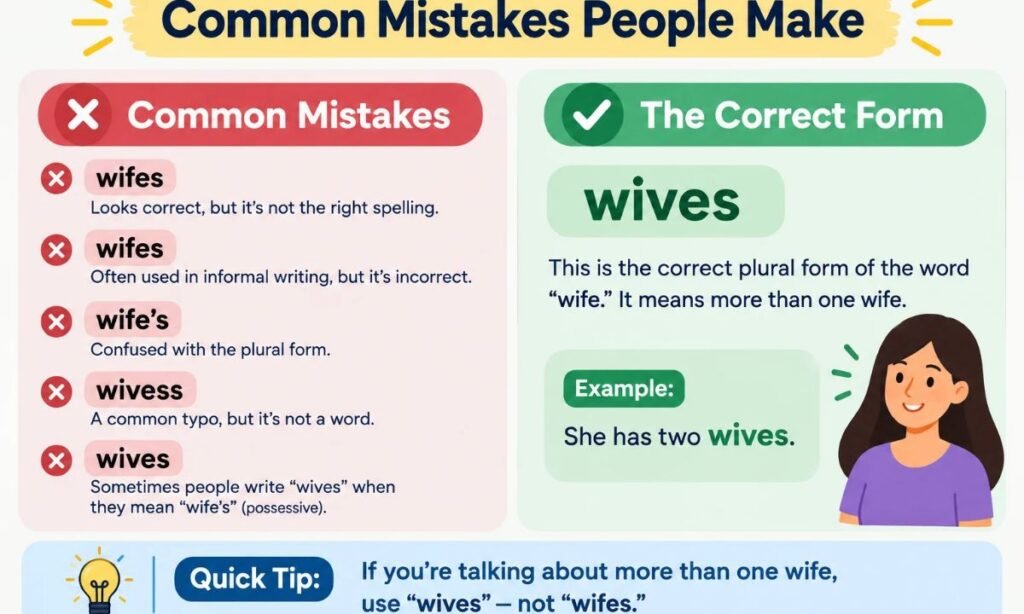
Even strong writers slip on this word. Here are the mistakes you will see most often.
1. Adding only “s.” Wrong: “Their wifes arrived early.” Right: “Their wives arrived early.”
2. Mixing up the plural and the possessive. Wrong: “Both wife’s came to the meeting.” Right: “Both wives came to the meeting.”
3. Using “wives’s” for the possessive. Wrong: “The wives’s choice was unanimous.” Right: “The wives’ choice was unanimous.”
4. Copying a typo from the internet. Because “wifes” appears in casual posts, comments, and captions, it can feel normal. Frequency does not make it correct. When in doubt, trust a dictionary over a trending hashtag.
5. Overcorrecting other words. Some people learn the f to ves rule and apply it everywhere, writing “roofves” or “chieves.” Remember the exceptions above.
A 10-Second Checklist Before You Hit Send
- Do you mean more than one married woman? Write wives.
- Do you mean one woman and something she owns? Write wife’s.
- Do you mean several women and something they share? Write wives’.
- Not sure about another word ending in f or fe? Check a dictionary.
Frequently Asked Questions
Is it wifes or wives?
It is wives. “Wifes” is a common misspelling and is not accepted in standard English. Use “wives” any time you mean more than one wife.
What is the plural of wife?
The plural of wife is wives. You form it by changing the final f to v and adding es. The same rule gives you life and lives, or knife and knives.
Why does wife become wives?
The change comes from the history of English pronunciation. The final “f” sound softened to a “v” sound before the plural ending, and the spelling eventually matched. Today the pattern appears in many everyday nouns.
Is it correct to say “wife’s”?
Yes, but only in the right situation. “Wife’s” is a singular possessive (“my wife’s phone”) or a contraction of “wife is” (“my wife’s home”). It is never the plural. For more than one wife, use “wives” or the possessive “wives’.”
Conclusion
The question of wifes or wives has a simple answer. Wives is correct, and “wifes” is a mistake. The change from f to v matches how the word is actually spoken, and it follows the same pattern as life, knife, and leaf.
Keep three things in mind: “wives” for the plural, “wife’s” for one wife’s belongings, and “wives'” for belongings shared by several. If you can hear the “v,” you can spell it.