
You are writing an email, and you want to say that an idea really connected with your team. Your fingers pause. Resignate or resonate? One looks official, the other looks familiar, and neither feels certain.
A wrong guess can leave a made-up word sitting in the middle of an otherwise sharp message. Nobody wants a reader tripping over a typo in the key sentence. The answer to Resignate or Resonate is short, and once you see why the two get tangled, the mix-up stops.
What Does “Resonate” Mean?
Resonate is a verb with two main meanings.
1. To sound deep, full, or long-lasting. This is the original, physical meaning. A bell resonates after it is struck. A voice resonates in a big hall. A guitar body resonates when the string vibrates.
2. To feel meaningful or relatable to someone. This is the meaning most people search for. When a message, story, or song resonates with you, it connects with your own experience or feelings.
Both meanings share the same idea: something echoes. In the first case, sound echoes in the air. In the second, an idea echoes in a person.
Is “Resignate” a Real Word?
No. “Resignate” is not listed as a standard word in the major English dictionaries, and it is not part of everyday, edited English. If you type it in a document, spellcheck will usually flag it.
That is worth saying plainly, because the word looks believable. It has a familiar start (“resign”), a familiar ending (the “-ate” you see in “create” and “negotiate”), and it seems to follow an English pattern. But a word that looks right is not the same as a word that exists.
If you ever see “resignate” in print, treat it as an error, not as a variant spelling.
Why the Mix-Up Happens
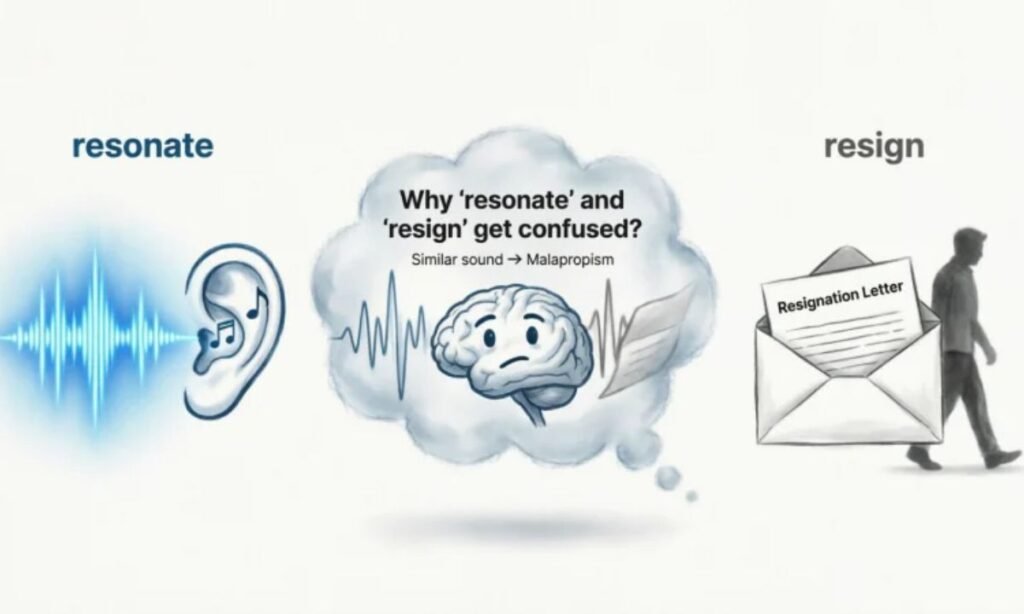
People rarely type “resignate” by accident for no reason. A few things push them toward it.
- The sounds are close. Both words start with “res-” and both have a soft middle. Said quickly, “resonate” can sound like “rez-ig-nate” to the ear.
- “Resign” is a very common word. Many people write “resign” more often than “resonate,” so the brain reaches for the familiar stem.
- The “-ate” ending feels natural. English has many verbs that end in “-ate,” so adding it to “resign” feels reasonable.
- Hearing it, not reading it. If you have mostly heard “resonate” in speech, you may never have seen its spelling.
None of this means you are bad at spelling. It means your brain is pattern matching, which is usually helpful, just not here.
Resonate vs Resign vs Resignate
Here are the three words side by side.
| Word | Real word? | Meaning | Example |
| Resonate | Yes | To echo, or to connect emotionally | Her speech resonated with the audience. |
| Resign | Yes | To quit a job or position, or to accept something unwelcome | He will resign at the end of the month. |
| Resignate | No | Not a standard word; a common error | Avoid using it. |
The real choice is between resonate and resign. They are unrelated in meaning, so picking the wrong one changes your sentence completely. “The idea resigned with me” makes no sense, while “the idea resonated with me” does.
Pronunciation and Verb Forms
Pronunciation helps lock in the spelling. Say resonate as REZ-uh-nayt. There are three syllables, and the stress falls on the first one. Notice the “n” sound in the middle. “Resignate” would need a “g” sound that simply is not there.
Compare that with “resign,” which is pronounced ri-ZYNE. The “g” in resign is silent, but it still shows up in the spelling.
Here are the forms of resonate:
| Form | Word |
| Base form | resonate |
| Third person singular | resonates |
| Present participle | resonating |
| Past tense and past participle | resonated |
| Noun | resonance |
| Adjective | resonant |
The past tense is resonated, as in “The message resonated with voters.” Notice that the “n” stays in every form. If you ever write a “g” in the middle, stop and check.
What Does “Resonate With” Mean?
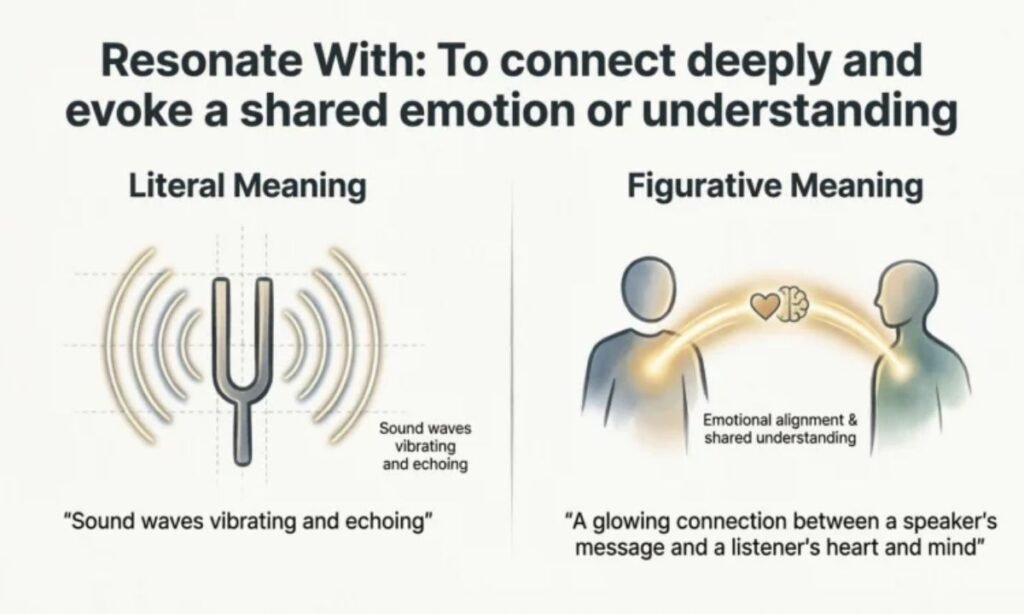
Most of the time, resonate shows up in the phrase resonate with. It means that something feels true, relevant, or emotionally meaningful to a particular person or group.
- A story resonates with you because it reminds you of your own life.
- A product message resonates with customers because it speaks to a real need.
- A song resonates with listeners because it captures a shared feeling.
In each case, the thing doing the resonating is the idea, story, or message. The person on the receiving end is the one it connects with.
This is why you often hear it in business and marketing. A message that resonates is one people remember and respond to, not just one they read and forget.
Example Sentences Using “Resonate”
Real sentences are the fastest way to get comfortable. Here are examples for each meaning.
Sound meaning:
- The cathedral bell resonated across the valley.
- His deep voice resonates in the small room.
- The drum resonated long after the last beat.
Emotional meaning:
- Her words resonated with everyone who had moved to a new city.
- The film resonates because it feels honest.
- That advice resonated with me when I changed careers.
- Your story will resonate with readers who have felt the same way.
And here is how it looks when the mix-up happens:
| Incorrect | Correct |
| The speech really resignated with me. | The speech really resonated with me. |
| I hope this message resignates with you. | I hope this message resonates with you. |
| His story resignated with the crowd. | His story resonated with the crowd. |
Is “I Resonate With That” Correct?
Yes, and you will hear it often. “I resonate with that” is widely used in speech and informal writing, and it means “that feels true or relevant to me.”
That said, some editors prefer the version where the idea is the subject: “That resonates with me.” Both are understood. In formal writing, such as a report or a cover letter, “that resonates with me” tends to read a little smoother.
A quick guide:
- Conversation or social media: either version is fine.
- Professional or formal writing: lean toward “that resonates with me” or “this idea resonates with our team.”
Synonyms and Alternatives for “Resonate”
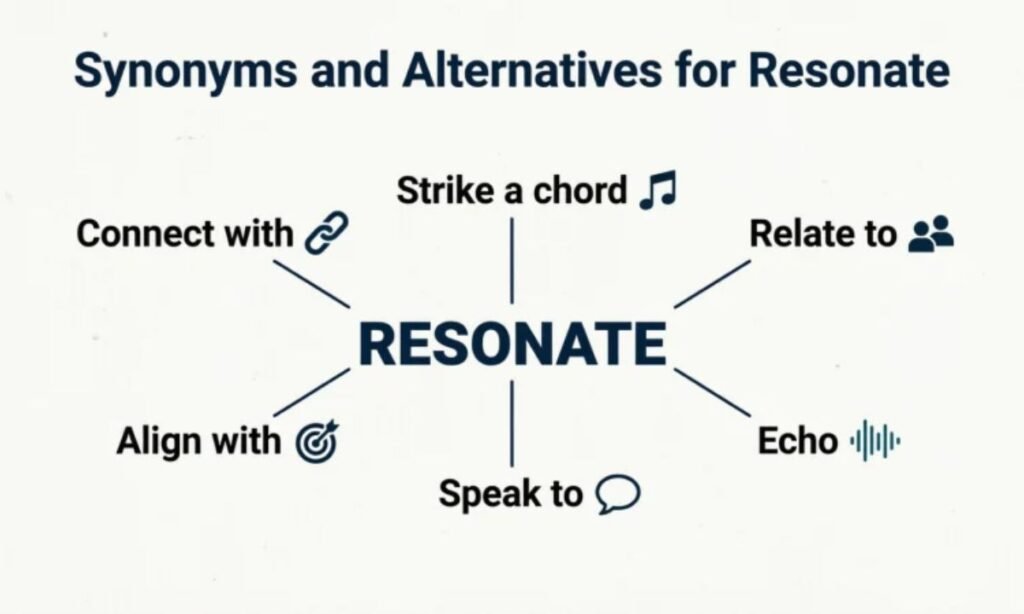
Sometimes the best fix is to use a different word. The right alternative depends on which meaning you want.
For the emotional meaning:
- connect with
- strike a chord
- ring true
- speak to
- land with (informal)
- appeal to
For the sound meaning:
- echo
- reverberate
- resound
- ring out
- vibrate
Try this in a sentence: “The speech struck a chord with voters” says nearly the same thing as “The speech resonated with voters.” Use whichever sounds more natural to you, and avoid using “resonate” three times in one paragraph.
Where “Resonate” Comes From
The word traces back to Latin. “Resonate” comes from the Latin verb resonare, which means to resound or echo. That Latin verb is built from re-, meaning back or again, and sonare, meaning to sound.
So the core idea has always been a sound coming back. That is a helpful memory hook: resonate has “son” in it, like sonic and sonar, both of which connect to sound.
“Resign” has a different family tree. It comes from Latin resignare, which roughly means to unseal or cancel. The idea of giving something up grew from there. Different roots explain why the two words mean such different things.
Common Mistakes and Easy Memory Tricks
Most errors with this word fall into a few predictable groups.
- Writing “resignate.” This is the big one. It is not a real word.
- Using “resign” when you mean “resonate.” “That idea really resigned with me” changes the meaning entirely.
- Spelling it “resinate” or “resonnate.” Both are misspellings. The correct spelling has one “n” and an “o” in the middle: res-o-nate.
- Overusing “resonate” in business writing. It is a good word, but it can get repetitive. Mix in alternatives.
Here are some tricks that help:
- Think “sound.” If the word has “son” in it, it connects to sound or echo. That points you to resonate.
- Ask what you mean. If you mean quit, use resign. If you mean connect or echo, use resonate.
- Say it slowly. REZ-uh-nayt has no “g” sound.
- Search before you send. If you tend to make this error, run a quick search for “resignate” in your document before sharing it.
Frequently Asked Questions
What does resonate mean?
Resonate means to sound deep and lasting, or to connect emotionally with someone. For example, “the song resonated with me” means the song felt meaningful or relatable.
Is it resonate or resignate?
It is resonate. “Resignate” is not a standard English word. It is a common mistake that mixes “resign” with “resonate.”
What does the word resignate mean?
It has no standard meaning because it is not a real English word. If you see it, the writer most likely meant “resonate” (to connect or echo) or “resign” (to quit).
Can you say “I resonate with that”?
Yes. It is common in spoken English and informal writing. In more formal writing, “that resonates with me” often reads more smoothly, though both are understood.
Final Takeaway
The Resignate or Resonate question has a clear winner. Resonate is the real word, and it covers both echoing sound and emotional connection.
Resignate is a mix-up that does not belong in your writing. When in doubt, remember the “son” in resonate, think of sound and echo, and check whether you actually meant “resign” instead.
Pingback: Run or Ran: Which Spelling Is Correct?
Pingback: Impatient vs. Inpatient: What’s the Difference?
Pingback: Seal or Sill: What’s the Difference?
Pingback: Volumn or Volume: Which Spelling Is Correct?
Pingback: Alr Meaning in Text: What Does It Mean in Chat?