
You are typing a sentence about fighting climate change, corruption, or misinformation, and then you freeze. Is it combating or combatting? One extra T looks harmless, but it can make you doubt the whole draft.
A wrong spelling in a report, essay, or press release can also distract readers from your point. The good news is that the Combating vs Combatting question has a simple answer, and a few easy rules will help you choose.
What Does “Combat” Mean as a Verb?
Before comparing spellings, it helps to know the root word. To combat something means to fight against it, try to stop it, or reduce its effect. The target can be an actual enemy or an abstract problem.
- Doctors combat disease.
- Cities combat air pollution.
- Banks combat fraud.
“Combat” is also a noun (combat training, hand-to-hand combat) and an adjective (combat boots). The spelling question only affects the verb, because that is where we add endings such as -ing and -ed.
Combating vs Combatting at a Glance
Here is the whole topic in one table.
| Feature | Combating | Combatting |
| Number of Ts | One | Two |
| Part of speech | Present participle / gerund | Present participle / gerund |
| Meaning | Fighting against something | Fighting against something |
| Past tense match | Combated | Combatted |
| American English | Preferred | Accepted variant |
| British English | Common and accepted | Common and accepted |
| Safe for formal writing | Yes | Yes, if used consistently |
The meaning never changes. Only the spelling does, and neither form is a typo.
Why Two Spellings Exist

The reason comes down to pronunciation. The verb “combat” can be stressed in two ways:
- com-BAT, with stress on the second syllable
- COM-bat, with stress on the first syllable
Both pronunciations are used by native speakers. That small difference matters because English spelling often changes based on where the stress falls. If the stress sits on the last syllable, writers tend to double the final consonant before adding -ing. If it sits on the first syllable, they usually do not.
So if you say com-BAT, “combatting” feels natural. If you say COM-bat, “combating” feels natural. Both habits became established in print, and dictionaries recorded both.
The Consonant Doubling Rule, Explained
You may remember a rule from school: when a verb ends in a single vowel followed by a single consonant, and the stress falls on the last syllable, double the consonant before adding an ending.
Here is how it works with familiar words:
- begin becomes beginning (stress on “gin,” so the N doubles)
- refer becomes referring (stress on “fer,” so the R doubles)
- visit becomes visiting (stress on “vis,” so no doubling)
- open becomes opening (stress on “o,” so no doubling)
Now apply it to “combat.” The final syllable “bat” is a single vowel plus a single consonant, so the rule asks one question: is that syllable stressed? Because speakers stress “combat” differently, the rule gives two answers. That is why you can defend either spelling.
A simple way to remember it: the doubled T follows the com-BAT stress, and the single T follows the COM-bat stress.
American English: Which Form Do Style Guides Prefer?
American dictionaries generally list combating first and treat combatting as a variant. Most American writers, editors, and news outlets use the one-T form, so it is the form readers expect to see.
If you write for a US audience, such as a college paper, a business blog, or a grant application, use combating. You will not get a second look. Using combatting is not an error, but it may look slightly unusual to American readers.
This is a good example of how American spelling often leans toward the simpler, shorter form. You see the same habit in words such as “traveling” (US) versus “travelling” (UK).
British English: Is Combatting Standard?
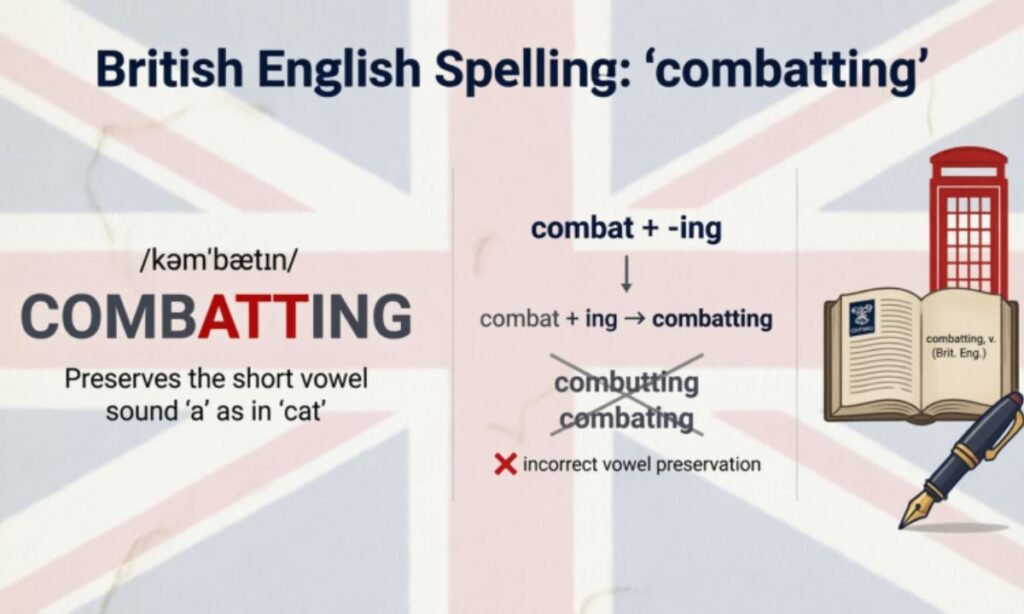
A common belief is that British English requires “combatting.” That is too strong. British dictionaries accept both spellings, and combating is common in UK publications too. The difference is that combatting appears more often in British writing than in American writing, and British readers will not find it odd.
So the practical rule is:
- US audience: choose combating
- UK, Australian, or other Commonwealth audience: either works, but be consistent
- Unsure who will read it: choose combating, because it is accepted everywhere
If your company or school follows a specific style guide, check it first. A house style always beats a general rule.
Combated or Combatted: The Past Tense Question
The same split shows up in the past tense. The verb forms line up like this:
| Form | One-T version | Two-T version |
| Base | combat | combat |
| Third person | combats | combats |
| Present participle | combating | combatting |
| Past tense / past participle | combated | combatted |
Notice that the one-T forms go together (combating, combated) and the two-T forms go together (combatting, combatted). The simple rule is to pick one pair and use it throughout your document. Writing “combating” in one paragraph and “combatted” in the next will look inconsistent.
Example Sentences You Can Borrow
Seeing the words in context is the fastest way to feel comfortable with them.
Using combating:
- The new campaign is combating misinformation about vaccines.
- Local volunteers are combating food waste by collecting unsold produce.
- Combating identity theft starts with strong passwords.
- She spent her career combating poverty in rural communities.
Using combatting:
- The council is combatting noise pollution near the airport.
- He credits daily exercise with combatting stress.
- Combatting counterfeit goods remains a priority for customs officers.
- The charity is combatting loneliness among older adults.
Each pair carries identical meaning. Swap one spelling for the other and nothing changes except the letter count.
Common Mistakes to Avoid

Most errors with this word are easy to prevent once you know what to look for.
- Mixing spellings in one document. Writing “combating” in the introduction and “combatting” in the conclusion looks careless. Pick one.
- Assuming one spelling is a typo. Both are valid, so do not “correct” a colleague’s two-T version in a British document.
- Treating the spellings as different words. They are not synonyms or near-synonyms. They are one word with two accepted spellings.
- Using “combatting” because it feels more formal. The extra T does not add formality or authority.
- Doubling the T in other forms by habit. The noun and adjective stay “combat.” There is no such word as “combatt.”
- Confusing “combat” with “compete.” Combating something means fighting against it. Competing means striving against others for a prize.
A quick editing trick: use your word processor’s find tool to search for “combatt” and “combat” plus “ing,” then make sure the spellings match.
How to Choose and Stay Consistent
When you are not sure which version to use, follow this short checklist:
- Who is your audience? American readers expect one T. British readers accept both.
- Does a style guide apply? Follow it, even if you personally prefer the other form.
- What does the rest of your document use? Match your other spelling choices, such as “color” or “colour.”
- Still unsure? Go with combating. It is the lowest-risk choice for any audience.
Consistency matters more than the specific spelling you choose. Readers rarely stumble over a spelling they are allowed to see once, but they notice when it changes midway.
Similar Words That Trip People Up
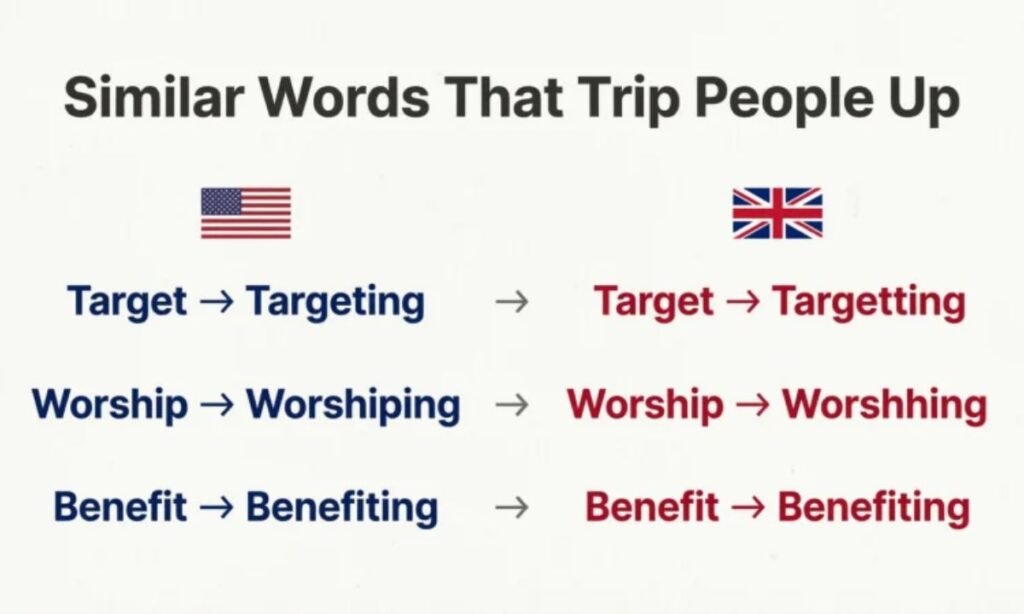
“Combat” is not the only verb with this issue. Several other words follow the same pattern, where stress or regional habit decides the spelling.
- Benefit: benefited / benefiting is standard in American English, while benefitted / benefitting is also seen in British writing.
- Focus: focused / focusing is standard in American English, while focussed / focussing is a British variant.
- Worship: worshiped / worshiping (US) versus worshipped / worshipping (UK).
- Target: targeted / targeting, where the stress is on the first syllable, so no doubling is needed.
- Format: formatted / formatting, where the doubling is standard.
Learning that doubling depends on stress and regional habit makes all of these easier. When a word can be stressed two ways, expect two accepted spellings.
Frequently Asked Questions
Which is correct, combating or combatting?
Both are correct. Combating is the more widely used spelling, especially in American English. Combatting is an accepted variant that appears more often in British English. Neither one is a mistake.
Is there any difference in meaning between combating and combatting?
No. Both words mean fighting against, resisting, or working to reduce something harmful. The only difference is the spelling, which comes from two ways of stressing the word “combat.”
Is it combatting with one T or two?
It can be either. One T gives you combating, and two Ts gives you combatting. If you want the safest option for a general or American audience, use one T.
Why do some writers double the T in combatting?
They are applying the rule that a final consonant is doubled when the last syllable is stressed. Because some speakers say com-BAT, the double T feels natural to them. Others say COM-bat, so they keep a single T.
Final Takeaway
The Combating vs Combatting debate comes down to one letter and one idea: both spellings are right. Use combating when you want the safe, widely preferred form.
Use combatting if your style guide or your British-leaning audience favors it. Whichever you choose, keep it consistent from the first paragraph to the last.
Pingback: Resignate or Resonate: Which Word Is Correct?
Pingback: Resignate or Resonate: Which Word Is Correct?
Pingback: Lieing or Lying: Which Spelling Is Correct?
Pingback: Run or Ran: Which Spelling Is Correct?
Pingback: Impatient vs. Inpatient: What’s the Difference?
Pingback: Seal or Sill: What’s the Difference?
Pingback: Requester vs. Requestor: Which Spelling Is Correct?
Pingback: Monkeys or Monkies: Which Spelling Is Correct?
Pingback: Volumn or Volume: Which Spelling Is Correct?
Pingback: Chonies vs Chones: Which Spelling Is Correct?
Pingback: Repore or Rapport: Which Spelling Is Correct?
Pingback: Transferred vs Transfered: Which Spelling Is Correct?
Pingback: Drier or Dryer: Which Spelling Is Correct?