
You are about to send a report, and one word makes you pause. Volumn or volume? Your fingers typed one, your brain whispers the other, and the spell checker is nowhere in sight.
It is a small slip, but readers notice it fast, and it can make a careful document look rushed. Many writers second-guess this word because it sounds like it could hide a silent letter. It does not. Here is the correct spelling, the reason behind it, and a few tricks to lock it in.
What Does “Volume” Mean?
“Volume” is a noun with several related meanings. Which one applies depends on the context.
- Amount of space: How much room something takes up. The volume of this tank is 50 gallons.
- Loudness: How loud a sound is. She raised the volume on the speaker.
- A book: One book in a set, or a bound collection of pages. The encyclopedia has twenty volumes.
- Quantity: A large or measurable amount. The store handles a high volume of orders.
All four meanings share one idea: size or amount. Whether you measure space, sound, pages, or sales, you are asking “how much?”
Why People Write “Volumn”
Nobody invents a misspelling for no reason. “Volumn” usually appears because of a few predictable habits.
- Silent letter confusion: English has many words that end in a silent “n,” so the brain expects one here too.
- Rhyme with “column”: “Volume” and “column” both have a “-lum” sound in the middle, so they get mixed up.
- Fast typing: The “m” and “n” keys sit next to each other, so one slip is easy.
- Sound spelling: The final syllable sounds like “yoom,” which is hard to match to the letters.
Knowing why the mistake happens makes it easier to catch.
Where the Word “Volume” Comes From

“Volume” comes from the Latin word volumen, which referred to a roll, especially a scroll of writing. That Latin word is related to volvere, meaning “to roll” or “to turn.” The word passed into English through Old French.
This history explains the book meaning. Long before bound books, texts were written on scrolls. Each roll was one “volume.” Over time, the word grew to mean the space something fills, and later the strength of a sound.
The Latin root also explains the spelling. The word ends in -ume because it came from volumen, not from any word ending in “-umn.”
How to Pronounce Volume
In American English, “volume” is pronounced VAHL-yoom. The word has two syllables, with the stress on the first one.
Many speakers say the second part quickly, so it can sound like “VAHL-yum.” That quick sound is one reason people reach for the wrong ending when they write it.
If you say the word slowly and clearly, you can hear the “oom” at the end. That “oom” is spelled -ume.
Is Volume Spelled Differently in American and British English?
No. Volume is spelled the same way in the United States, United Kingdom, Canada, and Australia. There is no regional variant, so you never need to switch spellings based on your audience.
| Word | American English | British English |
| Correct spelling | volume | volume |
| Plural | volumes | volumes |
| Abbreviation | vol. | vol. |
| Misspelling | volumn | volumn |
Some words do change between regions, such as “color” and “colour.” Volume is not one of them.
Volume vs. Column: Words With a Silent N
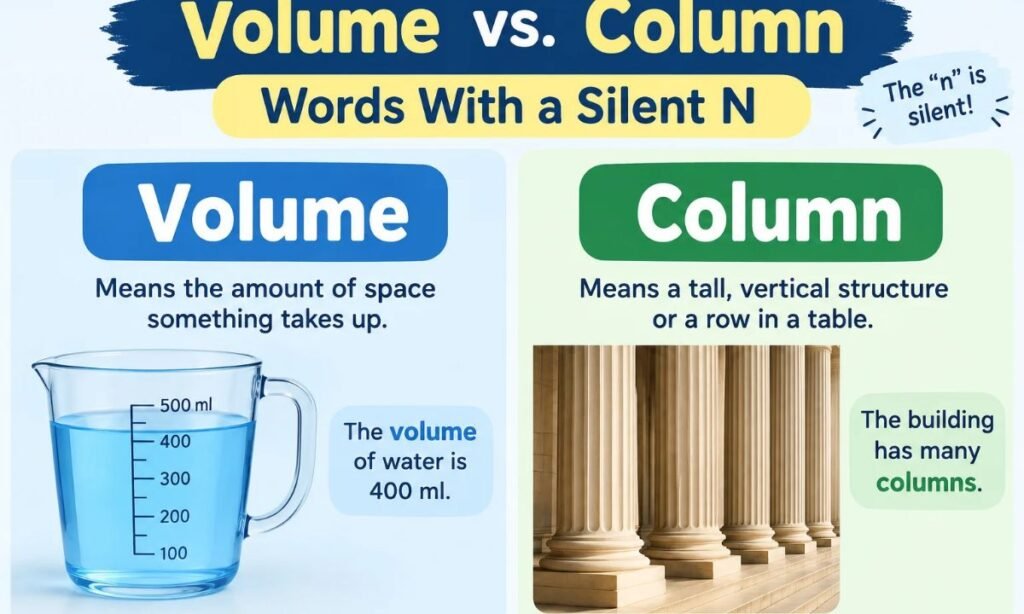
The confusion between “volume” and “column” is understandable, because both have an “l” and a “u” followed by a nasal sound. The difference is in how each word ends.
Some English words do end in a silent “n” after an “m”:
- column
- autumn
- hymn
- solemn
- condemn
Other words end in -ume:
- assume
- consume
- costume
- perfume
- resume
“Volume” belongs in the second group. Think of it as a cousin of “assume” and “perfume,” not “column” and “autumn.”
Volume in Real Sentences
Seeing the word in use helps the spelling stick. Here are examples for each meaning.
Space and measurement
- The volume of a box equals its length times its width times its height.
- Measure the volume of water in the cup.
Sound
- Turn the volume down, the baby is sleeping.
- The volume on my phone is stuck.
Books
- She borrowed volume two of the series.
- The library keeps old volumes in a locked room.
Business and data
- The company saw a rise in sales volume this quarter.
- Trading volume often jumps when big news breaks.
Everyday phrases
- Speak volumes means to say a lot without words. Her smile spoke volumes.
- Volume control is the button or dial that changes loudness.
Common Mistakes With Volume
Besides “volumn,” a few other errors show up often.
| Incorrect | Why it is wrong | Correct |
| volumn | Ends with a silent “n” that does not exist | volume |
| volum | Final “e” is missing | volume |
| volumne | Letters are swapped at the end | volume |
| volumen | This is a Spanish, Latin, and German spelling | volume |
| volumns | Plural of the misspelling | volumes |
A quick note on “volumen”: it is a real word in languages such as Spanish and German, so it is not a random typo. In English, though, the “n” is not used.
Related Words You Should Know

Several words come from the same root and follow the same spelling pattern.
- Voluminous: Very large or full. She wore a voluminous coat.
- Volumetric: Related to measuring volume. A volumetric flask measures liquid.
- Volumize: To add fullness, often to hair. This shampoo helps volumize thin hair.
- Volume control: A switch that adjusts sound level.
- Multivolume: Made up of several books or parts.
Notice that the “-um-” stays in every one of these words. If you can spell “voluminous,” you already know there is no “n” after the “m” in “volume.”
Easy Ways to Remember the Spelling
Try one of these tricks.
- Look at the ending. Volume ends in “me.” You can picture it as “vol-ume.”
- Think of rhymes. Match it with “assume,” “resume,” and “perfume,” all of which end in -ume.
- Use the root. Remember the Latin volumen, which ends in “-men.” The English version simply drops the “n.”
- Break it into chunks. Say “vol,” then “ume,” then put them together.
- Check the plural. “Volumes” sounds natural. “Volumns” does not.
Pick whichever trick feels most natural to you and repeat it a few times.
FAQs
What is volumn?
“Volumn” is not a real word. It is a common misspelling of volume. The extra “n” likely comes from words such as “column” and “autumn,” which end with a silent “n.”
Which is correct, volume or volumes?
Both are correct. Volume is the singular form, and volumes is the plural. Use “volume” for one item or one measurement, and “volumes” for several books, quantities, or amounts.
How do you spell volume as in sound?
The spelling is the same for sound: volume. Whether you mean loudness, space, or a book, the word never changes. Turn up the volume uses the same spelling as the volume of a cube.
What does volumen mean?
“Volumen” is the word for volume in Spanish, Latin, and German. It is not used in standard English. In English, you should write volume instead.
Conclusion
The answer to “volumn or volume” is simple. Volume is correct, and “volumn” is a spelling mistake. The word comes from the Latin volumen, ends in -ume, and has the same spelling in every major English-speaking region.
Remember that it rhymes with “assume,” not “column.” Do that, and this word will not trip you up again.