
You are telling a friend about your weekend and stall on one tiny word. Yesterday I run? Yesterday I ran? Maybe even “I have ran”? Short verbs like this can make confident writers doubt themselves.
A wrong guess can make a polished paragraph look careless. The good news is that run or ran is not a coin toss. Each form has a fixed job tied to time, and one small clue in the sentence tells you which to pick.
The Three Forms of Run at a Glance
Verbs have principal parts, which are the forms you build every tense from. Here are the ones for “run.”
| Form | Word | Example |
| Base form | run | I run before work. |
| Third person singular | runs | She runs a bakery. |
| Present participle | running | They are running late. |
| Simple past | ran | He ran a marathon last year. |
| Past participle | run | We have run this route before. |
The important detail is that the base form and the past participle look identical. Both are “run.” That overlap is the main reason people mix things up.
When to Use “Run”
“Run” shows up in three situations.
1. Present tense with I, you, we, and they.
- I run three times a week.
- You run faster than I do.
- Our dogs run in the yard every evening.
For he, she, and it, add an -s: “He runs,” “She runs,” “The faucet runs.”
2. After “to” or a modal verb. These always take the base form.
- I want to run a 10K.
- She can run a mile in under ten minutes.
- We should run the numbers again.
3. As the past participle with a helper verb. This is covered in its own section below.
When to Use “Ran”
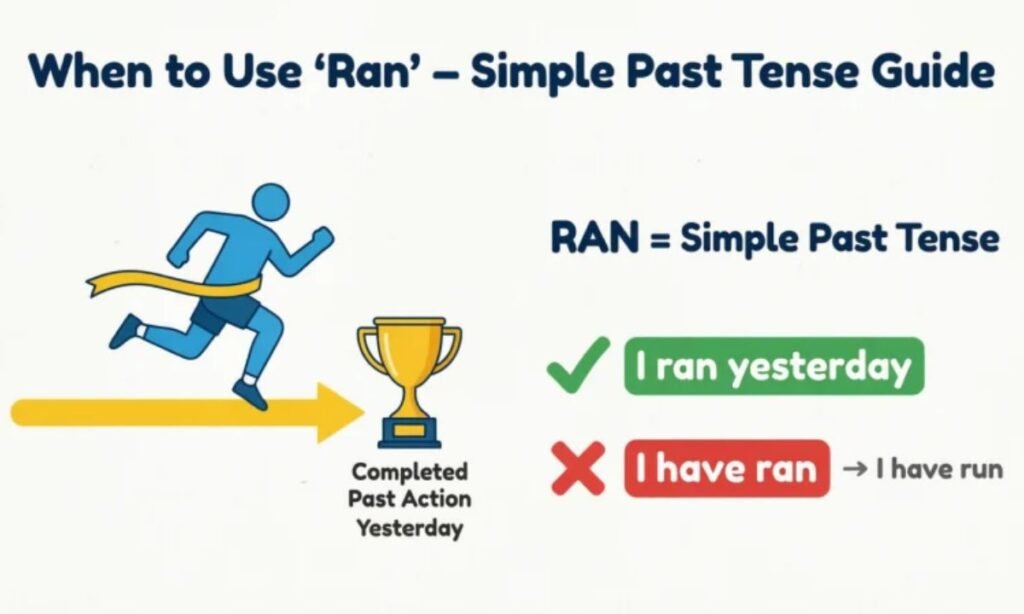
“Ran” has one job only: the simple past tense. Use it when the action is finished and you are talking about a specific time in the past.
- I ran to the bus stop this morning.
- She ran the meeting last week.
- The software ran without errors yesterday.
- They ran out of coffee by noon.
Notice that “ran” never needs a helper verb. You say “I ran,” not “I did ran” and not “I have ran.” If you see time words like yesterday, last night, in 2019, or two days ago, “ran” is almost always the right choice.
Have Run, Has Run, Had Run: The Past Participle
The past participle is the form you use after have, has, or had, and after forms of be in the passive voice. For this verb, the past participle is run, not “ran.”
- I have run this race five times.
- She has run the office since 2020.
- By noon, we had run out of paper.
- The program was run overnight.
This is where the most common mistake happens. Many people feel that “have ran” sounds right because “ran” feels like the past form. In standard English, though, it is not accepted. The correct versions are:
| Incorrect | Correct |
| I have ran every day this week. | I have run every day this week. |
| She has ran the numbers twice. | She has run the numbers twice. |
| We had ran out of time. | We had run out of time. |
You will hear “have ran” in casual speech and some regional dialects, but in writing for school, work, or publication, use “have run.”
Run Across All Major Tenses
Seeing every tense in one place helps you spot where each form belongs. Here is “run” with the pronoun “I” (and “he/she” where it changes).
| Tense | Form | Example |
| Simple present | run / runs | I run. She runs. |
| Present continuous | am/is/are running | I am running. |
| Present perfect | have/has run | I have run. |
| Present perfect continuous | have/has been running | I have been running. |
| Simple past | ran | I ran. |
| Past continuous | was/were running | I was running. |
| Past perfect | had run | I had run. |
| Simple future | will run | I will run. |
| Future perfect | will have run | I will have run. |
Only one tense in the entire list uses “ran.” Every other tense uses run, runs, or running. That makes “ran” the easiest form to place. If your sentence is not simple past, you almost never need it.
Why Run Is an Irregular Verb

Regular verbs form the past tense by adding -ed: walk becomes walked, jump becomes jumped. “Run” does not follow that pattern, which makes it irregular. Its past tense changes the vowel inside the word (run becomes ran), and its past participle returns to the base form.
Several related verbs behave the same way:
| Base | Past | Past participle |
| run | ran | run |
| come | came | come |
| become | became | become |
| overcome | overcame | overcome |
| outrun | outran | outrun |
| rerun | reran | rerun |
Once you know this pattern, you can apply it to many verbs at once. If you would say “I have come,” then “I have run” follows the same logic. Nobody says “I have came,” and the same instinct should rule out “I have ran.”
More Than One Meaning: Why “Run” Is So Common
“Run” is one of the most flexible words in English. That is partly why its forms matter so much, since you use them constantly. Here are some of its common meanings, with the past tense shown in each.
- Move quickly on foot: She ran to the station.
- Manage or operate: He ran a small shop for ten years.
- Operate, as a machine or program: The app ran smoothly.
- Flow: Water ran down the window.
- Stand for election: She ran for city council.
- Publish or broadcast: The paper ran the story on Friday.
- Extend or lie in a direction: The trail ran along the river.
“Run” can also be a noun, as in “a morning run,” “a run in my stocking,” or “a run of bad luck.” In those cases, it does not change tense at all. Only the verb uses ran.
Common Phrases and Idioms with Run
Phrasal verbs and idioms follow the same tense rules. Change the form to match the time of the sentence.
| Phrase | Meaning | Past tense example |
| run out of | use up the supply | We ran out of milk. |
| run into | meet by chance | I ran into an old friend. |
| run down | criticize, or lose power | The battery ran down overnight. |
| run up | accumulate, as in a bill | He ran up a large tab. |
| run across | find by chance | She ran across my old photos. |
| in the long run | over a long period | It paid off in the long run. |
Note that “in the long run” is a fixed phrase and never changes form.
A Quick Test for Choosing Run or Ran

When you are not sure, ask these questions in order.
- Is there a helper verb (have, has, had, or a form of be)? Use run. (“I have run.” “It was run.”)
- Is the action finished, with no helper verb? Use ran. (“I ran.”)
- Is it happening now, or does it happen regularly? Use run or runs. (“I run.” “She runs.”)
- Is there “to,” “can,” “will,” “should,” or “must” before it? Use run. (“I will run.”)
Here is a trick for the stubborn case. Replace “run” with “come” and see how it sounds. “I have came” is clearly wrong, so “I have ran” is wrong too. “I have come” sounds right, so “I have run” is right.
Common Mistakes with Run and Ran
Here are the errors worth watching for, with quick fixes.
- Saying “have ran.” Use “have run.”
- Saying “I run yesterday.” Use “I ran yesterday.”
- Using “ran” after “to” or a modal. Say “I want to run,” not “I want to ran.”
- Using “run” for a finished past action. Say “I ran it last night,” not “I run it last night.”
- Writing “runned.” This is not a word. Run is irregular, so there is no -ed form.
- Mixing tenses in one sentence. “She ran to the store and buys milk” jumps from past to present. Write “She ran to the store and bought milk.”
Frequently Asked Questions
Which is correct, is run or is ran?
Neither is standard. After “is,” use the present participle: “is running” (“She is running late”). For a passive sentence, use “is run”: “The company is run by two sisters.”
Do you say “ran” or “run”?
It depends on the tense. Say ran for a finished action in the past (“I ran yesterday”). Say run for the present (“I run daily”) or after have, has, or had (“I have run”).
Is it “I had run” or “I had ran”?
It is I had run. The past perfect tense uses the past participle, and the past participle of run is “run.” “Had ran” is a common error in speech but is not correct in standard writing.
What does “ran” mean?
“Ran” is the simple past tense of the verb “run.” It describes an action that was completed in the past, such as moving quickly on foot, operating something, or managing a business. For example: “He ran the company for twenty years.”
Final Takeaway
The choice between run or ran comes down to time and helper verbs. Use ran for a finished action in the simple past.
Use run for the present, after “to” or a modal, and after have, has, or had. When in doubt, swap in “come” and trust your ear: if “have came” sounds wrong, “have ran” is wrong too.
Pingback: Alr Meaning in Text: What Does It Mean in Chat?