
You are folding warm towels, typing a quick note about the laundry, and then you stall. Drier or dryer? Spell check says nothing, because both are real words, so you are left guessing.
Guess wrong in an email, a product listing, or a school essay and the sentence reads slightly off. The fix is simple. One word compares, and the other names a machine. This guide shows you which is which, with examples, memory tricks, and a short quiz.
What Does “Drier” Mean?
Drier is an adjective. It compares two things and says one has less moisture than the other. It can also describe humor, wine, or tone, not just wetness.
- The desert is drier than the coast.
- This towel feels drier than that one.
- Her humor is drier than mine.
- I like my white wine drier.
The spelling follows a regular English pattern. When a word ends in a consonant plus “y,” the “y” usually turns into “i” before “-er” or “-est.” That is how happy becomes happier and dry becomes drier and driest.
Drier can also work as a noun, though this is rare. It names a substance added to paint, ink, or varnish to speed up drying. Most everyday writers will never need that sense.
What Does “Dryer” Mean?
Dryer is a noun. It names something that dries, usually a machine. Think of it as the verb “dry” plus “-er,” the same way a runner runs and a blender blends. The “y” stays because nothing is being compared.
Common types include:
- Clothes dryer: the appliance in your laundry room
- Hair dryer: the handheld tool for drying and styling hair
- Hand dryer: the wall unit in public restrooms
- Tumble dryer and spin dryer: the usual British terms for laundry machines
- Industrial dryers: equipment that dries grain, lumber, paint, or food
One detail many guides skip: some dictionaries list “dryer” as an accepted variant of the comparative “drier,” and “drier” as a variant for machines. You may spot these swaps in older or industrial writing. They are not disasters, but modern readers expect the clean split described here.
Drier vs Dryer: Side-by-Side Comparison
| Feature | Drier | Dryer |
| Main role | Adjective (comparative of “dry”) | Noun |
| Core meaning | More dry, less wet | A machine or device that dries |
| “More dry” swap works? | Yes | No |
| Typical phrases | drier air, drier skin, drier wit | clothes dryer, hair dryer, hand dryer |
| Related forms | dry, drier, driest | dryer, dryers |
| Most common error | Replaced by “dryer” in comparisons | Replaced by “drier” for appliances |
Why English Has Two Spellings
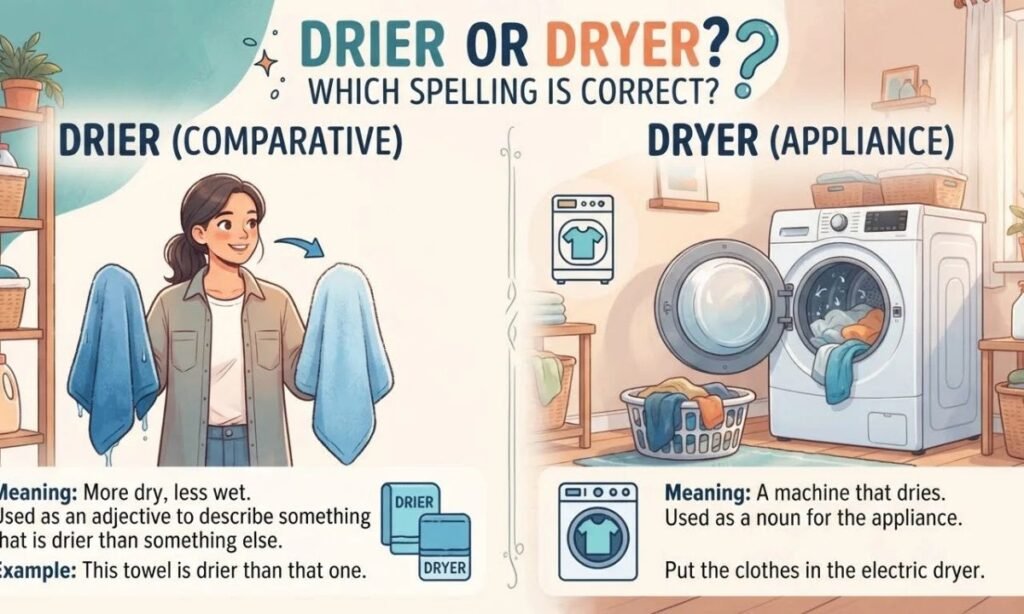
The split comes from two different word-building jobs that happen to use the same ending.
- Comparing: English adds “-er” to short adjectives (tall, taller). Because “dry” ends in a consonant plus “y,” the “y” becomes “i,” giving you drier.
- Naming a tool or doer: English adds “-er” to a verb to name the thing that performs the action (to dry, a dryer). The “y” stays, giving you dryer.
Other pairs follow a similar pattern. “Flier” and “flyer” overlap, and “shier” and “shyer” both appear in dictionaries. English spelling rarely sorts itself out neatly, so a simple rule of thumb beats memorizing exceptions.
Drier or Dryer in American and British English
The rule is almost identical on both sides of the Atlantic, which makes life easy.
American English: Writers use drier for the comparative and dryer for the machine. This is the cleanest split, and most American style guides and publishers follow it.
British English: The same pairing is standard in modern writing. The main difference is vocabulary. Britons say tumble dryer or spin dryer, while Americans say clothes dryer. Older British texts sometimes use “drier” for machines, so you may see it in historical or industrial writing.
If your audience is mixed or unknown, this is the safest approach anywhere:
- drier for “more dry”
- dryer for appliances
Hair Dryer, Clothes Dryer, or Hand Dryer: Which Spelling?
Appliance names cause most of the slips, so here is the short version. Use dryer every time.
| Phrase | Preferred spelling |
| Laundry machine (US) | clothes dryer |
| Laundry machine (UK) | tumble dryer |
| Styling tool | hair dryer |
| Restroom unit | hand dryer |
| Kitchen appliance | dish dryer |
You may occasionally see “hair drier” in print. Readers will understand it, and some dictionaries list it as a variant, but “hair dryer” is what appears on product boxes, store pages, and search results. If you write product descriptions or blog posts people will search for, use the form they type.
Example Sentences You Can Copy
With “drier”:
- After the heater ran all night, the room felt much drier.
- This spring was drier than the last one.
- Switch to a drier shampoo if your scalp gets oily.
- The second batch of cookies came out drier than I wanted.
With “dryer”:
- The dryer buzzed, so I folded the towels while they were still warm.
- She packed a compact hair dryer for the trip.
- The hand dryer in the airport restroom was surprisingly loud.
- We bought a new dryer because the old one needed two cycles per load.
With both words:
- My jeans came out drier after I cleaned the lint from the dryer.
- The new dryer leaves clothes drier than our old one did.
Common Mistakes With Drier and Dryer

Using “dryer” for a comparison. Incorrect: The air today is dryer than yesterday. Better: The air today is drier than yesterday.
Using “drier” for an appliance. Incorrect: I left my shirt in the drier. Better: I left my shirt in the dryer.
Treating “drier” as always wrong. It is not. It is the standard comparative of “dry” and the right choice any time you mean “more dry.”
Treating “dryer” as never acceptable for comparisons. Some dictionaries record it as a variant. It is not the preferred choice, so use drier to keep your writing consistent and polished.
Ignoring context. “The dryer climate helps” is unclear. Is that a machine or a climate with less moisture? Read the full sentence, then pick the word that matches your meaning.
Switching spellings mid-document. If you write “hair dryer” in one paragraph and “hair drier” in the next, readers notice. Choose one form and stay with it.
Easy Ways to Remember the Difference
Pick the trick that sticks for you.
- The swap test: Replace the word with “more dry.” If the sentence still works, choose drier.
- The machine test: Could you plug it in, load it, or hold it? Choose dryer.
- The “i” for comparison hint: Comparatives like happier, busier, and drier all swap “y” for “i.” If you are comparing, you want the “i.”
- The “y” stays for the thing: In “dryer,” the base word “dry” stays intact, just like the verb you are building the tool name from.
Here is a four-step routine for editing:
- Swap in “more dry.” If it fits, use drier.
- If the word names a machine or tool, use dryer.
- Think about your audience. General and formal readers expect the standard split.
- Reread the whole sentence to confirm the meaning is clear.
Mini Practice Quiz

Try these, then check the answers below.
- The weather is getting (drier / dryer) every week.
- Please clean the lint trap on the (drier / dryer).
- Which word names an appliance?
- True or false: “drier” is the comparative form of “dry.”
- Choose the correct phrase: hair (drier / dryer).
- Which spelling fits: “This bread is much (drier / dryer) than yesterday’s.”
Answers: 1. drier. 2. dryer. 3. dryer. 4. True. 5. dryer. 6. drier.
Frequently Asked Questions
Is it drier or more dry?
Both are correct, but drier is shorter and more natural for a one-syllable adjective like “dry.” “More dry” is not wrong, yet it can sound clunky. Say “a drier towel,” and save “more dry” for cases where you want extra emphasis.
Is it a hand dryer or drier?
Use hand dryer. It is the standard spelling on restroom signs, product pages, and in most dictionaries. “Hand drier” is understood but far less common.
How do you spell laundry dryer?
Spell it laundry dryer. In American English the usual term is clothes dryer, and in British English it is tumble dryer. In all of these, the machine takes the “y.”
Is it dryer or drier weather?
Use drier weather when comparing conditions, as in “Next week looks drier.” The word is an adjective describing weather, so it follows the comparative rule. “Dryer weather” is not the preferred form.
Can “drier” ever refer to a machine?
Rarely. Some dictionaries list “drier” as a variant for devices, and you may see it in older or industrial writing. For everyday writing, use dryer for any machine so your readers never have to pause.
Final Verdict: Drier or Dryer?
Keep it simple. Use drier when you mean “more dry” and dryer when you mean a machine that dries. If you can replace the word with “more dry,” drier is your answer. If you are talking about laundry, hair, or restroom hands, dryer wins. Learn that one split and you will not second-guess this pair again.