
You are typing a message, and your fingers freeze. Is it “of course” or “ofcourse”? Maybe you even searched “course or ofcours” hoping spellcheck would save you.
Don’t worry. This small slip trips up students, bloggers, and professionals alike. One wrong spelling can make a polished email look rushed. Here is the clear answer, plus simple ways to get it right every time.
What Does “Of Course” Mean?
“Of course” is an everyday English phrase with three main jobs:
- Agreeing or giving permission: “Can I borrow your pen?” “Of course.”
- Showing something is obvious: “Of course the store is closed. It’s 3 a.m.”
- Adding a point the reader already knows: “Exercise, of course, helps with sleep.”
The phrase comes from an older idea of “the normal course of things.” If something happens “of course,” it follows the expected path. That history explains why the phrase feels natural and confident.
Of Course or Ofcourse: The Correct Spelling
The correct spelling is of course. Standard English dictionaries list it as two separate words, and no major dictionary treats “ofcourse” as a valid variant.
Think of it like “at least,” “in fact,” or “by the way.” These are fixed phrases made of separate words. They work together, but they never merge into one.
So if you are asking how to spell “of course,” the answer is simple: of, a space, then course.
Why People Write “Ofcourse” and “Ofcours”

Mistakes happen for understandable reasons:
- Fast typing. When you type quickly, the space bar sometimes gets skipped.
- Texting habits. Casual chat teaches us to shorten and merge words.
- Sound. When we say it aloud, “of course” flows as one smooth sound, so it feels like one word.
- Missing letters. “Ofcours” drops the final “e” because the “e” is silent, and silent letters are easy to forget.
- Autocorrect gaps. Some tools do not flag “ofcourse,” especially on phones.
The pattern is clear: the error comes from speech and speed, not from any real grammar rule.
Of Course vs Ofcourse vs Of Coarse
Three versions float around the internet. Only one is correct.
| Version | Correct? | What went wrong |
| of course | Yes | Nothing. This is the standard form. |
| ofcourse | No | Two words merged into one |
| ofcours | No | Merged and missing the final “e” |
| of coarse | No | Wrong word. “Coarse” means rough |
The “of coarse” mix-up deserves special attention. Course means a path, a class, or a direction, as in “a course of study” or “golf course.” Coarse describes a rough texture, like coarse sand or coarse fabric. Since the phrase has nothing to do with texture, “coarse” never belongs in it.
How to Use “Of Course” in a Sentence.
As a reply:
- “Are you coming to the meeting?” “Of course.”
- “Could you send me the file?” “Of course, I’ll do it now.”
At the start of a sentence:
- Of course, no one expected the rain to last all week.
- Of course I remembered your birthday.
In the middle of a sentence:
- The team, of course, deserves most of the credit.
- She will, of course, need a ticket to enter.
With “not” for a firm no:
- “Did you take my keys?” “Of course not.”
With “but” for a gentle contrast:
- Of course, it’s your decision, but I’d think it over.
Comma Rules for “Of Course”
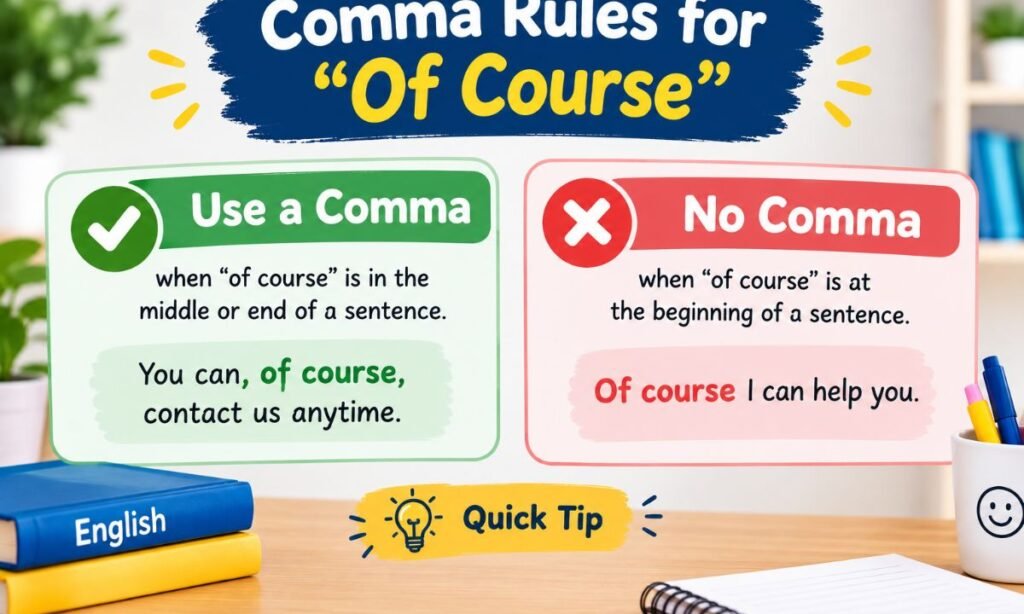
- At the start of a sentence, a comma usually follows when a full clause comes next: “Of course, we can reschedule.” The comma is optional when the sentence is short and flows quickly: “Of course I will.”
- In the middle of a sentence, use commas on both sides when “of course” interrupts the flow: “Our manager, of course, approved it.”
- As a standalone reply, use a period or exclamation mark: “Of course.” or “Of course!”
- With “not,” skip the comma: “Of course not.”
If you can remove “of course” and the sentence still works, then commas around it are the right call.
When “Of Course” Sounds Rude or Sarcastic
“Of course” can sound warm or cold depending on delivery. Compare these:
- Warm: “Can you help me?” “Of course! Happy to.”
- Cold: “Did you read the report?” “Of course I did.” (This can sound defensive.)
- Sarcastic: “Of course you forgot.” (This is clearly an insult.)
In writing, the reader cannot hear your voice. That means a plain “of course” in an email can come across as impatient. When you want to sound friendly, add a few warm words: “Of course, glad to help.” Small additions like that change the whole feel.
Using “Of Course” in Formal and Professional Writing
The phrase itself is perfectly acceptable in business emails, essays, and reports. The key is using it with care.
Good formal examples:
- “Of course, we will provide a full refund.”
- “The results, of course, may vary by region.”
Things to avoid:
- Writing “ofcourse” in a cover letter or client email. It signals carelessness.
- Overusing the phrase. Too many “of course” statements can sound like you are talking down to the reader.
- Using it when the point is not actually obvious. Telling a reader that something is “obvious” when it is not can feel dismissive.
In academic writing, many instructors suggest limiting “of course” and similar phrases, since a claim should earn its place through evidence, not through assumption.
Real Life Places Where This Mistake Shows Up

The error appears in more spots than you might expect:
- Email subject lines and openings. A message that starts with “Ofcourse, I’ll send it” looks sloppy.
- Social media captions and comments. Common, and usually forgiven, but still noticeable.
- Blog posts and web pages. Readers notice repeated spelling errors, and they can weaken trust in your content.
- Resumes and cover letters. A single typo can distract a hiring manager.
- School assignments. Teachers mark it as a spelling error every time.
If you publish content online, the fix is quick: search your draft for “ofcourse” before you hit publish.
Easy Tricks to Remember the Correct Spelling
Try one of these memory aids:
- The space test. Say “of” and “course” as two separate beats. If you can pause between them, a space belongs there.
- The “a lot” rule. Many people know “alot” is wrong. “Ofcourse” is the same kind of error: a phrase mistakenly glued together.
- The “Of” first rule. “Of” is a tiny word that rarely attaches to the front of another word. If it starts a phrase, give it breathing room.
- Read it backward. Read your draft from the last sentence to the first. Your eyes catch spelling errors more easily when the meaning is not pulling you along.
- Use a checker. A basic grammar tool will flag “ofcourse” quickly, but still proofread, since tools miss things too.
Other Phrases People Often Merge by Mistake
| Correct | Common mistake |
| a lot | alot |
| all right | alright (informal, not accepted everywhere) |
| in fact | infact |
| at least | atleast |
| as well | aswell |
| each other | eachother |
Learning one rule helps with all of them: if a phrase is made of separate words in a dictionary, it stays separate in your writing.
Frequently Asked Questions
Is “ofcourse” ever correct?
No. “Ofcourse” is not accepted in standard English. The correct form is always of course, written as two words.
Does “ofcourse” mean “yes”?
People do use it to mean “yes” or “certainly,” but the spelling is wrong. When you want to say yes in a friendly, confident way, write “of course.”
Is it “of course” or “of coarse”?
It is “of course.” “Coarse” describes something rough, like sandpaper. It has no place in this phrase.
Is “of course” formal or informal?
It works in both. You can say it casually with friends or use it in a professional email. Just watch your tone, since it can sound sharp if the reader feels you are stating the obvious.
Keywords Used Naturally in the Article
Primary: of course or ofcourse, course or ofcours, of course correct spelling
Secondary: ofcourse spelling mistake, how to spell of course, of course meaning, of course in a sentence, of course grammar rules, correct use of of course, is ofcourse one word, of course examples, of course in formal writing, common English spelling mistakes, of coarse vs of course
Semantic terms: two-word phrase, standard English, English learners, comma rules, formal and informal writing, spelling errors, sentence examples
Conclusion
The answer to the “course or ofcours” question is simple: write “of course” as two words, every time. “Ofcourse” and “ofcours” are spelling mistakes, and “of coarse” is a different word entirely. Remember that the phrase means “naturally” or “certainly,” keep your commas in the right spots, and watch your tone in emails.
Fix this one habit, and your writing instantly looks more careful. Of course, a quick proofread never hurts either.