
You are typing fast. A text, a work email, a caption. You write “I realy appreciate it,” hit send, and then spot the typo a second too late. It happens to everyone, and the realy or really question trips up even careful writers because the wrong version looks almost right.
The good news is that the fix comes down to one tiny rule about suffixes. Learn it once, and that missing letter stops sneaking past you.
Why Really Has Two L’s
The spelling follows a simple building-block rule.
real (adjective) + ly (adverb ending) = really
The root word already ends in L, and the ending starts with L. Nothing gets dropped, so you end up with a double L. The same pattern works across English:
| Adjective | + ly | Adverb |
| real | + ly | really |
| final | + ly | finally |
| usual | + ly | usually |
| careful | + ly | carefully |
| actual | + ly | actually |
| total | + ly | totally |
If you can spell “finally” and “usually,” you can spell “really.” They all work the same way.
There is one small exception worth knowing. Words that end in a double L, like full and dull, usually lose one L before -ly, giving fully and dully. Real has only one L, so nothing is lost.
What Really Means
Really is a flexible adverb with a few common jobs.
1. To mean “in truth” or “in fact.”
- “What really happened that night?”
2. To add emphasis or strength.
- “That was a really good movie.”
- “I really appreciate your help.”
3. To show surprise or doubt, often as a one-word question.
- “Really? You finished already?”
4. To soften a statement or push back politely.
- “I do not really agree.”
- “It is not really my style.”
The word comes from real, which traces back to a Latin root meaning “thing.” That is why real describes something that actually exists, and really describes something that happens or is true in fact.
How to Pronounce Really
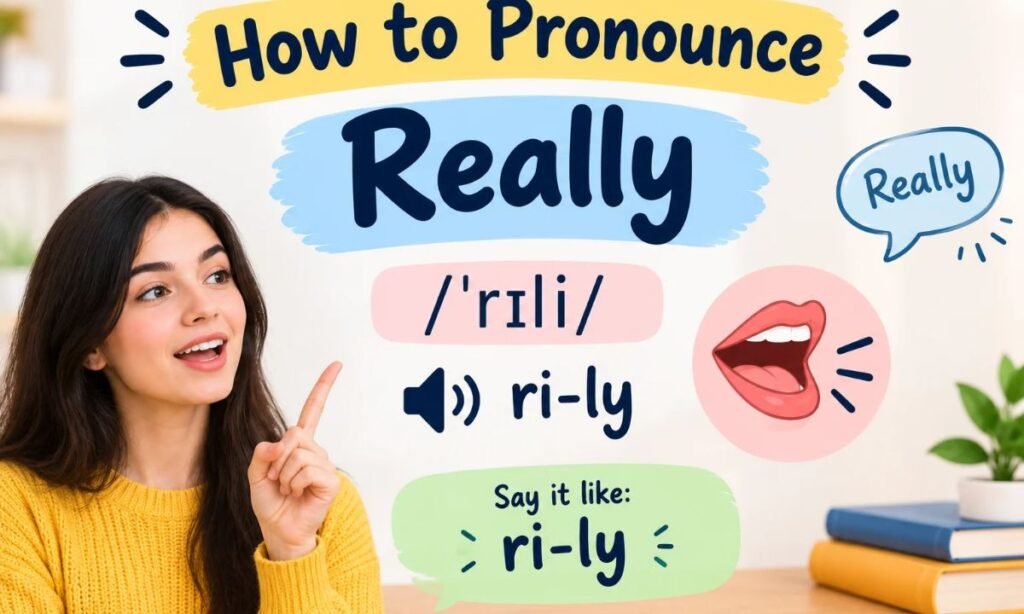
Most speakers use one of two patterns:
- REE-uh-lee (three syllables)
- REE-lee (two syllables, faster speech)
Both are normal in American English. British speakers use a similar rhythm, with a slightly different vowel sound at the start.
The shorter version, REE-lee, is one reason people spell it “realy.” When you say it quickly, the double L blends into a single sound, so the ear hears one L. The spelling still needs two.
Realy or Really in British and American English
Here is one less thing to worry about. The spelling does not change between regions. Both use really.
| Feature | American English | British English |
| Spelling | really | really |
| Spelling of “realy” | Not accepted | Not accepted |
| Common spoken form | REE-uh-lee or REE-lee | Similar, with a different first vowel |
| Formal writing | Fine, though often replaceable | Fine, though often replaceable |
So whether you write for readers in Texas, Manchester, or Karachi, the correct spelling is the same.
Why People Type “Realy”
The mistake has a few clear causes.
- Fast typing. Double letters are easy to skip when your fingers move quickly. A repeated L is a common victim.
- Casual speech. As shown above, the quick pronunciation hides the second L.
- The base word. “Real” has one L, so writers carry that single L over without adding the suffix.
- Autocorrect gaps. Most spell checkers catch “realy.” Still, it can slip through in usernames, handwritten notes, text boxes with no spell check, or when autocorrect is turned off.
In other words, the mistake is not a sign of weak writing. It is a very human typo, and an easy one to fix.
Common Spelling Mistakes With Really
| Incorrect | Correct | What went wrong |
| realy | really | Second L missing |
| reallly | really | Extra L added |
| realli | really | Wrong ending |
| reely | really | Spelled by sound |
| rily | really | Spelled by sound |
| real good (in formal writing) | really good | Adjective used instead of adverb |
| I real like it | I really like it | Adjective used instead of adverb |
The last two are grammar slips, not spelling ones. In casual American speech, people do say “real good,” and it can sound friendly in conversation. In careful writing, use really.
Easy Ways to Remember the Spelling

Pick whichever trick fits your brain.
- Build it in two pieces. Write real, then add ly. You will see both L’s side by side.
- Match it with “finally.” Both end in -ally or -lly after the same kind of root. Spell one, and the other follows.
- Count the L’s out loud. Say “R-E-A-L-L-Y.” Two L’s, one at the end of the root and one at the start of the ending.
- Think of the letter shape. The two tall L’s stand together like a pair of posts in the middle of the word.
Use one trick for a week, and it will become automatic.
Really vs Real vs Very
These three words get mixed up often, so here is the quick difference.
Real is an adjective. It describes a noun.
- “This is a real diamond.”
Really is an adverb. It describes a verb, adjective, or another adverb.
- “She really enjoys painting.”
- “He is really tall.”
Very is also an adverb. It adds strength, but it does not carry the “in truth” meaning that really can.
| Word | Job | Example |
| real | adjective | A real friend shows up. |
| really | adverb | I really mean it. |
| very | adverb | It is very cold today. |
A quick test: if you can swap in “truly” or “in fact,” you probably want really. If you are describing a thing, you probably want real.
Synonyms for Really
Really is useful, but it can get repetitive. Here are some alternatives, grouped by meaning.
| Meaning | Alternatives |
| In fact | actually, truly, genuinely |
| Very (for emphasis) | extremely, highly, remarkably |
| Surprise or doubt | seriously, is that so, no way (casual) |
| Softening | not exactly, not quite, not especially |
One tip for stronger writing: instead of “really good,” try a precise word like excellent or outstanding. Instead of “really tired,” try exhausted. One sharp word often beats an adverb plus a plain adjective.
Really in Everyday Examples

These examples show how the word fits real situations.
- “I really appreciate your quick reply.”
- “Thanks for the update. I really enjoyed the presentation.”
Text or chat
- “Really? That is amazing news!”
- “Do you really need that today?”
News writing
- “The mayor said the plan was not really ready for a vote.”
Social media
- “This coffee is really worth the wait.”
Formal writing
- “The committee did not really consider the second proposal.”
Notice that the word works in each setting. In formal writing, it just needs to earn its place.
Frequently Asked Questions
Is “realy” a real word?
No. Realy is not a standard English word. It is a misspelling of really. You may see it as a name, username, or brand name, but in regular writing, always use two L’s.
Does really have one L or two?
Two. The root word real ends in L, and the suffix -ly begins with L. Both letters stay, giving r-e-a-l-l-y.
Can I use “really” in formal writing?
Yes, it is acceptable. Still, many editors suggest cutting it when it adds little. “The results were really significant” often reads better as “The results were significant,” or “The results were striking.” Use it when it truly adds meaning.
What is the difference between very and really?
Both add strength, but really also carries a sense of truth. “It is very cold” simply adds intensity. “It is really cold” can add emphasis, and “Is it really cold?” asks whether it is true. In formal writing, very tends to sound more neutral.
Conclusion
The answer to realy or really is simple: really, with two L’s. It is the adjective real plus the ending -ly, and neither letter gets dropped. The spelling is the same in American and British English, and the same rule explains words like finally, usually, and carefully.
Next time your fingers rush, build the word in two parts, real and ly, and the missing L will show up on its own. Then keep your writing sharp by using the word where it truly adds meaning.

Alexander John grammar content writer with 4 years of experience creating accurate, engaging, and SEO-friendly content. I specialize in spelling differences, commonly confused words, vocabulary, grammar rules, and writing tips. My goal is to simplify English for learners through clear explanations, practical examples, and helpful articles.