
You are proofreading a scholarship essay, and one word keeps nagging at you. Privilege or priviledge? That sneaky “d” looks like it belongs, yet something feels off. Misspelling a key word in an application can undercut an otherwise strong message, and spellcheck is not always there to rescue you.
The fix is easier than it seems. Here is a clear answer to privilege or priviledge, with a simple memory trick that makes the right spelling hard to forget.
Is “Priviledge” a Real Word?
No. “Priviledge” does not appear in standard dictionaries, and it has no meaning of its own. It is a spelling mistake that adds a “d” before the “g.”
The same is true of “priviledged” and “priviledges.” If you see any of these, the “d” should come out. When people search for the priviledge spelling mistake, the answer is always the same: remove the “d” and you have the real word.
What Does “Privilege” Mean?
The privilege meaning is a special right, advantage, or permission given to a person or group. It can also mean a rare honor.
| Use | Meaning | Example |
| Noun | A special right or advantage | Seniors get early boarding as a privilege. |
| Noun | An honor or a chance to do something special | It was a privilege to meet the author. |
| Noun | A legal protection | Conversations with a lawyer are covered by attorney-client privilege. |
| Noun | Access rights in computing | Only admins have the privilege to delete files. |
| Verb | To give priority or advantage to something | The study privileges speed over accuracy. |
A helpful way to think about it: a right is something you are entitled to, while a privilege is something extra that can often be taken away. That is why people say, “Driving is a privilege, not a right.”
How to Spell and Say “Privilege”
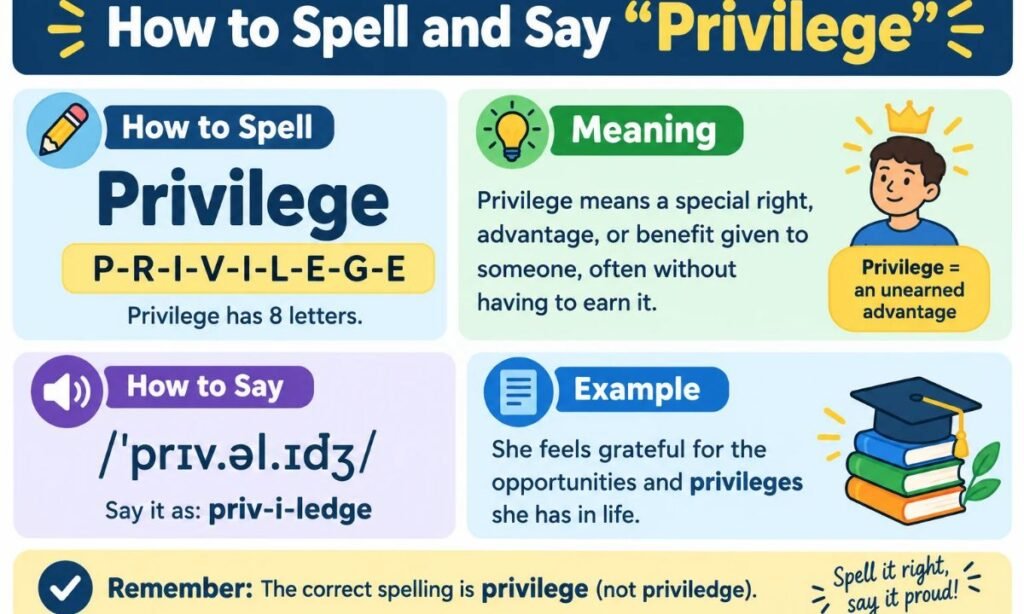
The spelling is p-r-i-v-i-l-e-g-e. That is nine letters, with no “d” at all.
The pronunciation is PRIV-uh-lij (three syllables) or PRIV-lij (two syllables). Both are common. Notice what you do not hear: there is no “d” sound in either version. The ending sounds like “ij,” as in “bridge,” but the spelling uses “ege,” not “edge.”
There is no regional difference. American and British English both write privilege, so you can use it for any audience.
Why Do People Write “Priviledge”?
This mistake is very common, and it has understandable causes.
- The “-edge” pattern. Many English words end with that “ij” sound spelled -edge, such as “ledge,” “hedge,” “pledge,” and “edge.” Writers reach for the same ending.
- Sound-based spelling. The final sound feels like “dj,” so the “d” seems natural.
- The past-tense “d.” In “privileged,” the final “d” is real, which can make the earlier “d” feel normal.
- Fast typing. A quick slip adds a letter that does not belong.
Knowing why the error happens makes it easier to spot in your own writing.
Easy Tricks to Remember the Spelling
Here are a few memory aids you can use right now.
The “leg” trick. Look inside the word: priv-i-leg-e. There is a “leg” in the middle. Legs do not need a “d.” Picture a leg standing on a stage, and the spelling sticks.
The “no d, no ledge” trick. The word does not end like “ledge” or “pledge.” It ends like “college,” with -ege. If you can spell “college,” you can spell the end of “privilege.”
The vowel pattern. The vowels go i, i, e, e: privilege. Say that rhythm a few times, and the “d” has no place to hide.
You do not need all three. Pick the one that feels easiest, and use it every time you write the word.
Privilege in Real Sentences
Let’s see the word at work in different settings.
In everyday life:
- It is a privilege to live near the beach.
- Kids in our house earn screen time as a privilege.
In emails:
- It was a privilege to work with your team this quarter.
- Please let me know if my account privileges need to be updated.
In school and academic writing:
- The author explores how privilege shapes access to education.
- Students lose library privileges if books are returned late.
In business writing:
- Members receive special privileges, including priority support.
- The new policy removes admin privileges from standard users.
Whatever the setting, the spelling stays exactly the same.
Privilege, Privileged, and Related Words
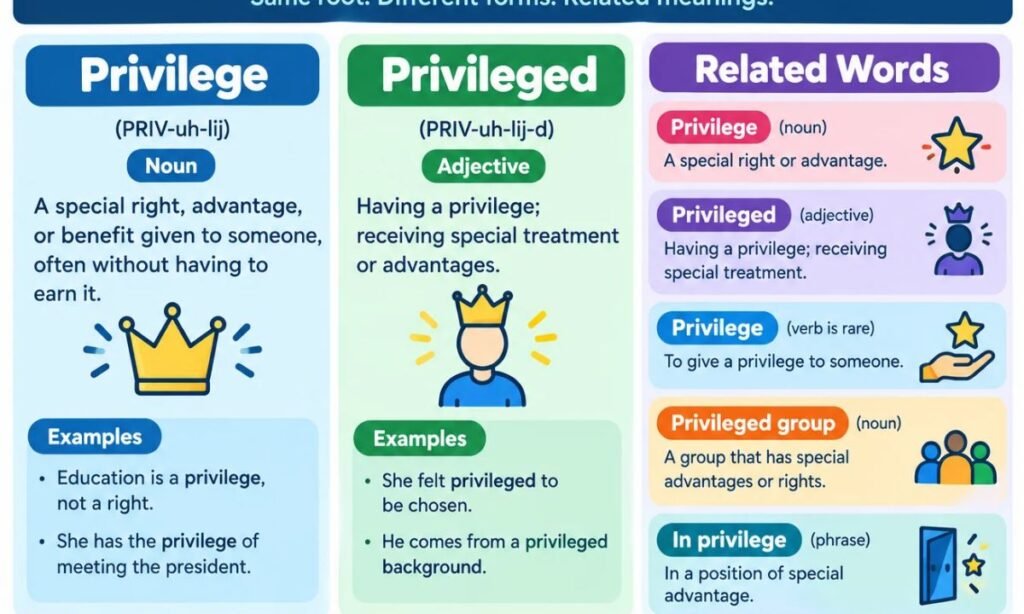
Once you know the base word, the rest of the family is simple. None of the forms add a “d” before the “g.”
| Word | Role | Example |
| privilege | noun, verb | Voting is a privilege many people value. |
| privileges | plural noun | Employees have parking privileges. |
| privileged | adjective, past tense | She felt privileged to be invited. |
| privileging | -ing form | The report is privileging cost over quality. |
| underprivileged | adjective | The charity supports underprivileged children. |
| unprivileged | adjective | An unprivileged user cannot change system settings. |
Here are a few notes on the differences:
- Privilege names the advantage or honor.
- Privileged describes the person who has it, or the feeling of being honored.
- Underprivileged describes people with fewer advantages or resources than most. Many writers now prefer “disadvantaged” in formal writing, so check the style guide for your field.
- Unprivileged is common in technical writing, where it means having limited access.
The final “d” in “privileged” is real. It is the past-tense ending, so it comes after the “e,” not before the “g.”
Is It Correct to Say “I Was Privileged”?
Yes. Saying “I was privileged to attend” means you felt honored. Saying “I grew up privileged” means you had advantages. Both are correct, and both use the same spelling.
Privilege in Legal, Work, and Tech Settings
The word has a few specialized uses that are worth knowing, since these are common places to type it.
- Attorney-client privilege: a legal protection that keeps certain conversations between a lawyer and client confidential.
- Privileged information: details that are protected or restricted, often in a legal or workplace setting.
- Admin privileges: permissions in a computer system that allow a user to change settings or manage files.
- Library or membership privileges: extra access that comes with a card or a subscription.
In all of these, “privilege” keeps the same spelling. If you write documents for a workplace or a classroom, you will probably use at least one of these terms.
Where Does the Word “Privilege” Come From?
“Privilege” comes from the Latin word privilegium, which meant a law that applied to one person or group. It was built from privus, meaning “private” or “individual,” and lex, meaning “law.”
The word then passed through Old French before reaching English. The idea behind it is easy to see: a privilege was originally a “private law,” a rule that gave special treatment to someone. The spelling kept the Latin shape, with “leg” in the middle, which is where our memory trick comes from. At no point in this history was there a “d.”
Common Mistakes With “Privilege”
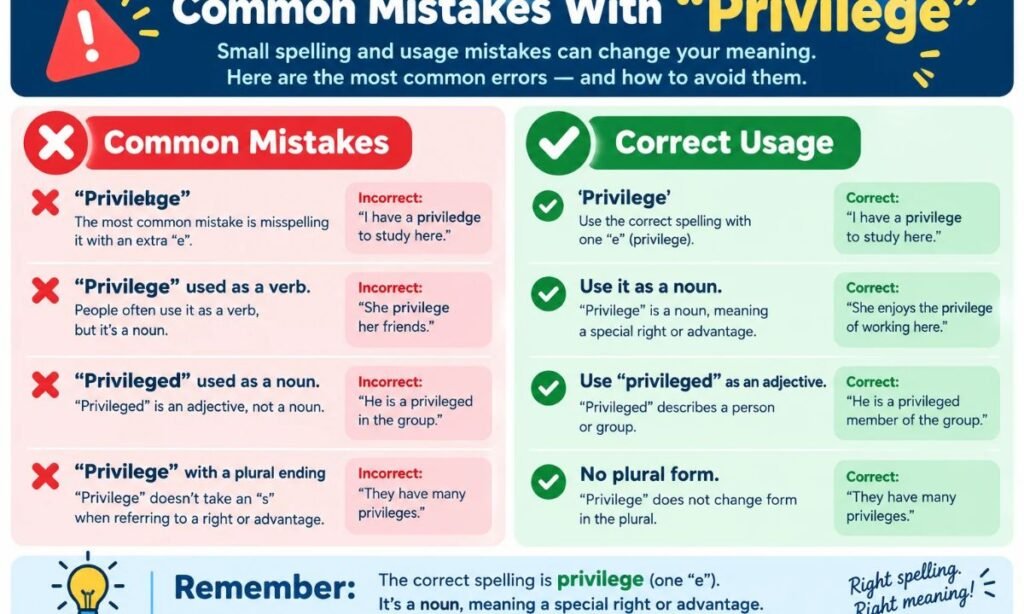
Check your writing for these slips.
- Adding a “d.” Writing “priviledge,” “priviledges,” or “priviledged.”
- Changing the vowels. Spellings like “privelege” and “privilage” are also wrong.
- Dropping a letter. Forms like “privlege” skip a vowel.
- Using “-edge.” Treating the ending like “pledge” instead of “college.”
- Mixing up “privilege” and “privileged.” The first is the noun, and the second is the describing word.
A fast proofreading step helps: search your draft for “ledge.” If it shows up inside a form of “privilege,” remove the “d.”
Frequently Asked Questions
Is it privilege or priviledge?
It is privilege. The word has no “d.” “Priviledge” is a common misspelling and is not accepted in standard English.
Is there a “d” in privilege?
No. There is no “d” in “privilege.” The only place a “d” appears in the family of words is the ending of “privileged,” where it marks the past tense.
How do you spell privilege in the UK?
The same way as in the US: privilege. There is no British variant of this spelling, so you do not need to change it for a UK audience.
What is the meaning of a privileged person?
A privileged person is someone who has special advantages, such as access, resources, or opportunities that many others do not have. In another sense, “privileged” can describe someone who feels honored, as in “I felt privileged to be there.”
Final Thoughts
The answer to privilege or priviledge is simple: always write privilege. The word has a “leg” in the middle and ends like “college,” so there is never a “d” in the base word. Remember the vowel rhythm, keep the “d” only in the past-tense “privileged,” and give important documents a quick proofread. With that habit, the spelling will stay right every time.

Alexander John grammar content writer with 4 years of experience creating accurate, engaging, and SEO-friendly content. I specialize in spelling differences, commonly confused words, vocabulary, grammar rules, and writing tips. My goal is to simplify English for learners through clear explanations, practical examples, and helpful articles.
Pingback: Occasion or Ocassion: Which Spelling Is Correct?
Pingback: Career: Meaning, Definition, Examples, and Correct Usage
Pingback: Sweetie vs. Sweety: Which Spelling Is Correct?
Pingback: Carrer vs Career: Which Spelling Is Correct?
Pingback: Of Course or Ofcourse: Which Spelling Is Correct?
Pingback: Drier or Dryer: Which Spelling Is Correct?
Pingback: Forth or Fourth: What’s the Difference? Meaning & Examples
Pingback: Lieing or Lying: Which Spelling Is Correct? Meaning & Examples
Pingback: Peice or Piece: Which Spelling Is Correct?
Pingback: Sergeant or Sargeant: Which Spelling Is Correct?
Pingback: Vessel of Sleep Token: Age, Biography, Career & Net Worth (2026)
Pingback: IShowSpeed Age, Height, Family & Biography (2026)
Pingback: Dior Goodjohn Age, Height, Family & Biography (2026)