
You are writing a thank-you note to a veteran, a news caption, or a quick email about a police report. Then you freeze. Does that word have an “a” like it sounds, or an “e” like it looks?
The sergeant or sargeant question trips up careful writers because the pronunciation gives no clue about the spelling. A wrong guess can look sloppy, especially when the word names someone’s rank. Here is the answer, plus simple ways to lock it in.
What Does “Sergeant” Mean?
A sergeant is a person who holds a mid-level rank in an armed force, a police department, or a similar organization. In most systems, a sergeant leads a small group and supervises the daily work of lower-ranked members.
The word is a noun. You can use it in two ways:
- As a job title or rank: “Sergeant Lopez gave the briefing.”
- As a general term: “Her brother is a sergeant in the Marine Corps.”
In everyday speech, people also use it for a strict, commanding person, usually as a joke. “My aunt runs the kitchen like a drill sergeant” is a fair example.
Why Is Sergeant Spelled So Differently From How It Sounds?
The odd spelling comes from the word’s history. English borrowed sergeant from Old French, and that word traces back to a Latin term meaning a person who serves. That is why the word is related to serve and servant, which is a handy clue for the “er” at the start.
The sound is the strange part. In older English, the “er” sound in some words shifted toward “ar.” That change shows up in British English words like clerk and Derby, which are said with “ar” in the UK. For the word sergeant, the spelling stayed with “er” while the pronunciation moved toward “ar.” So the spelling kept its older form, and the sound changed.
You do not need to memorize the history. Just remember that this word does not spell itself the way it sounds.
Sergeant vs Sargeant at a Glance
| Feature | Sergeant | Sargeant |
| Correct as a common word | Yes | No |
| Found in standard dictionaries | Yes | No |
| Meaning | A rank or title in the military or police | None as a common word |
| First syllable | S-E-R | S-A-R |
| Pronunciation | SAR-juhnt | Often matches the sound, but the spelling is wrong |
| Use in school, news, and official writing | Correct | Treated as an error |
| Other use | None | Occasional surname |
If you are writing about a rank, always choose sergeant.
When Is “Sargeant” Actually Used?
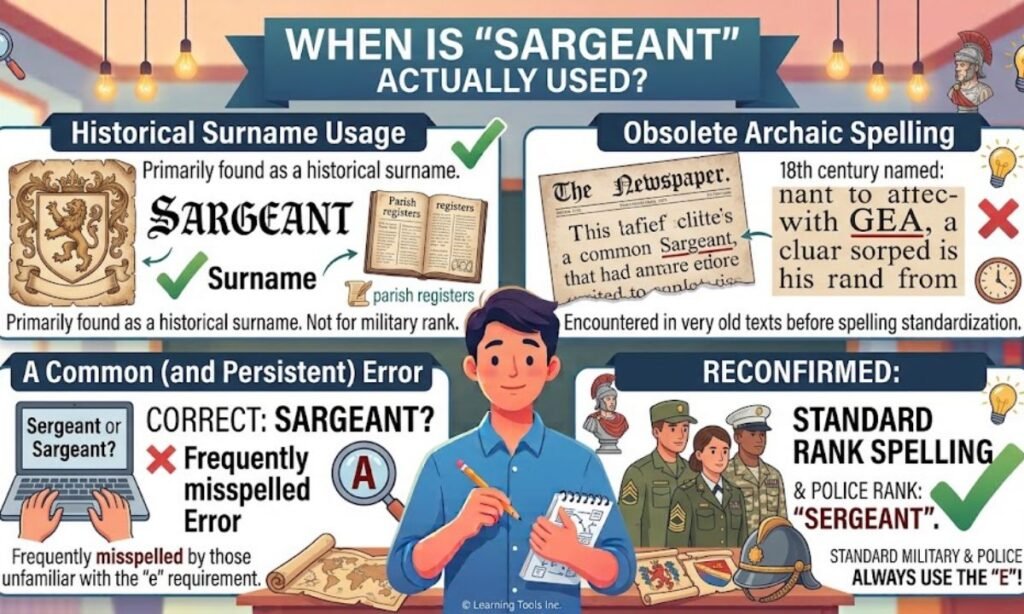
Here is a detail that confuses many people. Sargeant does appear in real life, but as a family name, not as the rank. Names often keep older or unusual spellings, and a person named Sargeant spells it their own way.
So the rule is simple:
- Writing about the rank or job? Use sergeant.
- Writing the name of a person who spells their name Sargeant? Copy their spelling exactly.
That means “Sergeant Sargeant” could be a real, correctly spelled name and title in the same breath. When in doubt about a person’s name, check how they write it.
How to Spell Sergeant: Easy Memory Tricks
Try one of these, and pick the one that sticks.
Break it into chunks. Say it slowly as SER-GEANT. Then picture the pieces: ser + geant. The “ea” sits in the second chunk.
Use the “serve” link. A sergeant is someone in service. Both words start with ser, which helps the beginning feel natural.
Spot the hidden word. Inside sergeant, you can see gean, then ant. Some people picture an ant standing at attention. Silly, but it works.
Remember the “ea.” Say to yourself, “A sergeant has an e at the start and an ea in the middle.” The two vowels tell you the word is not a plain sar word.
Write it five times. Handwriting the word helps your hand remember the pattern. It takes under a minute.
Common Mistakes People Make With Sergeant
Most errors fall into a few clear groups.
1. Spelling it the way it sounds. Writing “sargent” or “sargeant” is the most common slip, because the first syllable sounds like “sar.”
2. Dropping a letter. Some people write “sergent” and leave out the “a.” The word needs both e and a in the second half.
3. Swapping vowels in the end. Typing “sergaent” or “sergeunt” happens when you type fast. Read it back slowly.
4. Capitalizing it wrongly. More on this in the next section.
5. Mixing it up with a name. Seeing the name “Sargent” in art or history can make “sargent” look familiar. It is still not the correct spelling of the rank.
Should “Sergeant” Be Capitalized?
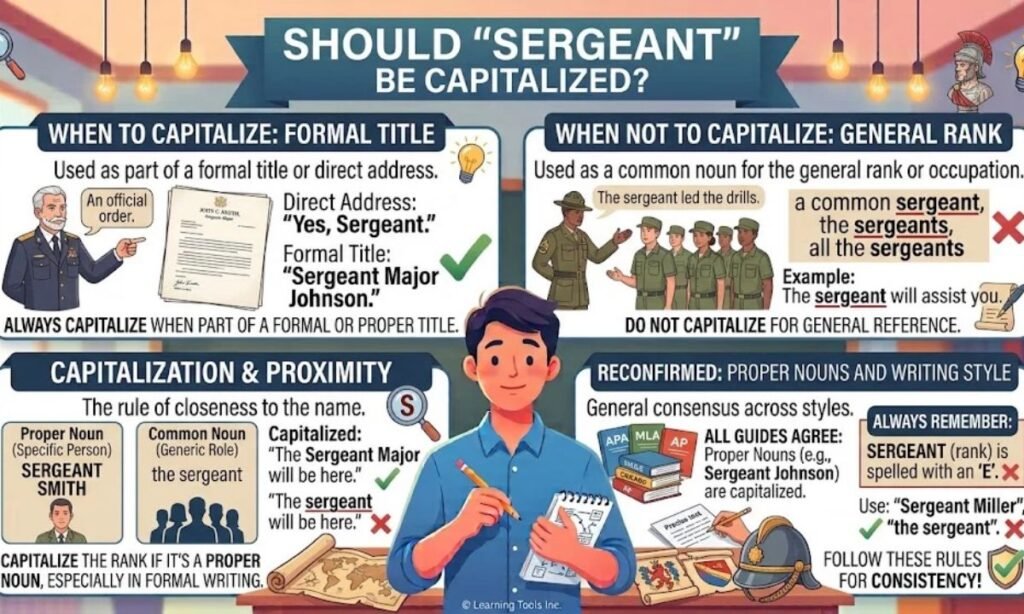
It depends on how you use it.
Capitalize it when it comes right before a person’s name, as a title:
- Sergeant Miller arrived at the scene.
- I spoke with Sergeant Chen yesterday.
Keep it lowercase when it stands alone as a general word:
- The sergeant walked into the room.
- He was promoted to sergeant last spring.
Lowercase it when it follows a name and acts as a description:
- Maria Lopez, a sergeant in the Army, spoke at the event.
Many style guides also use the abbreviation Sgt. before a name, as in “Sgt. Miller.” Use the full word in formal writing unless a style guide tells you otherwise.
Sergeant in a Sentence: Real Examples
Examples make the correct spelling easier to remember.
In emails:
- Please forward the schedule to Sergeant Brooks by Friday.
- The sergeant requested an updated list of volunteers.
In news writing:
- A police sergeant confirmed that the road is closed.
- The sergeant received a medal for service.
On social media:
- My grandfather retired as a sergeant, and I am proud of him.
- Our class hosted a sergeant to talk about teamwork.
In daily conversation:
- My dad says our neighbor is a retired Army sergeant.
- She bossed us around like a drill sergeant at the picnic.
In school writing:
- The story’s main character is a tired but kind sergeant.
How Does the Sergeant Rank Work?
Many readers search this word because they want to understand the rank, not only the spelling. Here is a simple picture.
- In the U.S. Army and Marine Corps, sergeant is a non-commissioned officer (NCO) rank. NCOs usually rise from the enlisted ranks and lead small teams.
- Higher sergeant ranks include staff sergeant, sergeant first class, master sergeant, first sergeant, and sergeant major in the Army. Names vary a bit between branches.
- In many police departments, a sergeant is a supervisor who sits above patrol officers and below lieutenants. Exact structure depends on the department.
Note that the word appears in many forms: staff sergeant, master sergeant, sergeant major. In every one of them, the spelling stays the same.
Which Is Higher, a Sergeant or a Lieutenant?
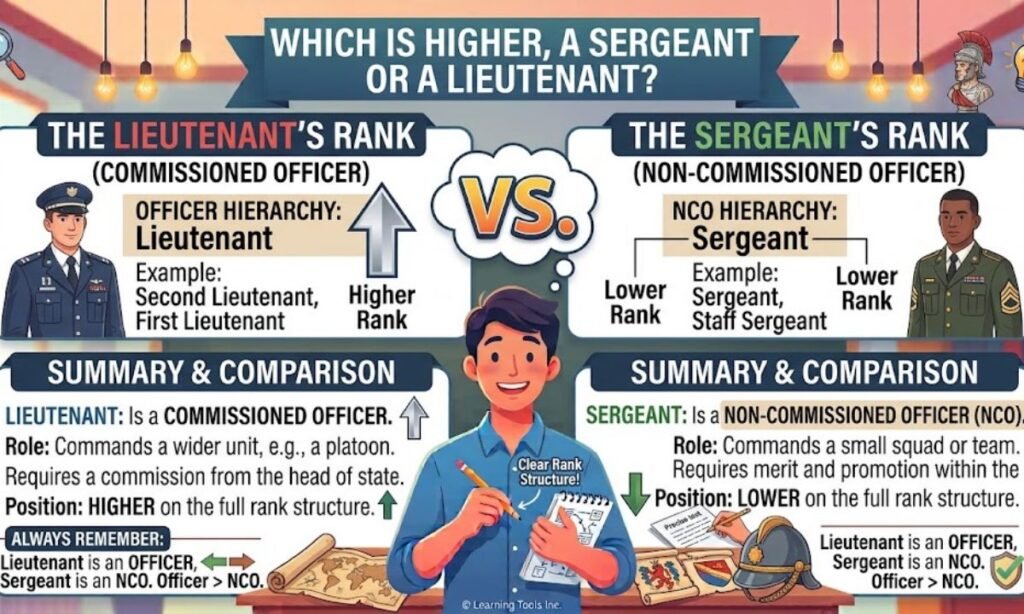
In the military, a lieutenant outranks a sergeant. Lieutenants are commissioned officers, while sergeants are non-commissioned officers. In practice, an experienced sergeant often has deep hands-on knowledge and guides new lieutenants.
In police departments, a lieutenant usually ranks above a sergeant as well. Since each department sets its own structure, the exact order can differ from place to place.
Is the Spelling Different in the UK?
No. Sergeant is the standard spelling in both American and British English. The UK uses the same word for the military and police ranks.
A different spelling, serjeant, appears in a few old titles and in some historic legal and ceremonial contexts. It is rare, and you will not need it for everyday writing. When you mean the common rank, sergeant is always correct.
Quick Practice: Test Yourself
Choose the correct spelling for each blank. The answers are below.
- The ______ led the team through the exercise.
- She is a police ______ in her city.
- We saw a ______ major at the ceremony.
- The drill ______ was strict but fair.
- He was promoted to staff ______ last year.
Answers: All five are sergeant.
Frequently Asked Questions
Is it sergeant or sargeant?
It is sergeant. “Sargeant” is a misspelling for the rank, though it can appear as a family name. Always use sergeant when you mean the rank or job.
What does sergeant mean?
A sergeant is a mid-level rank in the military, police, or a similar organization. Sergeants usually lead small groups and supervise daily work.
How do you pronounce sergeant?
It is pronounced “SAR-juhnt.” The first syllable sounds like “sar,” even though it is spelled with “er.”
What is higher, a lieutenant or a sergeant?
In the military, a lieutenant is higher, because lieutenants are commissioned officers and sergeants are non-commissioned officers. In most police departments, a lieutenant also ranks above a sergeant.
Conclusion
The sergeant or sargeant question has one clear answer: sergeant is correct. Remember that the word hides its spelling behind its sound. Link it to serve, break it into SER and GEANT, and capitalize it only when it comes before a name. Once you use it a few times, the right spelling will feel automatic.