
You are filling out a college application, a job form, or a quick bio for your profile. Then the cursor stops blinking where you need to type it: is it high school or highschool?
The word is so common that we rarely stop to look at it, which is exactly why one tiny space can feel so confusing. A wrong choice can make an otherwise polished sentence look rushed. Here is the clear answer, plus the rules that keep it right every time.
What Does “High School” Mean?
A high school is a school for students in their teenage years, between middle school (or junior high) and adult life, whether that means college, training, or work. Students typically earn a high school diploma when they finish.
In the U.S., high school usually includes four years, and each year has a common name:
- Freshman: ninth grade
- Sophomore: tenth grade
- Junior: eleventh grade
- Senior: twelfth grade
Setups vary by state and district, so some schools group grades a little differently. The general idea stays the same: it is the last stage of required schooling before graduation.
Why Is High School Two Words?
English forms compound nouns in three ways: as two words (open), as one word (closed), or with a hyphen. A compound that becomes common can slowly move from open to closed. Think of how “web site” became “website.”
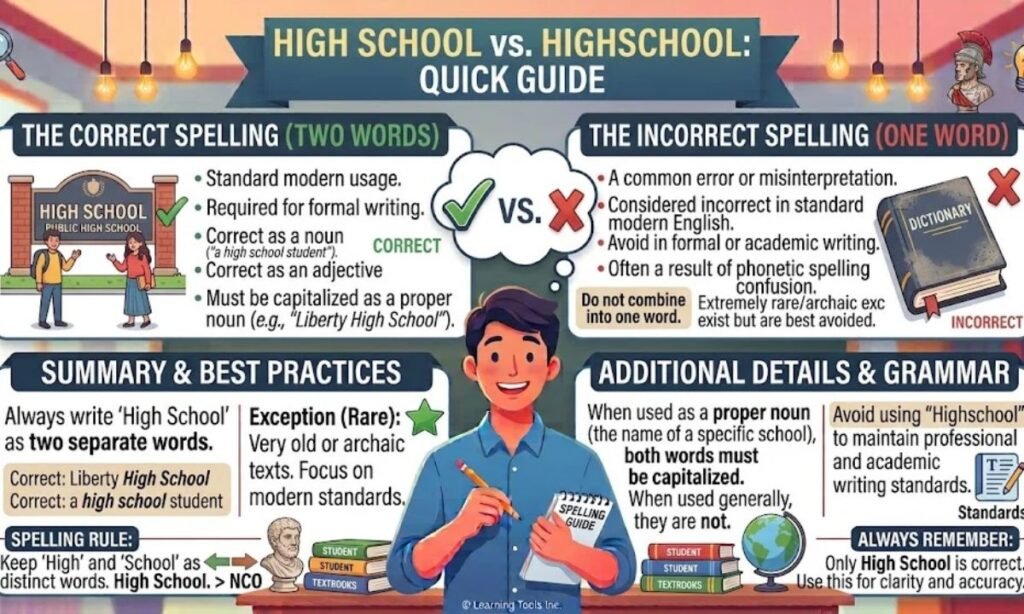
High school has not made that move in standard writing. Dictionaries and major style guides still list it as an open compound, which means two words with a space between them. Here is a simple way to see why it works: “high” describes the kind of school, and “school” is the noun. Both words stay separate, like “middle school” or “grade school.”
It helps to notice that no one writes “middleschool” or “gradeschool.” Using the same logic, “highschool” looks wrong in the same way.
High School vs Highschool at a Glance
| Feature | High school | Highschool |
| Standard English | Yes | No |
| Number of words | Two | One |
| Listed in major dictionaries | Yes | Not as a standard spelling |
| Works in school and work writing | Yes | No |
| Matches similar terms | middle school, grade school | No match |
| Example | She starts high school in fall. | ~~She starts highschool in fall.~~ |
If you only remember one line, remember this: space between the words, every time.
Is “Highschool” Ever Correct?
Not in regular writing, with a few small exceptions:
- Names and brands. Some businesses, apps, or usernames choose “Highschool” as a style choice. If it is part of an official name, copy it exactly as written.
- Titles and hashtags. Social media tags often drop spaces, as in #highschoolmemories. That is a hashtag style, not a spelling rule.
- Casual texting. People type fast, and the space can vanish. It is understandable, but it is still a mistake in formal writing.
For essays, resumes, emails, news writing, and applications, use high school.
Should You Use a Hyphen: High-School?
Usually, no. This is where many writers get stuck, so here is a clean rule.
Many compound adjectives take a hyphen before a noun, such as “well-known author.” But high school is already a well-established noun phrase, and most style guides do not add a hyphen when it comes before another noun.
- Correct: a high school student
- Correct: a high school diploma
- Correct: high school sports
- Usually avoided: a high-school student
You may still see “high-school” in older writing or in some publications with their own house style. If you work for one, follow its style guide. Otherwise, keep the two words open and unhyphenated.
High School vs High Schooler
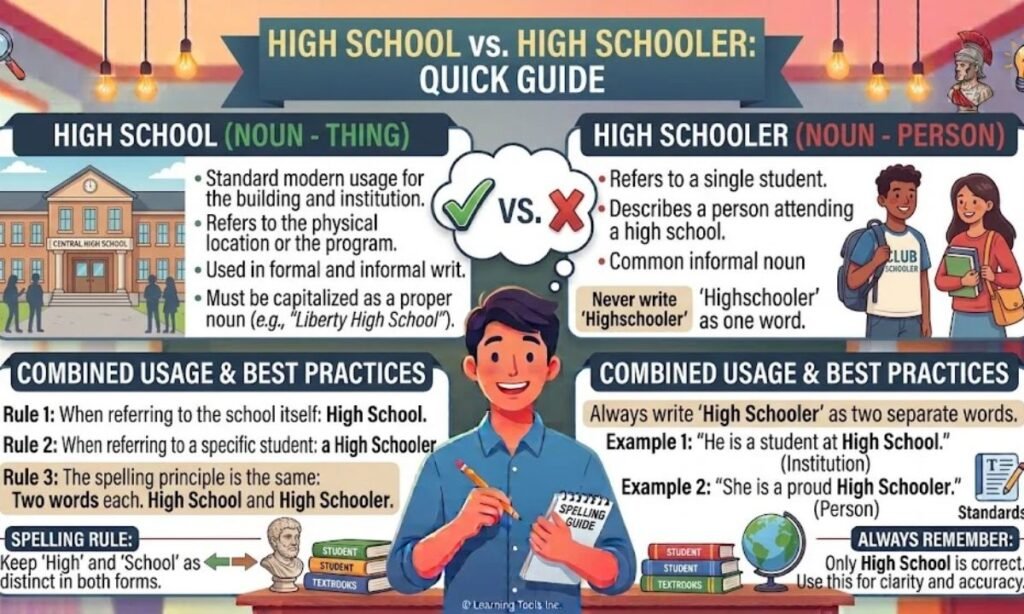
Here is a small bonus that competitors often skip. A high schooler is a student who attends high school. It is a casual noun and is written as one word.
- High school is the place or the stage of education.
- High schooler is the person.
Example: “Every high schooler at our school takes a health class.” In more formal writing, you can say “high school student” instead, which is clear and neutral.
When to Capitalize High School
Another common question is about capital letters.
Lowercase it when you mean the general type of school:
- She teaches at a high school in her hometown.
- Most high schools offer sports and clubs.
Capitalize it when it is part of a school’s official name:
- Lincoln High School
- Roosevelt High School
Notice that “School” is capitalized only inside the proper name. That also applies to the phrase “Class of 2026 at Jefferson High School.”
Is It “In High School” or “At High School”?
Both can appear, but they lean differently.
In American English, people usually say in high school when talking about that period of life:
- I played guitar in high school.
- She made great friends in high school.
They use at for a specific school:
- He studied at Lincoln High School.
- The game is at the high school tonight.
British and some other English speakers more often say “at school” or “at secondary school,” and “at high school” can sound natural there too. If your audience is American, follow the in pattern for the time of life.
High School Examples in Real Sentences

Seeing the term in context helps it stick.
In emails:
- I graduated from high school in 2018 and then started college.
- Please send a copy of your high school transcript.
On applications and resumes:
- High school diploma, Central High School
- Captain of the high school debate team
In news writing:
- A local high school announced a new science program.
- Hundreds of high school seniors attended the career fair.
On social media:
- Found my old high school yearbook and cannot stop laughing.
- Throwback to my high school graduation day.
In daily conversation:
- My brother is a high school teacher.
- We lived near the high school when I was little.
Is “High School” British or American?
The term is most closely linked to the United States, where it is the standard name for secondary school after middle or junior high.
In the UK, most students attend a secondary school. The term high school still appears there, mainly in school names (many in Scotland use it) and in some regions. So you will not see it as the general British word for secondary education, but you will see it in names.
Secondary school is also a broader term used around the world. In the U.S., it can include both middle school and high school, though many people use it as a general word for the grades after elementary school.
Common Mistakes With High School
Most mistakes come from a handful of habits.
- Writing it as one word. “Highschool” is the top error. Add the space.
- Adding a hyphen before a noun. “High-school student” is usually unnecessary.
- Over-capitalizing. Write “my high school,” not “my High School,” unless it is a proper name.
- Copying online spelling. Hashtags, usernames, and text messages can teach the wrong habit.
- Mixing it up with “high schooler.” Keep “school” for the place and “schooler” for the person.
Quick Practice: Test Yourself
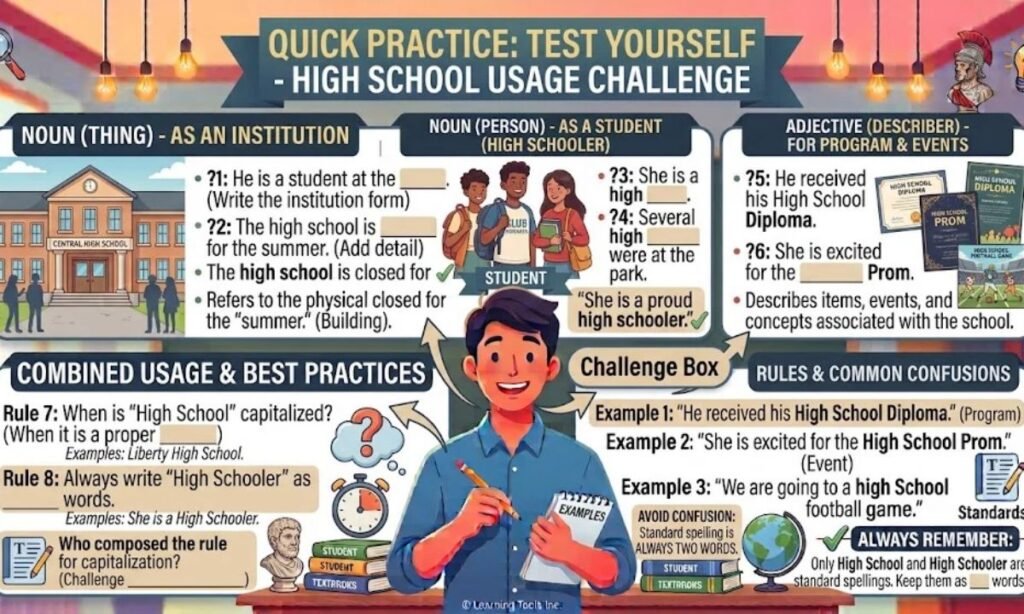
Choose the correct version for each sentence. The answers are below.
- She is a (high school / highschool) senior.
- He earned his (high school / highschool) diploma last June.
- My cousin plays on the (high school / highschool) soccer team.
- We graduated from Lincoln (high school / highschool) together.
- A new (high school / highschool) opened downtown.
Answers: All five use high school.
Frequently AskedQuestions
Is it spelled highschool or high school?
It is spelled high school, as two words. “Highschool” is nonstandard and is not accepted in formal writing.
What is the difference between secondary school and high school?
Secondary school is a broad term for schooling after elementary or primary school. High school is the common American name for the later years of secondary school, usually grades 9 through 12. In the UK, “secondary school” is the usual term.
Is high school British or American?
The term is mainly American as a general word for the upper secondary grades. It also appears in school names in the UK and other countries, but the UK usually says “secondary school.”
Is it “at high school” or “in high school”?
In American English, say “in high school” for the period of your life, such as “I ran track in high school.” Use “at” with a specific school, such as “at Lincoln High School.”
Conclusion
The high school or highschool question has a simple answer: write high school as two words. Skip the hyphen before a noun, lowercase it for general use, and capitalize it only inside a school’s proper name. Once you connect it to “middle school” and “grade school,” the space starts to feel natural.