
Picture this: you are texting a friend about your weekend, and the word you need stops you cold. Many or meny? Both look plausible, because the first vowel sounds like an “e.” That small gap between sound and spelling trips up native speakers and learners alike, and it can sneak into emails and school papers. Here is the good news: the answer is quick, and there is a neat trick that makes it stick. Let’s sort out many or meny once and for all.
Is “Meny” a Real Word?
Not in standard English. If you type “meny” in an English sentence, it is a spelling mistake, and a spellchecker will usually flag it.
That said, “meny” is a real word in other languages. In Swedish and Norwegian, for example, meny means “menu.” So if you searched for the meny meaning and landed on a restaurant page, that is why. In English, though, the word you want for “a large number” is always “many.”
What Does “Many” Mean?
The meaning of many is simple: a large or unspecified number of people or things. It points to things you can count.
| Use | Meaning | Example |
| Determiner | A large number of (before a plural noun) | Many students passed the test. |
| Pronoun | A large number of people or things | Many of them arrived early. |
| Noun | The majority of ordinary people | Good policy should help the many, not only the few. |
In grammar terms, “many” belongs with countable nouns that are plural, such as books, cars, ideas, and friends.
Why Is “Many” Spelled With an “A”?
This is the question behind most searches. The word sounds like MEN-ee, so the “a” feels out of place. English spelling often keeps old letters even after the sound shifts, and “many” is one of those words.
Here is the trick that fixes it. Look at the word any. It is pronounced EN-ee, and it is spelled with an “a.” Now add an “m” to the front:
- any + m = many
Both words use “a” to make an “e” sound, and they even rhyme. If you can spell “any,” you can spell “many.” This is the easiest memory aid you will find, and it works every time.
A second tip: say the word slowly and separate it into two parts, man and y. The first part looks like the word “man.” Many people find that picture helpful.
Why Do People Write “Meny”?
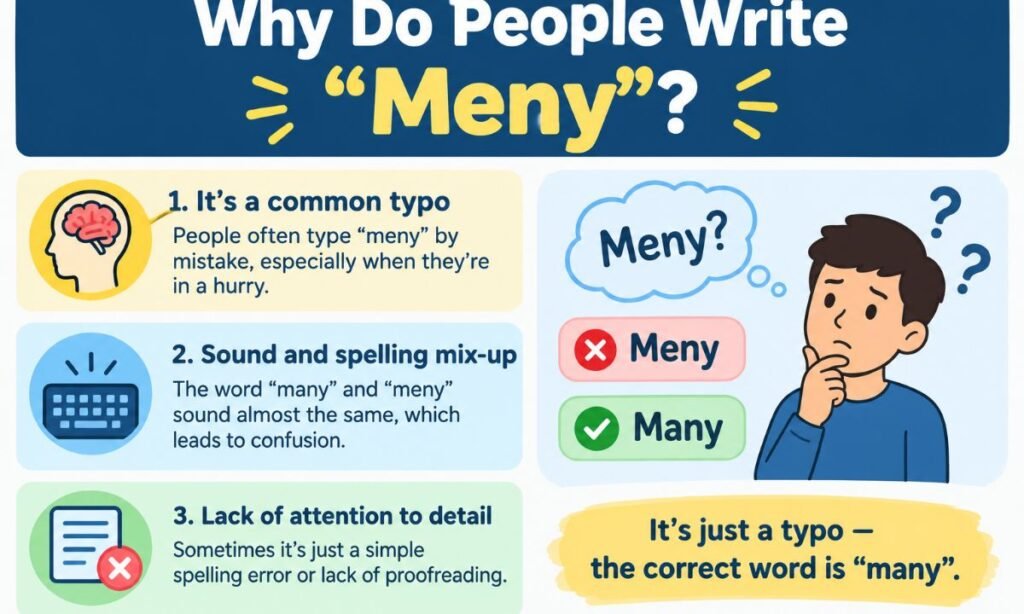
This error has clear causes, and none of them mean you are a weak speller.
- Sound over spelling. The vowel sounds like “e,” so writers spell what they hear.
- Phonetic spelling habits. Many learners and young writers spell by sound first, which works for plenty of English words but not this one.
- Fast typing. On a phone, a quick tap can swap a key.
- Other languages. Writers who know a language where “meny” is a real word may carry the spelling over.
Once you know the reason, you can catch the error in your own writing before anyone else does.
Many in Real Sentences
Seeing the word in action helps the spelling feel normal. Here are examples from several settings.
In everyday life:
- How many eggs do we need?
- There are many ways to make this recipe.
In emails:
- Many thanks for your quick reply.
- We received many questions about the new schedule.
On social media:
- So many good songs came out this year.
- Not many people know about this hidden cafe.
In school and academic writing:
- Many researchers agree that sleep affects memory.
- The essay lists many causes of the war.
In business writing:
- Many of our clients prefer weekly updates.
- The report covers many topics, from budgets to hiring.
The spelling never changes, whether the setting is casual or formal.
Many vs Much: Which One Do You Need?
This is the other big question people ask, and it connects directly to the spelling. The two words mean similar things, but they work with different kinds of nouns.
| Word | Used with | Example |
| Many | Countable nouns (plural) | How many apples are left? |
| Much | Uncountable nouns | How much water is left? |
So, is it “much money” or “many money”? The correct form is much money, because money in general is uncountable. But you would say many dollars, because dollars are countable. The same logic applies to other words: “much time” but “many hours,” “much advice” but “many tips.”
Here is a related pair. Use fewer with “many” things (fewer cars) and less with “much” things (less traffic).
How “Many” Works in Grammar
A few small rules will help you use the word with confidence.
- In questions: “How many people are coming?” This is the most natural place for “many.”
- In negatives: “I do not have many friends here.”
- In positive statements: “Many” works fine, though it can sound a bit more formal. In casual speech, people often say “a lot of” instead: “I have a lot of friends here.”
- With “a great many” or “a good many”: These are older or more formal forms. “A great many people attended.”
- With “many a”: A literary form followed by a singular noun. “Many a student has made this mistake.”
- Comparisons: The comparative is more and the superlative is most. We do not say “manier” or “maniest.”
These patterns cover nearly every situation you will meet in real writing.
Common Phrases and Expressions With “Many”
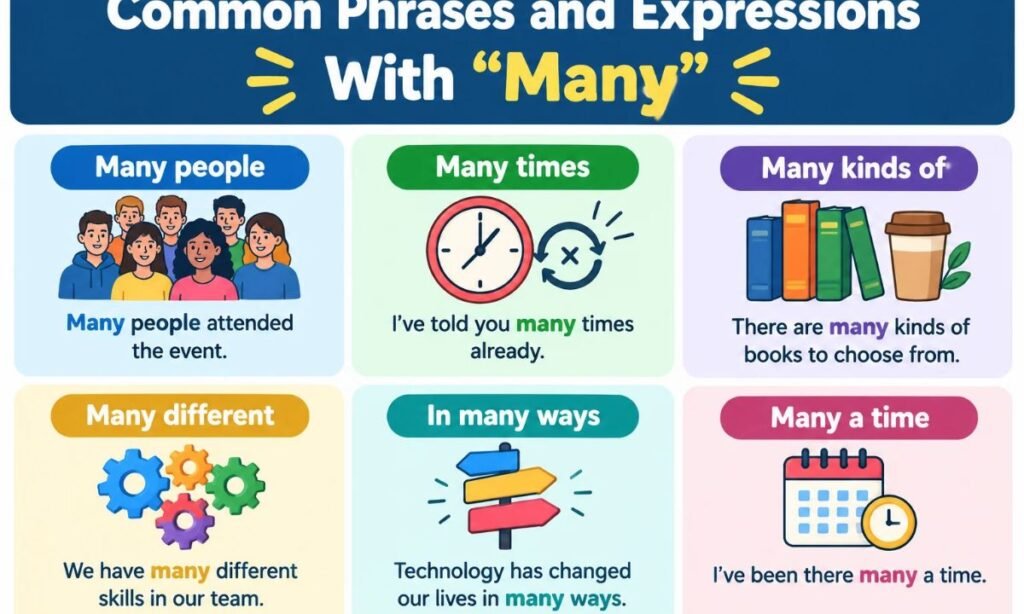
“Many” shows up in a lot of well-known phrases. These are good to read once so the spelling becomes automatic.
- Many thanks: a warm way to say thank you.
- Many happy returns: a birthday wish.
- Too many cooks spoil the broth: too many people working on one task can ruin it.
- Many hands make light work: a big group can finish a job quickly.
- One too many: more than is wise, often used about drinks.
- How many times: a common way to ask about repetition.
- As many as: used to stress a large number, as in “as many as fifty guests.”
Each of these uses the same spelling.
Where Does the Word “Many” Come From?
“Many” has a long history in English. It comes from the Old English word manig, which meant “many” or “numerous.” Over centuries, the pronunciation shifted, and the spelling changed along with it until it settled into the modern form.
This explains the odd “a.” The letter stayed in place while the sound moved toward “e.” Words like “any” followed a similar path. That is a helpful reminder that English spelling often reflects old pronunciation rather than the way we speak now.
British vs American Spelling of “Many”
There is no difference between British and American English for this word. Both write “many,” and both pronounce it MEN-ee.
If you are choosing between regional styles for other words, such as “color” and “colour,” you still do not need to adjust “many.” It stays the same everywhere, so you can use it with confidence in a global audience.
Common Mistakes With “Many”
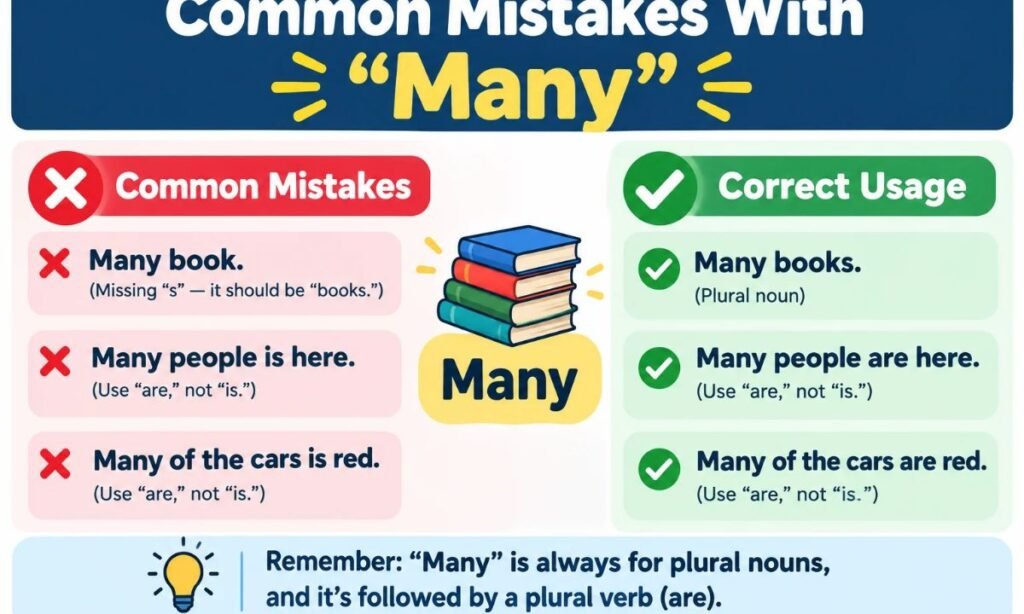
Look for these slips before you press send.
- Writing “meny.” The most common error, with an “e” in place of the “a.”
- Using “many” with uncountable nouns. Say “much water,” not “many water.”
- Using “much” with plural countable nouns. Say “many books,” not “much books.”
- Making up a comparative. There is no “manier.” Use “more.”
- Mixing “many” and “money” in typos. The words look alike on a fast screen, so reread important lines.
A quick check helps: search your draft for “meny.” If anything appears, change the “e” to an “a.”
Frequently Asked Questions
Is it many or meny?
It is many. The word is spelled with an “a” after the “m.” “Meny” is a misspelling in English and is not accepted in standard writing.
Why does “many” sound like it should be spelled “meny”?
Because the “a” in “many” is pronounced like a short “e,” as in “any.” English spelling often keeps older letters even after the sound changes, so the spelling and the sound do not match.
Does “meny” exist in any language?
Yes. In Swedish and Norwegian, “meny” means “menu.” It is not an English word, so it should not appear in English text unless you are quoting another language.
What is the difference between “many” and “much”?
Use many with countable plural nouns, such as “many cars.” Use much with uncountable nouns, such as “much traffic.” For money, the standard phrase is “much money,” while “many dollars” is also correct.
Final Thoughts
The answer to many or meny is simple: always write many. The word is spelled with an “a” for historical reasons, and the same pattern shows up in “any.” Keep the “m plus any” trick in mind, remember that “many” goes with countable nouns, and let “much” handle the uncountable ones. A quick proofread for the “meny” slip will keep your emails, essays, and posts clean.

Alexander John grammar content writer with 4 years of experience creating accurate, engaging, and SEO-friendly content. I specialize in spelling differences, commonly confused words, vocabulary, grammar rules, and writing tips. My goal is to simplify English for learners through clear explanations, practical examples, and helpful articles.
Pingback: Halves or Halfs: Which Spelling Is Correct?
Pingback: Cocoon: Meaning, Definition, Examples, and Uses
Pingback: Career: Meaning, Definition, Examples, and Correct Usage
Pingback: BabyChiefDoit Age, Real Name, Height & Biography (2026)