
You have been asked to say a few words at a wedding, a graduation, or a team lunch, and you open a blank document to type the title. Then your cursor stops. Is it speach or speech?
That small vowel choice can undercut a polished toast before anyone hears a word of it. Do not worry, because the speach or speech question has a quick answer, and a simple memory trick will lock in the right spelling.
What Does “Speech” Mean?
Speech has several related meanings, and most of them connect back to the idea of spoken words.
- A formal talk to an audience: a graduation speech, a wedding speech
- The ability to speak: a child’s early speech, speech after a stroke
- A way of speaking: slurred speech, clear speech
- Spoken language in general: the difference between speech and writing
The word is a noun, so it names a thing. You can give a speech, practice a speech, or listen to a speech.
It is pronounced SPEECH, with one syllable. The vowel sounds the same as in “beach,” “teach,” and “reach.” Only the spelling hides the sound in two letters, ee.
Is “Speach” a Real Word?
No. Speach does not appear as a standard word in major English dictionaries. If you type it into a dictionary search, you will usually be pointed to speech.
The spelling is the same in American and British English, so there is no regional exception. A writer in New York and a writer in London both spell it speech.
You may still see “speach” in:
- Rushed messages and social media captions
- Handwritten notes
- Usernames or stylized names chosen on purpose
None of those make it correct. In school work, work emails, and anything you publish, use speech.
Why Is It “Speech” and Not “Speach”?

The confusion has an understandable cause. The verb speak is spelled with ea, so many people assume the noun must be spelled the same way. It feels logical, but English spelling does not always follow logic.
Here is the short history. Both words come from Old English and share a root, but over the centuries their spellings settled in different ways. Speak ended up with ea. Speech ended up with ee. The sound is the same in both, which is why your ear cannot help you here.
Think of it as a family resemblance rather than an exact match. The two words are related, yet each one went its own way in spelling.
| Word | Part of speech | Vowel spelling | Example |
| speak | Verb | ea | I will speak first. |
| speech | Noun | ee | My speech is two minutes long. |
If you want to know why this happens, the honest answer is that English spelling grew over many centuries, and not every word followed the same path. The practical fix is to memorize each word once, and the tricks below help.
Speech vs Speak: What Is the Difference?
This is one of the most common related questions, so here is a clear answer.
Speak is a verb. It describes the action of using your voice to say words. Speech is a noun. It names the result, the words you say, or the formal talk you give.
| Word | Job | Example sentence |
| speak | Action | She will speak at the meeting. |
| speaker | The person | The speaker thanked the audience. |
| speech | The thing spoken | Her speech made everyone laugh. |
| speechless | Without words | I was speechless after the news. |
Notice that every form built from the noun keeps the ee: speech, speeches, speechless. Every form built from the verb keeps the ea: speak, speaking, speaker.
How to Pronounce Speech and Make It Plural
Pronunciation: SPEECH (one syllable, rhymes with beach). The “ch” at the end sounds like the “ch” in “church.”
Plural: The plural is speeches. Because the word ends in “ch,” English adds es, just as it does with church (churches), watch (watches), and beach (beaches).
- The president gave two speeches today.
- Her best speeches were short and funny.
Two plural mistakes show up often:
- “speechs” (missing the extra e)
- “speaches” (wrong vowel spelling)
The correct form is always speeches.
Speech in a Sentence: Real-Life Examples

Examples help the correct spelling feel normal. Here are sentences you might actually write or read.
At school
- Our teacher asked us to write a three-minute speech.
- She practiced her speech in front of the mirror.
At work
- The CEO’s opening speech set the tone for the conference.
- I need help trimming my speech before the meeting.
At events
- The best man’s speech made the whole room laugh.
- The mayor gave a short speech at the ribbon cutting.
In everyday life
- His speech was slow because he was tired.
- I lost my speech when I saw everyone looking at me.
In emails and messages
- Can you send me the final text of the speech?
- Thanks for the kind words in your speech last night.
Common Phrases That Use “Speech”
The word shows up in many fixed expressions. Seeing it in these phrases reinforces the spelling.
- Freedom of speech: the right to express your opinions
- Free speech: a shorter way to say the same thing
- Figure of speech: a phrase used in a non-literal way, like “it’s raining cats and dogs”
- Parts of speech: nouns, verbs, adjectives, and other word categories
- Direct speech: the exact words someone said, in quotation marks
- Indirect speech: a report of what someone said, without quotation marks
- Speech therapy: treatment for speech and language difficulties
- Speech recognition: technology that turns spoken words into text
- Speech bubble: the shape that holds spoken words in comics
Each of these keeps the spelling speech, so they make useful reminders.
Common Spelling Mistakes With Speech
Most errors are small, and most follow a pattern.
| Wrong | Right | Why it goes wrong |
| speach | speech | Copying the “ea” from speak |
| speachless | speechless | Same vowel mix-up |
| speaches | speeches | Wrong vowel plus plural |
| speechs | speeches | Missing the extra e in the plural |
| speeche | speech | Extra e at the end |
| speetch | speech | Spelling by sound |
Another quick trap is mixing up speech and speak in a sentence. “She will speech tomorrow” is wrong. It should be “She will speak tomorrow” or “She will give a speech tomorrow.”
Easy Ways to Remember the Spelling
Pick whichever trick works for you.
- Free speech: The word “free” has two e’s, and so does the word “speech.” Picture a banner reading FREE SPEECH.
- Two e’s, like “sweet”: Sweet speech and sweet sleep both have ee.
- Noun versus verb: The verb speak keeps ea. The noun speech takes ee. Say it out loud once: “I speak, then I give a speech.”
- Count the e’s: Speech has two e’s side by side. If you only see one, add the second.
- Type it three times: Muscle memory is real, and it helps.
How to Write a Speech: A Simple Structure
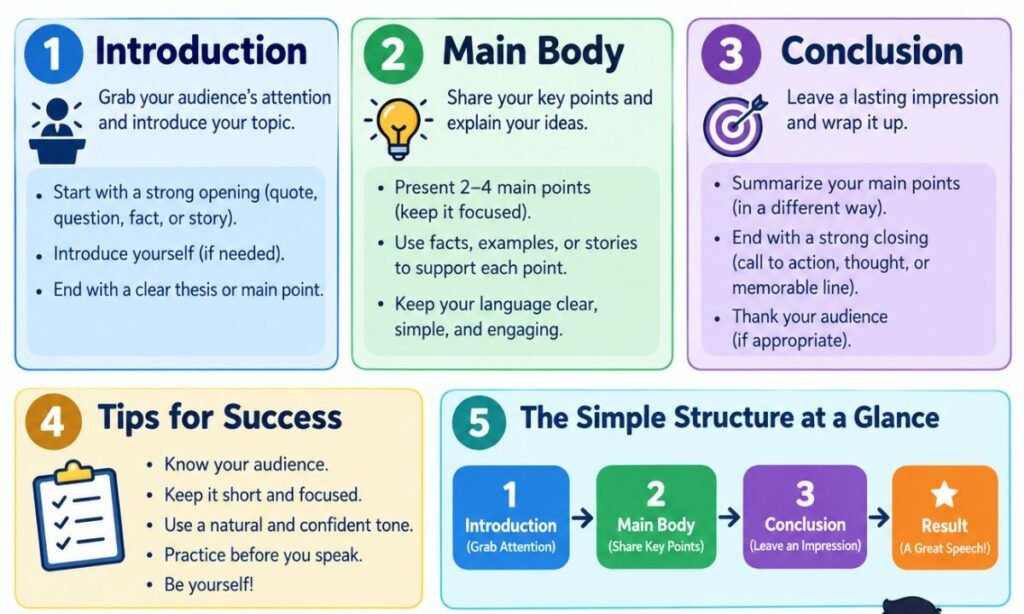
Since many searchers land here while writing one, here is a short, practical outline you can follow.
- Know your audience and your time limit. A two-minute toast and a ten-minute talk need different plans.
- Open with a hook. Start with a short story, a question, or a surprising fact that you can verify.
- Make two or three main points. Audiences remember short lists better than long ones.
- Use simple words. Write the way you talk. Read each line aloud.
- End with a clear closing. Finish with a thank-you, a call to action, or a memorable line.
- Practice out loud. Timing and flow only show up when you say the words.
Keep sentences short, because listeners cannot reread a spoken line the way readers can.
Frequently Asked Questions
Is it speach or speech?
It is speech. The spelling speach is a mistake and is not accepted in standard English, whether you write in American or British style.
Why is it speech and not speach?
The verb speak uses ea, but the noun speech settled into the ee spelling over time. English spellings follow history rather than a single rule, so each word has to be learned on its own.
What does speech mean?
Speech means the act of speaking, the ability to speak, or a formal talk given to an audience. It also names the way someone talks, such as “clear speech.”
What is the plural of speech?
The plural is speeches. Words that end in “ch” add es, so speech becomes speeches, just like church becomes churches.
Final Thoughts
The speach or speech question has a clear winner. Speech is the correct, dictionary-approved spelling, and it uses a double e, as in free speech. Keep the verb speak and the noun speech in separate boxes in your mind, and remember the plural speeches, and you will not hesitate again.
Now go write that toast. Your spelling is ready, and the rest is just practice.

Alexander John grammar content writer with 4 years of experience creating accurate, engaging, and SEO-friendly content. I specialize in spelling differences, commonly confused words, vocabulary, grammar rules, and writing tips. My goal is to simplify English for learners through clear explanations, practical examples, and helpful articles.