
You are filling out a form for an overseas client, and the line reads “authorized signatory.” Your colleague in London writes “authorised signatory” in the same document. Both look right, yet one might look odd to the person who reads it. Which one should stay?
The authorized or authorised question trips up careful writers because neither spelling is wrong. The answer depends on who is reading, and this guide shows you how to choose with confidence.
What Does “Authorized” Mean?
Authorized describes something or someone that has official permission, approval, or power to act. It comes from the verb authorize, which means “to give official permission for” or “to give someone the right to do something.”
You will see the word in many everyday settings:
- Authorized personnel only: only approved people may enter
- An authorized dealer: a seller approved by the brand
- An authorized signatory: a person with the power to sign for a company
- An authorized payment: a payment that has been approved
The spelling does not change the meaning. Authorised carries the exact same sense, and both are pronounced the same way: AW-thuh-rized.
Authorized vs Authorised: American and British Spelling
The only difference is the letter in the ending. American English uses z, and British English commonly uses s.
| Feature | Authorized | Authorised |
| Spelling style | American English | British English |
| Ending | -ized | -ised |
| Meaning | Officially approved | Officially approved |
| Pronunciation | AW-thuh-rized | AW-thuh-rized |
| Typical regions | United States, Canada | U.K., Australia, New Zealand |
| Noun form | authorization | authorisation |
| Opposite | unauthorized | unauthorised |
Canadian writers usually follow the -ize pattern, while Australian and New Zealand writers usually follow the -ise pattern. Style guides vary, so check your organization’s rules when accuracy matters.
Why Are There Two Spellings?
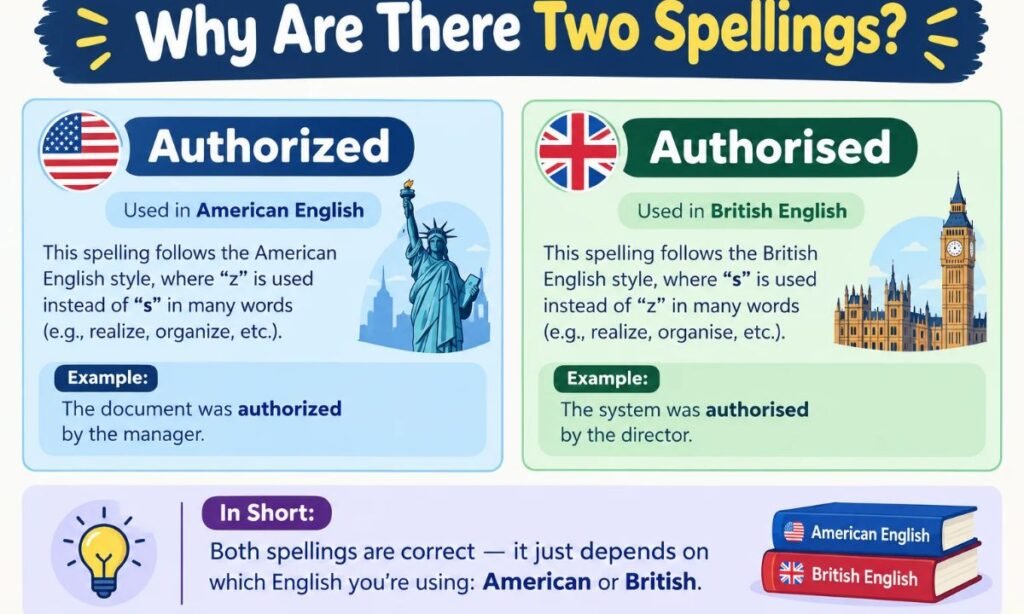
The ending -ize traces back to Greek, and it passed into English through Latin and French. For a long time, English writers used -ize widely. Over the years, British writers increasingly adopted -ise, partly through the influence of French spellings, and it became the usual choice in the U.K.
American spelling later settled on -ize as its standard, which is one of the reforms that made American spelling distinct from British spelling.
There is a useful twist here. In Britain, -ize is not a mistake. Some British publishers and academic presses, including Oxford University Press in its house style, use -ize spellings. People sometimes call this “Oxford spelling.” So seeing authorized in a British document does not always signal an American writer.
For everyday British writing, though, authorised is the common form.
Which Spelling Should You Use?
Choose the spelling that matches your readers, not your own habit. This quick guide covers most cases.
| Your situation | Use |
| Writing for a U.S. audience | authorized |
| Writing for a U.K. audience | authorised |
| Writing for Australia or New Zealand | authorised |
| Writing for Canada | authorized |
| Writing for a global audience | authorized, or follow your brand style guide |
| Following a company or school style guide | Whatever the guide says |
| Writing software, code, or technical documents | authorized is the usual convention |
A small technical note: web standards use the American spelling in places, such as the “Authorization” header in web requests. That is one reason many technical writers stick with the -ize form.
Most important, stay consistent. Do not use authorized in one paragraph and authorised in the next.
Authorize, Authorized, Authorization: Word Forms
Every form of the word follows the same pattern. Change the z to s for British spelling, and the rest stays the same.
| American | British | Part of speech |
| authorize | authorise | Verb |
| authorized | authorised | Verb (past) or adjective |
| authorizing | authorising | Verb (-ing form) |
| authorization | authorisation | Noun |
| unauthorized | unauthorised | Adjective |
| authorizer | authoriser | Noun (person or thing) |
So if you choose authorized, you also choose authorization and unauthorized. If you choose authorised, you also choose authorisation and unauthorised.
Other Words With the Same Pattern
The same z versus s difference appears in many other words. If you learn the rule once, you can apply it widely.
| American | British |
| organize | organise |
| recognize | recognise |
| realize | realise |
| apologize | apologise |
| customize | customise |
| summarize | summarise |
| criticize | criticise |
Some words end in -ise in both American and British English, so do not change them. Examples include advise, revise, supervise, surprise, exercise, and comprise. Only change the ending when the word is a true -ize or -ise variant pair.
Another pattern to know: analyze in American English becomes analyse in British English. That one uses -yse, not -ise, so treat it as its own case.
Authorized in a Sentence: Real-Life Examples
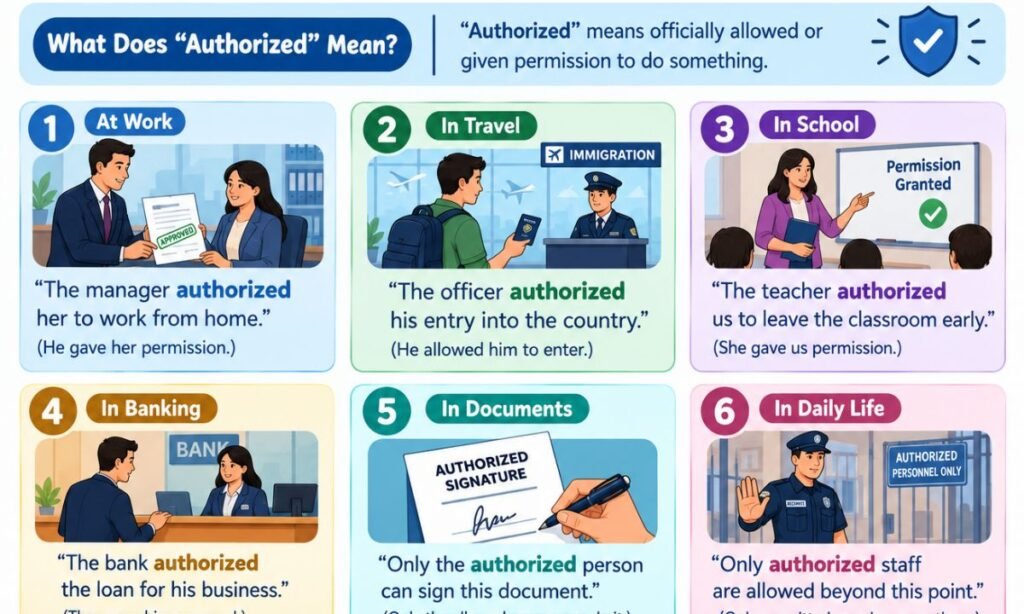
Seeing the word in context helps you pick the right spelling and keep it consistent.
In business and finance
- Only authorized employees can approve expenses over $5,000. (American)
- The bank blocked the transfer because it was not authorised. (British)
In shopping and customer service
- This store is an authorized dealer for the brand.
- Please buy from an authorised retailer to keep your warranty.
In security and access
- Authorized personnel only beyond this door.
- The system rejected the login because the user was not authorised.
In school and legal contexts
- The principal authorized the field trip last week.
- The court authorised the release of the documents.
In everyday messages
- Did you authorize that charge on my card?
- I have not authorised anyone to use my account.
Synonyms and Opposites
When you want variety, or when the word feels too stiff, these options help.
Synonyms for authorize:
- approve
- permit
- allow
- sanction
- license
- empower
- endorse
Opposites:
- forbid
- prohibit
- ban
- deny
- refuse
For the adjective, the opposites are unauthorized (American) and unauthorised (British). Both mean “without official permission.”
Pick the closest word for your tone. “The manager approved the request” sounds friendly. “The manager authorized the request” sounds more formal and official.
Common Mistakes With Authorized or Authorised
A few slips come up again and again.
| Mistake | Fix |
| Mixing both spellings in one document | Pick one and stay with it |
| Writing “authorized” next to “organisation” | Match all words to one style |
| authorised in a U.S. business email | Use authorized for U.S. readers |
| autorized, athorized, authorzed | authorized or authorised, depending on your audience |
| authorisation next to authorized | Use authorization with authorized |
| unauthorised in an American text | Use unauthorized |
Mixing styles. This is the most common issue. A single document should follow one standard throughout. If your spell checker is set to U.S. English, it will flag authorised as a mistake. Set it to U.K. English for British writing.
Treating one spelling as wrong. Neither is an error. If you edit someone’s text, change the spelling only if it conflicts with the style guide.
Dropping a letter. Some writers type “autorized” or “authorzed” by accident. Say the word slowly, au-thor-ized, and check that every part of it made it onto the page.
Tips for Consistent Spelling in Every Document
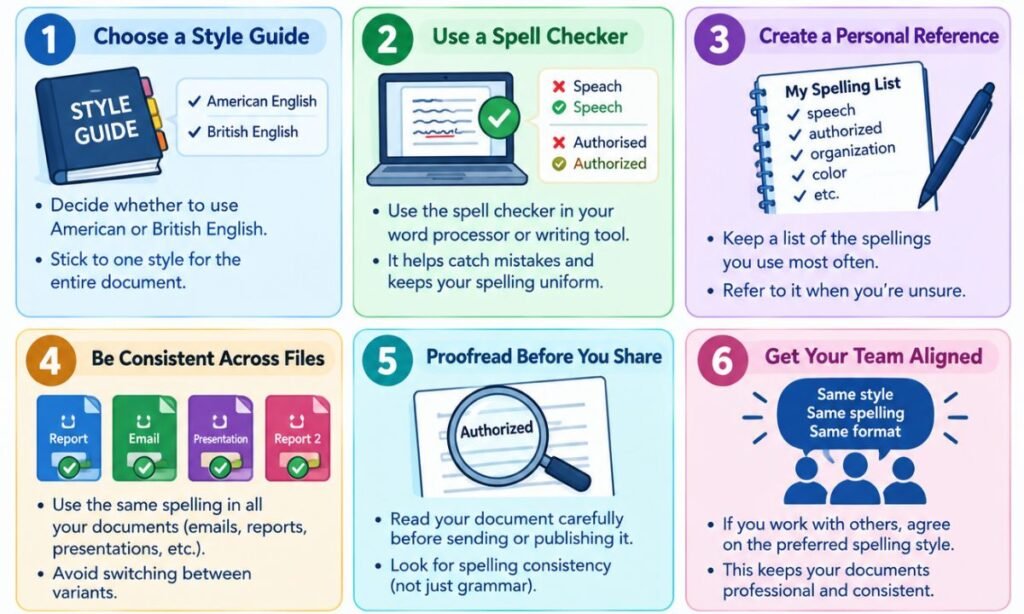
A few simple habits will save you from mixed spellings.
- Set your language. Use the proofing language that matches your audience in your word processor and browser.
- Check your style guide. Many companies, schools, and publishers have a rule already.
- Search and replace once. If you switch styles, search for “ise” and “ize” endings and update the full document.
- Watch for names. Do not change the spelling inside official titles, such as the name of an organization or a published document.
- Use one standard for global content. If your audience is international and you have no rule, American spelling is often the simplest choice, since it is widely used in software and online content.
Frequently Asked Questions
Is it authorized or authorised?
Both are correct. Authorized is the American spelling, and authorised is the British spelling. Choose the one that matches your audience and use it consistently.
Is it authorize or authorise?
It depends on your audience. Authorize is American English, and authorise is the usual British form. Both mean “to give official permission.”
What is the difference between authorization and authorisation?
There is no difference in meaning. Authorization is the American spelling, and authorisation is the British spelling. Both refer to official permission or approval.
What does authorise mean?
Authorise means to give official permission or approval for something, or to give someone the power to act. It is the British spelling of authorize.
Final Thoughts
The authorized or authorised question comes down to audience. Authorized fits American readers, authorised fits British readers, and both mean the same thing. Pick one, apply it to related words like authorization and unauthorized, and keep it steady from the first line to the last.
When in doubt, think about who will read your work, set your spell checker to match, and move on. Your meaning stays clear either way.

Alexander John grammar content writer with 4 years of experience creating accurate, engaging, and SEO-friendly content. I specialize in spelling differences, commonly confused words, vocabulary, grammar rules, and writing tips. My goal is to simplify English for learners through clear explanations, practical examples, and helpful articles.