
Picture a headline you are writing for tonight’s newsletter, or a quick note about the meeting on your calendar. You type the word, pause, and wonder about the apostrophe. Do you want todays or today’s?
One tiny mark can change how professional your writing looks, and spell checkers often let the wrong version slip by. Fortunately, the todays or today’s question has a clear answer, and a two-second test will settle it every time.
What Does “Today’s” Mean?
The word today usually names the current day. Add an apostrophe and an s, and it can do two different jobs.
1. Possessive: “of today” or “belonging to today.” This is the most common use. It connects a noun to the current day.
- Today’s meeting starts at 10 a.m.
- Today’s weather is cloudy and cool.
- Today’s top story is about local elections.
2. Contraction: “today is.” In casual writing and speech, “today is” can shrink to today’s.
- Today’s Friday, so the office closes early.
- Today’s the day I finally finish this draft.
Both uses share one spelling. That is good news, because you only have to remember one form with the apostrophe.
A quick way to tell which job the word is doing: replace it with “of today” or “today is.” If either one fits the sentence, you want today’s.
Is “Todays” Ever Correct?
In almost every sentence you will write, no.
Standard English has no everyday meaning for todays without an apostrophe. Writers usually produce it by accident, by typing fast, or by copying a pattern from plural words like “days” and “weeks.”
There is one narrow exception. Today can work as a noun, and a noun can be plural. In rare, playful, or literary writing you might see something like “all our yesterdays and todays.” That use is uncommon, and it has nothing to do with ownership or contraction. If you mean “the meeting of today,” the plural form is wrong.
The same goes for todays’, with the apostrophe after the s. That form would signal a plural possessive, which almost never applies here. Use today’s.
Why Time Words Take Apostrophes
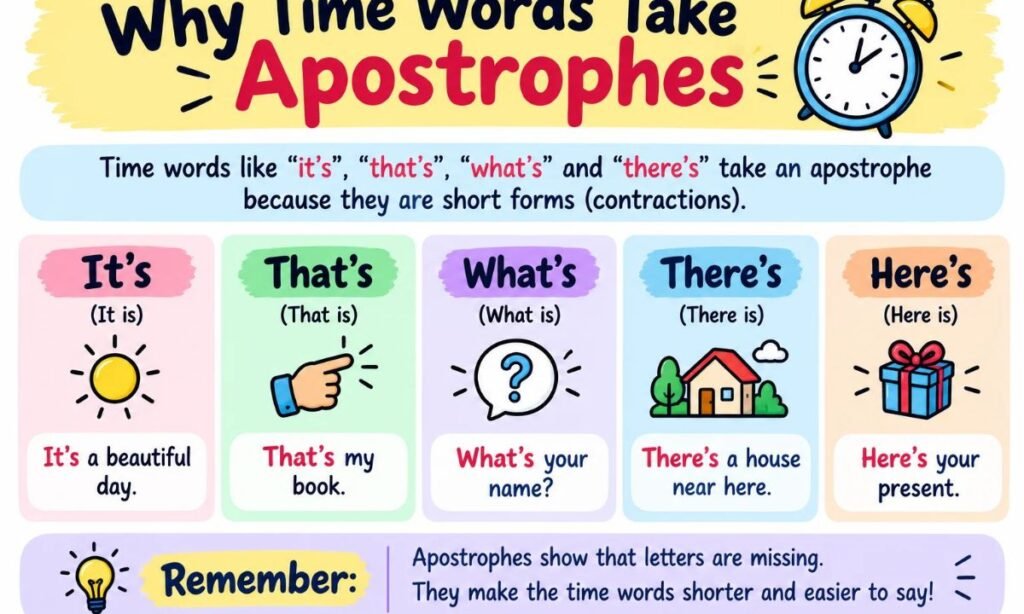
Many people think apostrophes belong only to people and pets, like “Maria’s car.” In fact, English uses the same pattern with time words. The apostrophe shows a link between the time and the noun that follows it.
| Time word | Possessive form | Example |
| today | today’s | Today’s agenda is short. |
| yesterday | yesterday’s | Yesterday’s call ran long. |
| tomorrow | tomorrow’s | Tomorrow’s forecast looks sunny. |
| tonight | tonight’s | Tonight’s game starts at seven. |
| a day | a day’s | That was a hard day’s work. |
| two weeks | two weeks’ | I need two weeks’ notice. |
If you would write “yesterday’s news” without a second thought, you already know the rule. Today’s works the same way.
Today vs Today’s vs Todays
Three forms cause most of the confusion. This table sorts them out.
| Form | Part of speech | Meaning | Example |
| Today | Noun or adverb | The current day | Today is busy. I will call you today. |
| Today’s | Possessive or contraction | Of today, or today is | Today’s lunch is pizza. |
| Todays | Not standard | Usually a mistake | Avoid in normal writing. |
The word today by itself has no apostrophe because it is not showing ownership or hiding letters. It only names the day. Add the apostrophe when the day “owns” the next noun or when you are shrinking “today is.”
Today’s Date or Todays Date?
This is one of the most searched versions of the question, and the answer is today’s date.
The date belongs to today, so the possessive form is needed.
- Please write today’s date at the top of the form.
- What is today’s date?
- Today’s date is October 25.
You can also skip the possessive and say “the date today” or “the date,” but “today’s date” is the natural choice. The same rule applies to related phrases:
- Today’s meeting (not todays meeting)
- Today’s weather (not todays weather)
- Today’s schedule (not todays schedule)
- Today’s special (not todays special)
Today’s in Real-Life Sentences
Seeing the word in context helps it stay with you. Here are examples from everyday writing.
In emails
- Please see today’s agenda attached.
- Thanks for joining today’s call.
In messages
- What is today’s plan?
- Today’s the day. Wish me luck.
On social media
- Today’s mood: coffee and deadlines.
- Sharing today’s sunset from the roof.
In news and headlines
- Today’s top stories: markets, weather, and sports.
- Today’s lesson: back up your files.
At school and work
- Today’s homework is on page 42.
- Today’s goal is to finish the report before lunch.
In shopping and restaurants
- Today’s soup is tomato basil.
- Today’s deal ends at midnight.
“Today Morning” or “This Morning”?

This question appears next to the apostrophe problem, so it is worth a quick answer.
In standard American English, people say this morning, this afternoon, and this evening. “Today morning” is common in some regions, but it sounds unusual to most American readers and may read as an error in formal writing.
| Instead of | Use |
| today morning | this morning |
| today afternoon | this afternoon |
| today evening | this evening |
| today night | tonight |
If you want to stress the day, you can write “today’s morning meeting” or “this morning’s meeting.” Both are correct and both keep the apostrophe.
Common Mistakes With Today’s
Most errors fall into a few predictable groups.
| Wrong | Right | Why |
| todays meeting | today’s meeting | The meeting belongs to today |
| todays’ meeting | today’s meeting | The apostrophe goes before the s |
| today meeting | today’s meeting | A possessive is needed before the noun |
| todays date | today’s date | The date belongs to today |
| today morning | this morning | Standard phrasing |
| Todays Friday | Today’s Friday | Contraction of “today is” |
Dropping the apostrophe before a noun. Writers type “todays agenda” because the word looks like a plural. The fix is simple: ask whether the agenda belongs to today. It does, so add the apostrophe.
Placing the apostrophe after the s. An apostrophe after the s (“todays'”) signals a plural possessive. Today is singular, so the apostrophe goes before the s.
Using plain “today” as an adjective. “Today meeting” or “today weather” sounds clipped and non-standard. English wants the possessive here.
Fast typing. On a phone, apostrophes are easy to skip. Read your message once before sending it, especially headlines, subject lines, and captions.
Easy Ways to Remember the Rule
Choose whichever trick sounds most natural.
- The “of today” test: If you can replace the word with “of today,” use today’s. “The meeting of today” becomes “today’s meeting.”
- The “today is” test: If “today is” fits, use today’s.
- The yesterday test: You would never write “yesterdays news.” Use the same logic with today.
- The noun test: If a noun follows and belongs to the day, you need the apostrophe.
Same Rule in American and British English

Both American and British writers use today’s in the same ways. The apostrophe rule does not change with the region, so there is no separate spelling to learn.
The word itself has a long history. It comes from Old English, where it began as a phrase meaning roughly “on this day.” In older printed English you may see it written with a hyphen as “to-day.” Modern standard English writes it as one word, today, and uses today’s for the possessive and the contraction.
Frequently Asked Questions
Is it todays or today’s?
It is today’s. The apostrophe shows that something belongs to today, as in “today’s meeting,” or that “is” has been shortened, as in “today’s Friday.”
Is it today’s date or todays date?
It is today’s date. The date belongs to today, so the possessive form with an apostrophe is correct.
Is todays a real word?
Not in everyday writing. Todays without an apostrophe has no standard meaning in normal sentences. It appears mostly as a typo, though it can work as a rare plural noun in creative writing.
What is the difference between today and today’s?
Today names the current day, as in “I will call you today.” Today’s shows ownership or shortens “today is,” as in “today’s schedule” or “today’s Monday.”
Final Thoughts
The todays or today’s question has a simple winner. Today’s is correct whenever the day owns a noun or stands in for “today is,” which covers almost every sentence you will write. Keep todays for the rare cases where you truly mean more than one today.
Before you hit send, run the quick test: “of today” or “today is.” If either fits, add the apostrophe and move on with your day.

Alexander John grammar content writer with 4 years of experience creating accurate, engaging, and SEO-friendly content. I specialize in spelling differences, commonly confused words, vocabulary, grammar rules, and writing tips. My goal is to simplify English for learners through clear explanations, practical examples, and helpful articles.