
You are about to send an important email, and something looks off. Is it foward vs forward, and which one belongs in your message? One wrong letter can make a polished note look rushed, and a missing “r” is easy to miss when you type fast.
The good news is that the fix takes seconds once you see the pattern. This guide shows which spelling is right, why the mistake happens, and how to never second-guess it again.
Is “Foward” a Real Word?
No. You will not find “foward” in any standard English dictionary. It is a spelling mistake that happens when the “r” in the middle of “forward” gets skipped.
It does not have a secret meaning, a regional spelling, or a British version. If you see it in a draft, treat it as a typo and fix it. This is why a search for foward meaning leads straight back to “forward.”
What Does “Forward” Mean?
The forward meaning in English depends on how the word is used. It works as an adverb, adjective, verb, and noun, which is part of why it shows up so often.
| Part of speech | Meaning | Example |
| Adverb | Toward the front or the future | She took a step forward. |
| Adjective | Located at the front, or moving ahead | The forward cabin is closed. |
| Verb | To send something on to another person | Please forward me that email. |
| Noun | A player in a front position in sports | The forward scored twice. |
One more meaning is worth knowing. As an adjective, “forward” can also describe someone who is bold or a little too direct. “That question was a bit forward” means it felt too personal.
How to Spell Forward Correctly
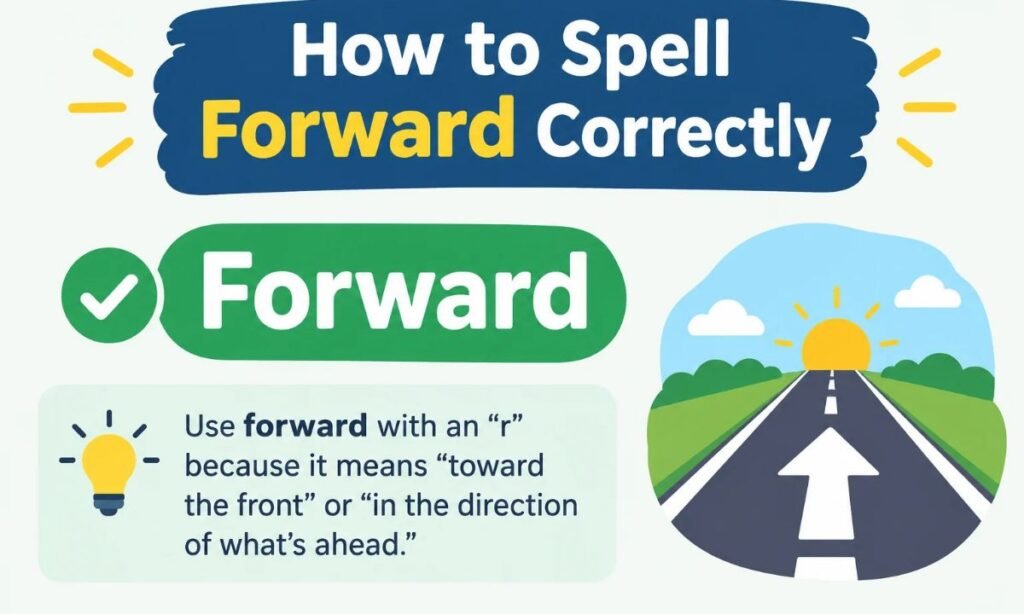
The spelling is f-o-r-w-a-r-d. Seven letters, with an “r” in the middle and an “r” near the end.
Here are a few simple ways to remember it:
- Split it in two. Think “for” plus “ward.” Both pieces are real words, and “for” already has its “r.”
- Say it slowly. You can hear “FOR” at the start. If you spell what you hear, the “r” appears.
- Picture the pair. Forward and backward both end in “ward.” Nobody writes “backwad,” so “foward” looks just as odd once you notice it.
If you want to practice, type the word five times with your eyes on the keys. It builds muscle memory fast.
Why Do People Type “Foward”?
This mistake is almost always about speed, not about not knowing English. A few reasons explain it.
- Fast typing. The “r” sits in the middle of a short word, so fingers can slip past it.
- Relaxed pronunciation. In everyday speech, many people say “forward” quickly, and the first “r” sound can get soft. The spelling then follows the sound.
- Similar patterns. Words like “toward” and “onward” are short and have one “r,” so the brain can apply the same pattern by mistake.
- Autocorrect trust. People assume their phone will fix it. It often does, but not every time.
Knowing the cause helps. If you know your fingers drop the “r,” you can proofread for it.
How to Use “Forward” in a Sentence
Seeing the word in context makes the spelling stick. Here are examples for each use.
As an adverb:
- The car rolled forward a few inches.
- Let’s move forward with the plan.
As an adjective:
- She took a forward position on the team.
- The forward section of the plane was quiet.
As a verb:
- I will forward the invoice to accounting.
- Can you forward this message to the whole team?
As a noun:
- He plays forward on the school soccer team.
- The team’s best forward was injured.
Notice that every example has the same spelling. The word never changes form, except when you add endings like “forwarded” or “forwarding.”
Look Forward To: The Phrase Everyone Types Wrong
The phrase “look forward to” is where the typo shows up most often, especially at the end of emails. The correct version is “I look forward to hearing from you.”
Here is a detail many writers miss. In this phrase, “to” is a preposition, so the word after it should be a noun or an -ing verb. That means:
- Correct: I look forward to meeting you.
- Incorrect: I look forward to meet you.
So the full correct pattern is “looking forward to seeing you,” never “looking foward to see you.” Two small errors in one line can hurt an otherwise professional message.
Forward vs Forwards
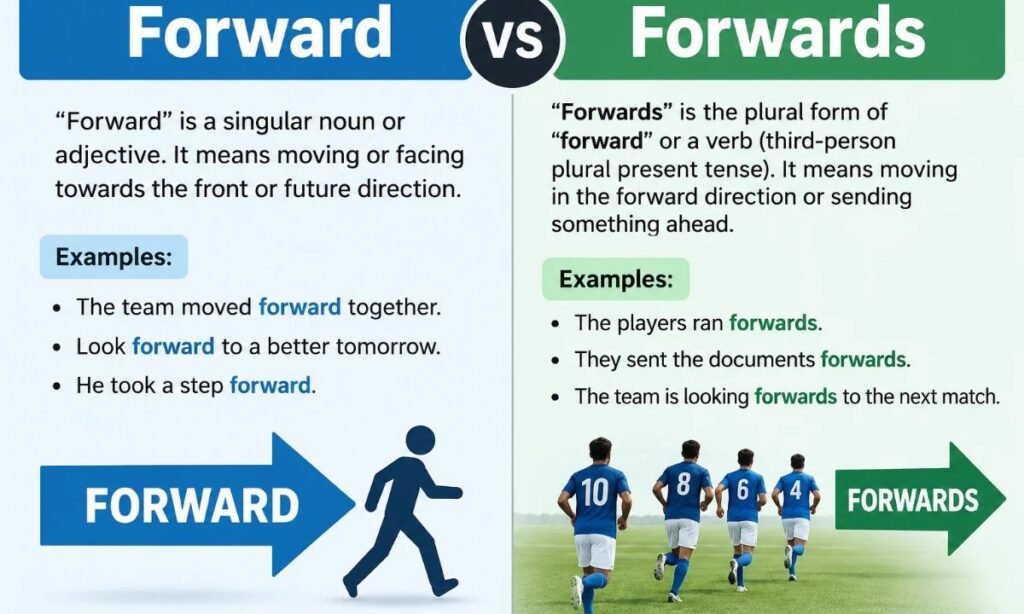
You may also see forwards and wonder if it is another typo. It is not. Both are real.
- Forward is the standard choice in American English for direction. “She leaned forward.”
- Forwards is common in British English as an adverb. “She leaned forwards.”
- Forwards is also the plural noun for players. “The team has three strong forwards.”
For most writing in the US, stick with “forward.” If you are writing for a UK audience, either form can work, but stay consistent.
Forward vs Foreword
Here is a different mix-up that has nothing to do with typos. Foreword is a real word, but it means something else entirely.
| Word | Meaning | Example |
| Forward | Toward the front, or to send on | Please forward the file. |
| Foreword | A short introduction at the start of a book | The author wrote a foreword for the new edition. |
The two sound almost the same, but they are not interchangeable. A foreword is the “word” that comes “before” the main text. If you are not talking about a book introduction, you want “forward.”
Forwarding an Email or Message Correctly
Because “forward” is so common in work settings, it helps to know the related forms.
- Forward (verb): “Please forward the report.”
- Forwarded (past tense): “I forwarded your note to Sam.”
- Forwarding (present participle): “I am forwarding the details now.”
- Forward button: the button in an email app that sends a message on to someone else.
In a subject line, you will often see “Fwd:” as a short form. That abbreviation is only a shortcut. In your own sentences, spell out the full word.
Where Does the Word “Forward” Come From?
“Forward” comes from Old English foreweard, built from “fore” (front or before) and the ending “-weard” (toward). The ending “-ward” is the same one you see in “backward,” “toward,” and “homeward,” and it carries the idea of direction.
This history is a handy reminder. The word began with “fore,” which includes an “r,” and over time the spelling settled into the “forward” we use now. So the middle “r” has been part of the word for a very long time.
Common Mistakes With Forward and Foward
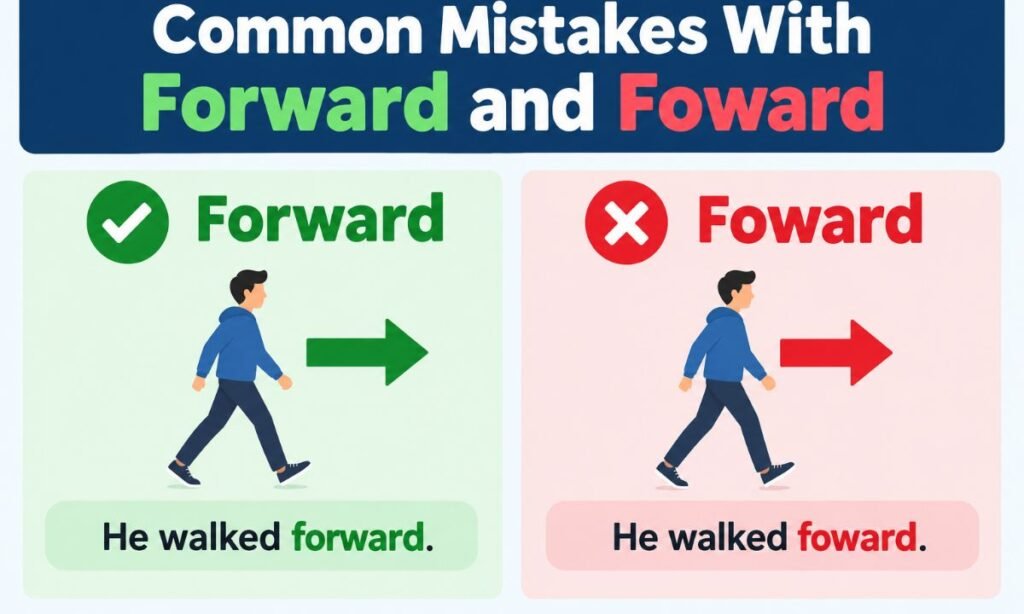
Here are the errors worth checking before you hit send.
- Missing the “r.” Writing “foward” instead of “forward.”
- Dropping letters in other forms. “Fowarded” and “fowarding” are also wrong. The correct forms are “forwarded” and “forwarding.”
- Using “foreword” by accident. This swaps in a book introduction when you meant direction or sending.
- Wrong verb after “look forward to.” Write “look forward to hearing,” not “look forward to hear.”
- Trusting autocorrect. Spellcheck can miss a typo when the surrounding words confuse it, so a quick read-through still matters.
A fast proofreading habit helps: search your draft for “fow” before sending. If anything turns up, you have found a typo.
Frequently Asked Questions
Is it spelled foward or forward?
It is spelled forward. “Foward” is a typo with a missing “r” and is not accepted in standard English.
What is the difference between foward and forward?
There is no difference in meaning, because “foward” is not a real word. It is only a misspelling of “forward.” The correct word means toward the front, ahead in time, or to send something on.
Why do people say foward instead of forward?
Mostly because of fast typing and quick, relaxed pronunciation. The “r” in the middle is easy to skip, so the typo spreads even though the word is simple.
Is it looking forward or foward?
It is looking forward. The full phrase is “looking forward to” followed by a noun or an -ing verb, as in “looking forward to seeing you.”
Final Thoughts
The answer to foward vs forward is simple: always use forward. The word has a middle “r” that comes from its old root “fore,” and it works as an adverb, adjective, verb, and noun. Keep the “for plus ward” trick in mind, watch the phrase “look forward to,” and do not mix it up with “foreword.” Do that, and your emails, messages, and documents will read clean every time.

Alexander John grammar content writer with 4 years of experience creating accurate, engaging, and SEO-friendly content. I specialize in spelling differences, commonly confused words, vocabulary, grammar rules, and writing tips. My goal is to simplify English for learners through clear explanations, practical examples, and helpful articles.
Pingback: Patient or Pacient: Which Spelling Is Correct?