
Your cover letter is ready, the job posting is live, and then you type the word that matters most: the position. Is it opening or openning? That extra “n” looks tempting, and it slips into resumes, signs, and announcements.
One wrong letter can pull a reader’s attention away from your message. This guide settles the opening or openning question fast, explains the spelling rule behind it, and gives you simple ways to get it right every time.
Is “Openning” a Real Word?
No. “Openning” does not appear in standard English dictionaries, and it has no special meaning. It is a spelling mistake that adds a second “n” where none belongs.
It is also not a British spelling or an American spelling. Both varieties of English write opening. If you are searching for the openning meaning, the answer is the same as for “opening,” because the first is only a typo of the second.
What Does “Opening” Mean?
The opening meaning in English changes slightly depending on how the word works in a sentence. It can be a noun, an adjective, or the “-ing” form of the verb “open.”
| Use | Meaning | Example |
| Noun | A gap, hole, or space | There is a small opening in the fence. |
| Noun | A job vacancy | The company has an opening in sales. |
| Noun | The start of something | The movie has a slow opening. |
| Adjective | Coming first, at the start | She gave the opening speech. |
| Verb form | Present participle of “open” | The store is opening at nine. |
Because it does so many jobs, “opening” is a word you will write often. That makes the correct spelling worth locking in.
The Spelling Rule Behind “Opening”
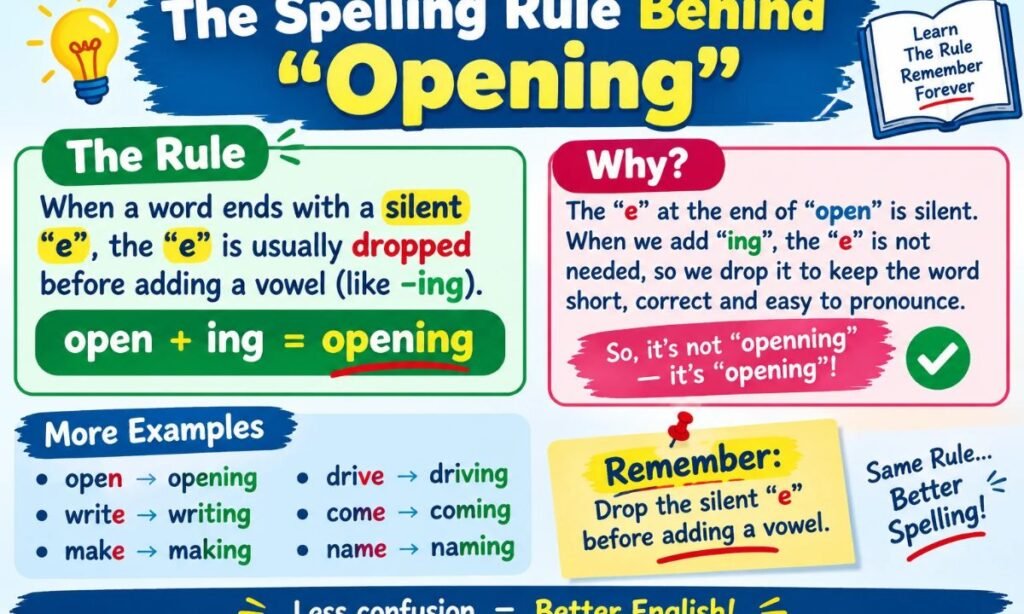
Many English verbs double their last letter before “-ing.” So why not “open”? The answer comes down to where the stress falls.
The rule has two parts:
- If a verb ends in one vowel plus one consonant, and the stress is on the last syllable, double the consonant.
- If the stress is on an earlier syllable, do not double it.
Say “open” out loud. The stress lands on the first syllable: O-pen. The final syllable is weak, so the “n” stays single. That is why the spelling is opening.
Now compare a verb like “begin.” The stress is on the last syllable: be-GIN. So the “n” doubles, and you get “beginning.” Same ending, different stress, different result.
Doubling vs Not Doubling: A Quick Comparison
This table shows how the stress pattern changes the spelling. Keep it handy if “-ing” endings ever trip you up.
| Verb | Stressed syllable | Add -ing | Doubles? |
| open | first (O-pen) | opening | No |
| happen | first (HAP-pen) | happening | No |
| listen | first (LIS-ten) | listening | No |
| visit | first (VIS-it) | visiting | No |
| begin | last (be-GIN) | beginning | Yes |
| prefer | last (pre-FER) | preferring | Yes |
| permit | last (per-MIT) | permitting | Yes |
If you remember only one thing, remember this: “open” belongs in the first group. It behaves like “listen” and “happen,” not like “begin.”
Why Do People Write “Openning”?
This mistake is understandable. A few common causes explain it.
- The “begin” pattern. Writers know that “beginning” has a double “n,” so they copy that pattern onto “opening.”
- Sounding it out. In speech, the middle of the word can feel a bit heavy, and the spelling follows the feeling.
- Fast typing. Fingers sometimes repeat a key, especially one in the middle of a word.
- Seeing it online. Once a typo appears on a sign or a post, others copy it without checking.
The fix is to stop trusting the sound and trust the rule. Ask yourself one question: is the stress on the first syllable? For “open,” it is, so there is no doubling.
Opening in Real Sentences
Seeing the word in use helps the spelling feel natural. Here are examples from everyday situations.
In daily life:
- The opening in the hedge is big enough for the dog.
- The new cafe is opening next Monday.
In emails:
- We have an opening on the design team and would love for you to apply.
- Thank you for opening the shared folder so quickly.
In formal or business writing:
- The chairperson delivered the opening remarks.
- The firm is opening a second office in the spring.
In casual messages:
- The store’s opening hours are posted on the door.
- What time is the opening act on?
Every sentence uses the same spelling, whether the word acts as a noun, an adjective, or a verb form.
Common Phrases That Use “Opening”

Some phrases show up again and again, and they are also places where the typo likes to hide.
- Job opening: a vacant position an employer wants to fill.
- Grand opening: the official first day of a new business.
- Opening ceremony: the event that begins a larger event, such as a festival or sports tournament.
- Opening statement: the first remarks made in a legal case or a debate.
- Opening night: the first public performance of a show or play.
- Opening hours: the times a place is available to visit.
- Opening move: the first step in a game or negotiation.
If you write for a business, a school, or a job site, you will probably use at least three of these in a month.
Opening in British and American English
Here is some good news. There is no difference between British and American spelling for this word. Both write “opening.”
Some words do change between the two. For example, Americans write “traveling” while British writers often use “travelling,” because British English doubles a final “l” in more cases. But that rule does not touch “open,” since its last letter is “n” and the stress falls early.
So whether you write for a US reader, a UK reader, or a global audience, “opening” stays the same.
Related Forms: Opened, Opener, and Openly
Once you know “opening,” the rest of the word family is easy. The spelling always builds on open without doubling anything.
| Word | Role | Example |
| open | verb, adjective | Please open the door. |
| opened | past tense | She opened the window. |
| opening | noun, adjective, -ing form | The opening scene was funny. |
| opener | noun | He used a can opener. |
| openly | adverb | They talked openly about the plan. |
Notice that none of these forms double the “n.” If one form of the word follows a pattern, the others usually do too.
Where Does the Word “Opening” Come From?
“Opening” comes from the verb open, which has deep roots in Old English. The word “open” itself is much older than the “-ing” ending. English adds “-ing” to verbs all the time to make nouns and participles, so “opening” is a very natural build.
This is useful to know because it shows there was never a reason for a second “n.” The ending “-ing” is simply attached to the base word, and the base word “open” already ends in a single “n.”
Common Mistakes With “Opening”
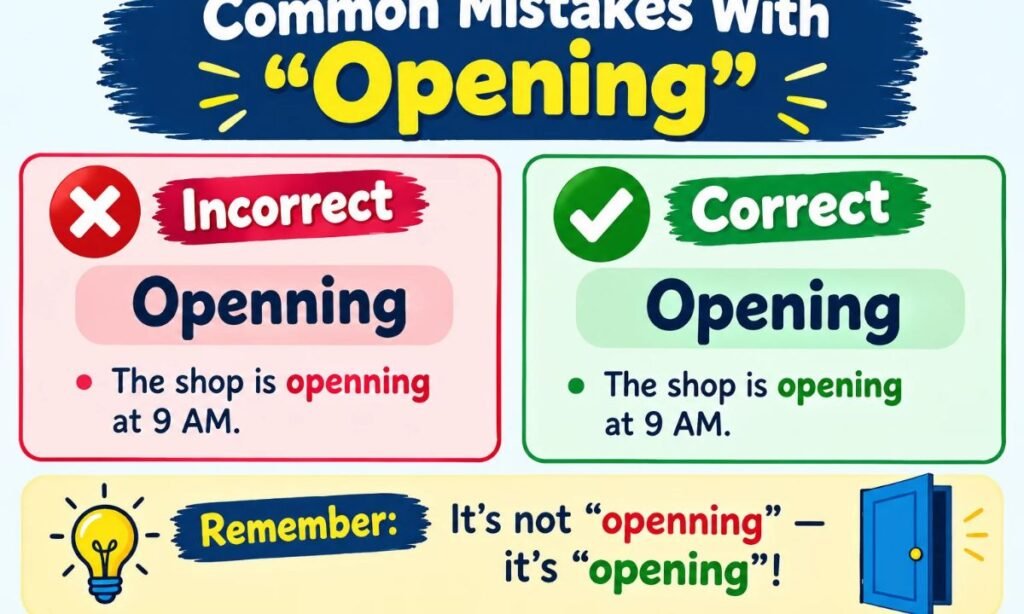
Watch for these errors before you publish or send anything.
- Adding an extra “n.” Writing “openning” instead of “opening.”
- Doubling in other forms. “Openned” is also wrong. The past tense is “opened.”
- Copying the “beginning” pattern. The two words end alike, but their stress patterns differ.
- Trusting how it sounds. Spelling does not always follow pronunciation, so rely on the rule.
- Skipping a final read. Signs, posts, and job listings go public quickly, so a quick proofread matters.
A simple habit helps: search your document for “nn” before you finish. Real words with a double “n” are less common than you would expect, and the search will catch most of these slips.
An Easy Trick to Remember the Spelling
Try this short memory aid. “Open” already has its “n,” so just add ing.”
You can also use the “glue” method. Picture the word “open” and the ending “ing” as two blocks. Glue them together without adding anything else. Open + ing = opening.
If you need one more check, say the two words side by side: opening and beginning. Stress “begin” on the second part, and you can hear why it needs the extra “n.” Stress “open” on the first part, and the extra “n” has no reason to be there.
Frequently Asked Questions
Is it opening or openning?
It is opening. The word has one “n” in the middle. “Openning” is a common typo and is not accepted in standard English.
Why do people write openning instead of opening?
Most people copy the double-letter pattern from words like “beginning,” or they type too fast. Both leave an extra “n” behind. Remembering that “open” has first-syllable stress prevents the mistake.
Is “opening” spelled differently in British and American English?
No. Both British and American English use opening. The two varieties differ on some other words, but not on this one.
Can opening be both a noun and a verb form?
Yes. As a noun, it can mean a gap, a job vacancy, or the start of something. As the “-ing” form of the verb “open,” it describes an action in progress, as in “The shop is opening now.” It can also work as an adjective, as in “opening remarks.”
Final Thoughts
The answer to opening or openning is simple: always write opening. The verb “open” has its stress on the first syllable, so the “n” never doubles when you add “-ing.” Keep the “glue” trick in mind, remember that “beginning” is the exception because of its stress, and give your job posts, emails, and signs a quick proofread. With that habit, the extra “n” will stay out of your writing for good.

Alexander John grammar content writer with 4 years of experience creating accurate, engaging, and SEO-friendly content. I specialize in spelling differences, commonly confused words, vocabulary, grammar rules, and writing tips. My goal is to simplify English for learners through clear explanations, practical examples, and helpful articles.