
A math worksheet is due, or a group project needs splitting, or an email needs the right word. You write “devide,” and something looks off, but you cannot say why. The devide or divide question catches students, professionals, and native speakers alike because the first vowel is easy to mishear.
A single wrong letter can make a polished sentence look rushed. Here is the answer, the reason behind it, and a few simple tricks to lock it in.
What Divide Means
Divide has a few clear meanings, and they all share the idea of separating something.
1. To split into parts (verb).
- “Divide the pizza into eight slices.”
2. To share or distribute.
- “They divided the prize money equally.”
3. To separate or set apart.
- “A fence divides the two yards.”
4. To cause disagreement.
- “The new policy divided the committee.”
5. To do division in math.
- “Divide 20 by 4.”
Divide also works as a noun. It can mean a gap or a point of separation.
- “The divide between the two groups kept growing.”
- “They hiked along the continental divide.”
Why Divide Begins With “Di”
The spelling has a clear history. Divide comes from the Latin verb dividere, which means to separate or force apart. The same root gave English a family of related words, and they all start with di:
- division
- dividend
- divisor
- divisible
- individual
- divider
Notice that none of these words begins with “dev.” If you know one family member, you can check the rest.
This also helps when you are comparing look-alike words. Words that really do start with de include develop, devote, devise, and device. Those come from different roots. Divide does not belong to that group.
How It Sounds and Why “Devide” Shows Up
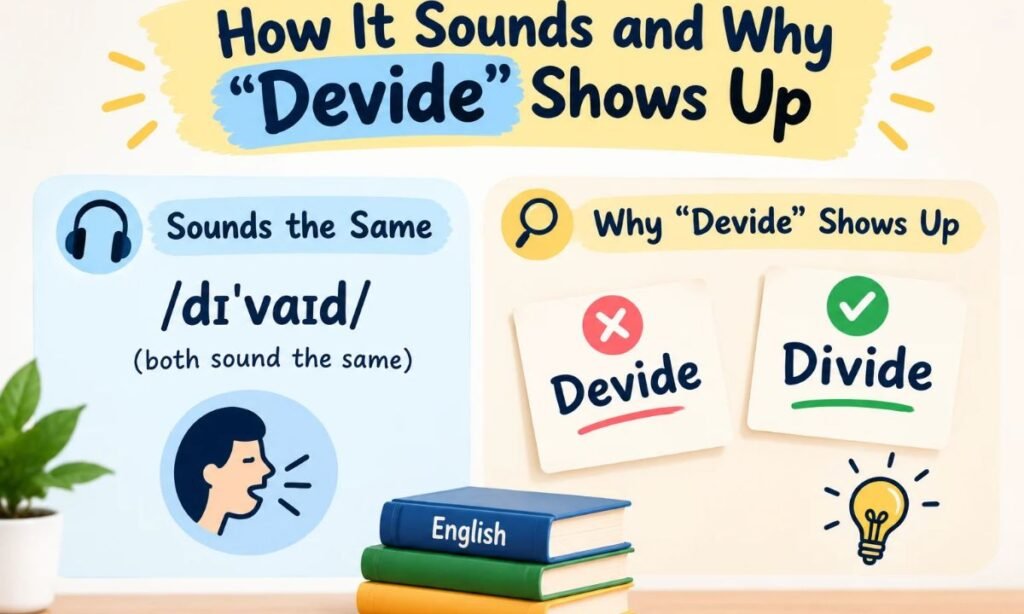
Say it as dih-VYDE.
- The stress falls on the second syllable (“VYDE”).
- The first syllable is weak and quick.
- The second syllable rhymes with “hide” and “side.”
Here is the problem. In fast speech, the unstressed first syllable can sound like “duh” or “deh.” Your ear hears a vague vowel and guesses at the letter. Many people guess e.
The same thing happens with other short, unstressed starts. Words like decide, devote, and divide all begin with a soft, quick sound, so it is easy to mix up the vowel.
The fix is to rely on the word family, not the sound. Think of division. In that word, the I is pronounced clearly, and the spelling is obvious.
Devide or Divide in British and American English
There is no regional difference to worry about. Divide is spelled the same in American, British, Canadian, and Australian English.
| Feature | American English | British English |
| Spelling | divide | divide |
| Past tense | divided | divided |
| Present participle | dividing | dividing |
| Accepted use of “devide” | No | No |
Whether you write for readers in New York or London, the answer does not change.
Divide Verb Forms and Grammar
Once the base word is right, the other forms follow easily. The final E drops before -ing, and a plain d is added for the past tense.
| Form | Spelling | Example |
| Base verb | divide | Please divide the work fairly. |
| Third person | divides | She divides her time between two jobs. |
| Past tense | divided | They divided the cake evenly. |
| Past participle | divided | The house was divided into two units. |
| Present participle | dividing | He is dividing the class into teams. |
| Person or tool | divider | A divider separates the drawers. |
Wrong forms like “devided” and “deviding” repeat the same first-letter error.
Divide by vs divide into
These two phrases sound similar but work differently.
- Divide by is used in math, to name the number you split with.
- “Twelve divided by three is four.”
- Divide into names the parts or groups you create.
- “Divide the class into four groups.”
- “Divide 12 into 3 equal parts.”
Pick by when you name the divisor, and into when you name the result or the groups.
Division Terms: Dividend, Divisor, and Quotient

Math students often search for this word too, so here are the key terms.
In the equation 12 ÷ 3 = 4:
| Term | Meaning | In this example |
| Dividend | The number being divided | 12 |
| Divisor | The number you divide by | 3 |
| Quotient | The answer | 4 |
| Remainder | What is left over | 0 |
A simple memory trick: the dividend comes first, and the divisor comes second. They both start with div, just like divide.
Dividend also has a second, non-math meaning. A company can pay a dividend, which is a share of profits given to its shareholders. The word shares its root with divide because it describes a portion that is divided out.
Another related word, divisible, describes a number that can be divided evenly. For example, 12 is divisible by 3.
Synonyms and Related Words for Divide
Divide is useful, but other words can add precision depending on the situation.
| Meaning | Alternatives |
| Split into parts | separate, split, break up, section |
| Share out | distribute, allocate, share, apportion |
| Set apart | partition, separate, segregate |
| Cause disagreement | split, polarize, estrange |
| Math use | divide (no real replacement) |
Take care with partition. It often suggests a physical wall or barrier, so it fits rooms and data better than people or opinions.
Common Spelling Mistakes With Divide
| Incorrect | Correct | What went wrong |
| devide | divide | Wrong first vowel |
| devided | divided | Same vowel error in the past tense |
| deviding | dividing | Same vowel error in the participle |
| devider | divider | Same vowel error in the noun |
| divid | divide | Missing final E |
| dividding | dividing | Extra D added |
| devision | division | Wrong first vowel |
Spell checkers catch most of these. Still, they can miss them in usernames, product labels, handwritten notes, or when autocorrect is off. A quick proofread helps.
Easy Ways to Remember the Spelling

You do not need a long rule. Try one of these.
- Link it to “division.” If you know division starts with di, divide does too.
- Think “I divide.” The word begins with di, so picture the letter I standing for the one doing the splitting.
- Spot the two I’s. Divide has an I in the first syllable and an I in the second, like this: d-i-v-i-d-e. The loud second I is easy to hear, and the first one matches it on the page.
- Match it with “individual.” An individual is one who cannot be divided further. Both words start with di or contain divi.
- Separate it from the “dev” words. Develop, devote, and devise are the only common ones that use dev.
Divide in Everyday Examples
Here are real sentences for typical situations.
- “Let’s divide the tasks so everyone has a clear role.”
- “Could you divide the budget by quarter?”
News writing
- “The vote divided lawmakers along party lines.”
Social media
- “We divided the bill four ways. Dinner was worth it.”
School
- “Divide each side by two to solve for x.”
Formal writing
- “The report divides its findings into three categories.”
As a noun
- “A wide divide separates the two cities in income and services.”
Frequently Asked Questions
Is “devide” a real word?
No. Devide is not in standard dictionaries. It is a misspelling of divide. You may see it in usernames or casual texts, but formal writing should always use divide.
What is the past tense of divide?
The past tense is divided. The past participle is also divided. Add a plain d because the base word already ends in E.
Which comes first, dividend or divisor?
The dividend comes first. In 12 ÷ 3, the dividend is 12, the number being divided. The divisor is 3, the number you divide by.
Is divide a noun or a verb?
Both. As a verb, it means to split or share. As a noun, it means a gap or separation, as in “the divide between rich and poor” or “the continental divide.”
Conclusion
The answer to devide or divide is simple: divide, with di at the start. The word comes from a Latin root that gave English division, dividend, divisor, and individual, and all of them keep that same beginning. The spelling is the same in every English-speaking region, and the forms divided, dividing, and divider follow naturally.
Next time your ear hears a vague first vowel, think of division. The I is loud and clear there, and it will point you back to the right spelling.

Alexander John grammar content writer with 4 years of experience creating accurate, engaging, and SEO-friendly content. I specialize in spelling differences, commonly confused words, vocabulary, grammar rules, and writing tips. My goal is to simplify English for learners through clear explanations, practical examples, and helpful articles.