
Your friend texts, “We splitted the pizza three ways.” It sounds natural out loud, but something looks off in writing. Many learners hit this same wall with Split or Splitted, because most past tense verbs end in -ed.
That habit leads to a tiny error that stands out in emails, essays, and job applications. The fix is easy and has no tricky rule to memorize. Here is the short, clear answer, plus examples that make it stick.
The Three Forms of Split
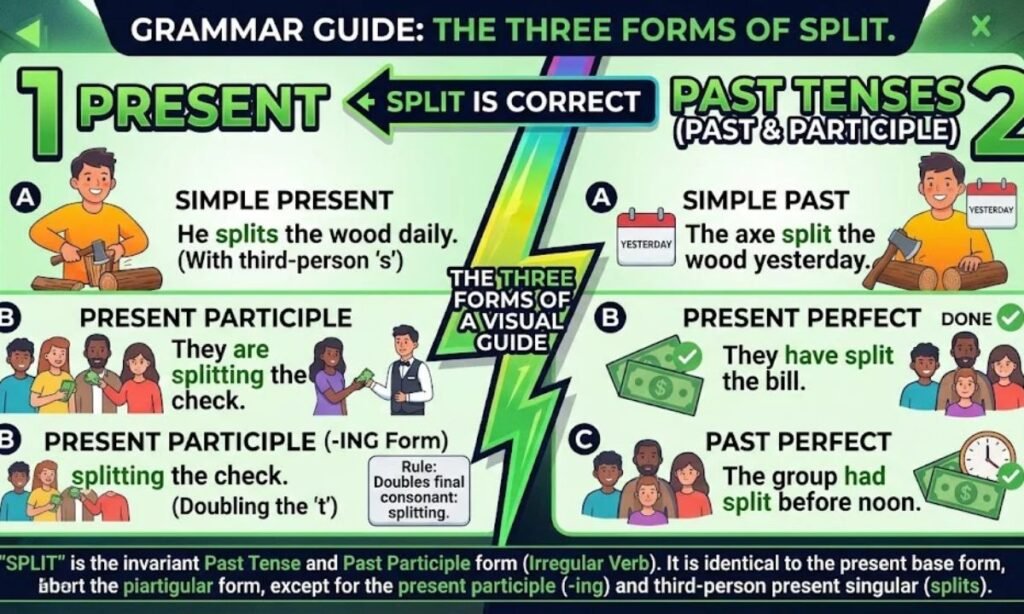
“Split” is an irregular verb. That means it does not follow the usual rule of adding -ed to make the past tense. It keeps the same spelling in its base form, past tense, and past participle.
| Form | Word | Example |
| Base form | split | “I always split the cost with my sister.” |
| Third person singular | splits | “She splits the work evenly.” |
| Past tense | split | “They split the prize last night.” |
| Past participle | split | “The wood has split in half.” |
| Present participle | splitting | “He is splitting the bill now.” |
Notice that the only forms that change are the -s form and the -ing form. Those follow normal rules. The past forms never change.
Why “Splitted” Looks Right but Is Wrong
Most English verbs are regular. You add -ed to the end: walk becomes walked, clean becomes cleaned. Your brain learns this pattern early, so it tries to use it everywhere.
That is why many learners, and many native speaker children, say “splitted.” It is a natural mistake. The brain applies a common rule to a word that does not follow it.
Splitted appears now and then in very old texts and in casual or learner English, but modern dictionaries and style guides treat it as nonstandard. For school, work, or formal writing, always use split.
Which Verbs Work Like Split?
Here is a helpful discovery: many short verbs that end in -t do not change in the past tense. Split belongs to a small group of verbs with identical forms.
| Base form | Past tense | Past participle |
| split | split | split |
| cut | cut | cut |
| put | put | put |
| hit | hit | hit |
| hurt | hurt | hurt |
| set | set | set |
| shut | shut | shut |
| let | let | let |
| cost | cost | cost |
| quit | quit | quit |
| spread | spread | spread |
You would never say “putted,” “hitted,” or “cutted” in standard English. Split follows the same pattern, so the same logic applies.
A word of caution: do not assume every verb ending in -t is irregular. Words like “visit” and “wait” are regular and become “visited” and “waited.”
How to Use Split in Different Tenses
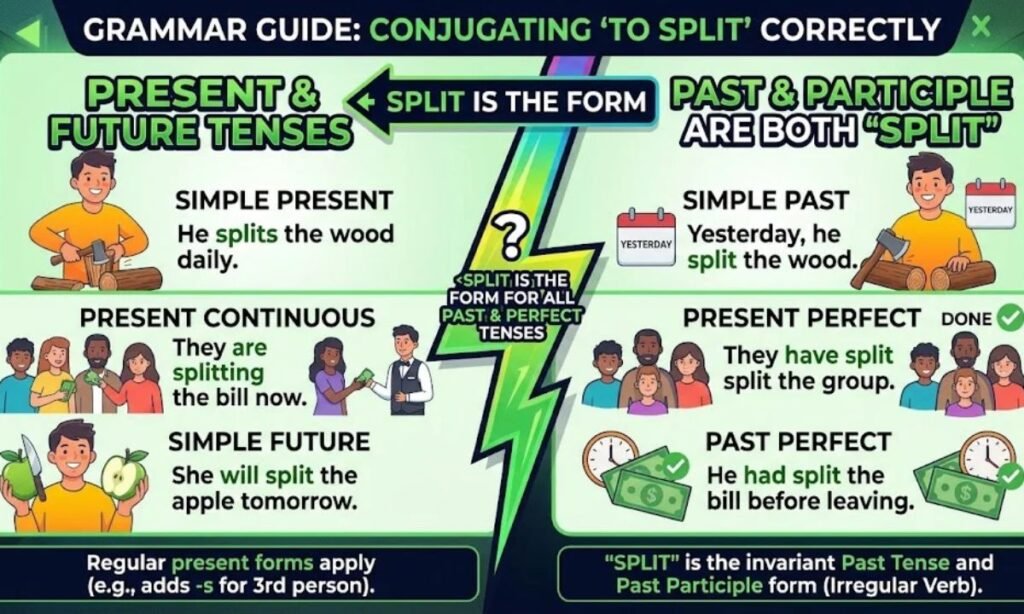
Seeing the verb across tenses makes the rule easier to trust.
- Simple present: “I split my time between two offices.”
- Simple past: “I split my time between two offices last year.”
- Present perfect: “I have split my time between two offices for years.”
- Past perfect: “I had split my time before I moved.”
- Future: “I will split my time again next month.”
- Passive voice: “The bill was split between four people.”
In every case, the form you need is just split. The helper words (have, had, will, was) carry the tense, not the verb itself.
Split Up: Past Tense and Meaning
Many people search for “split up” right after “split.” The phrasal verb works the same way: split up, split up, split up.
“Split up” has two common meanings:
- To end a relationship: “They split up last spring.”
- To divide into groups or parts: “Let’s split up and search different rooms.”
Examples with different forms:
- “The band split up in 2010.” (past tense)
- “They have split up twice already.” (past participle)
- “We are splitting up the chores this week.” (-ing form)
The word “up” never changes, and “split” stays “split.”
Real World Examples
Here is how the verb appears in daily life.
At home:
- We split the chores after dinner.
- The kids split the last cookie.
At work:
- The team split into two groups for the workshop.
- Our manager has split the project into smaller tasks.
In emails:
- “I split the report into two sections to make it easier to read.”
- “We have split the cost evenly between both departments.”
In the news:
- “The vote split along party lines.” (a very common news phrase)
- “The company split its stock to attract more buyers.”
With friends:
- “We split the check at the restaurant.”
- “Let’s split an appetizer.”
Common Mistakes to Avoid
1. Adding -ed to make the past tense. Wrong: “They splitted the money.” Right: “They split the money.”
2. Using “splitted” after “have” or “has.” Wrong: “She has splitted the document.” Right: “She has split the document.”
3. Using “splitted” in passive sentences. Wrong: “The work was splitted equally.” Right: “The work was split equally.”
4. Forgetting the doubled t in -ing. Wrong: “He is spliting the bill.” Right: “He is splitting the bill.”
5. Treating “split” as a regular verb. Remember it belongs to the group of verbs that stay the same, like cut, put, and hit.
Split as a Noun and Adjective
“Split” does more than one job, which can add to the confusion.
- Noun: “There was a split in the team.” / “She did a split in gymnastics.”
- Adjective: “A split decision,” “a split second,” “a split screen.”
- Verb: “They split the profit.”
In phrases like “split second” and “split decision,” the word is an adjective. These phrases never use “splitted.”
A Quick Note on Split Infinitives
You may also hear the term split infinitive. This is a different topic. It describes a word placed between “to” and a verb, as in “to boldly go.”
It has nothing to do with the past tense of split. Style guides today generally accept split infinitives, so you do not need to avoid them in everyday writing.
Simple Tricks to Remember the Rule
- Same word, three times. Say it out loud: “Split, split, split.”
- The -t group. If you would not say “cutted” or “putted,” do not say “splitted.”
- Helper verbs do the work. In “has split” and “was split,” the helper word shows the time, so the main verb stays unchanged.
- Check the time words. Yesterday, last week, already, and just all use the same form: split.
Frequently Asked Questions
What is the past tense of split?
The past tense of split is split. The past participle is also split. For example, “We split the cake yesterday,” and “We have split the cake.”
Is “splitted” a real word?
“Splitted” is not standard English. It is a nonstandard past form that learners and young speakers sometimes produce by adding -ed. Dictionaries list split as the correct past tense and past participle.
What is the past tense of split up?
It is split up. For example, “They split up last year,” and “They have split up.” The word “up” never changes, and the verb “split” stays the same.
Is split the past participle?
Yes. The past participle of split is split, and it is used after have, has, had, and in passive sentences. Examples: “She has split the bill” and “The log was split in two.”
Conclusion
The question of Split or Splitted has a simple answer. Use split for the base form, the past tense, and the past participle. Skip “splitted” in school work, emails, and professional writing.
If you ever doubt it, remember the -t group: cut, put, hit, and split all stay the same. Say it three times, and the rule will stick.