
You are about to hit send on a message that calls a plan a little nieve. Something looks off, but you cannot tell why. You are not alone. Naive or Nieve is one of those spelling puzzles where the wrong version looks perfectly reasonable, thanks to patterns like believe and relieve.
The word has an odd shape, and your brain keeps trying to fix it. Here is the correct spelling, the meaning, and a simple way to never second guess it again.
What “Naive” Means
“Naive” is an adjective. It describes a person, an idea, or an action that shows a lack of experience, caution, or realistic judgment.
Common meanings include:
- Innocent and trusting: “She was too naive to suspect a scam.”
- Inexperienced: “As a new manager, he was naive about office politics.”
- Overly simple or unrealistic: “It is naive to think the project will finish early.”
The word can be neutral or critical, depending on how you use it. More on that tone below.
What About “Nieve”?
“Nieve” is not a standard English word. In English, it is simply a misspelling of naive.
It does exist in another language. In Spanish, nieve means “snow.” It is also used as a given name in some Spanish speaking communities. That is why you may see it in names, song titles, or Spanish text, but it has no connection to the English word naive.
So if you meant to describe someone as innocent or unrealistic, the spelling you need is naive.
Naive vs Nieve at a Glance
| Feature | Naive | Nieve |
| Standard English? | Yes | No |
| Word type | Adjective | None (a misspelling in English) |
| Meaning | Innocent, trusting, inexperienced | Not an English word (means “snow” in Spanish) |
| Pronunciation | nah-EEV (or ny-EEV) | Spanish: NYEH-veh |
| Variant spelling | naïve | None |
| Example | “That was a naive mistake.” | Not used in English |
Why People Spell It “Nieve”
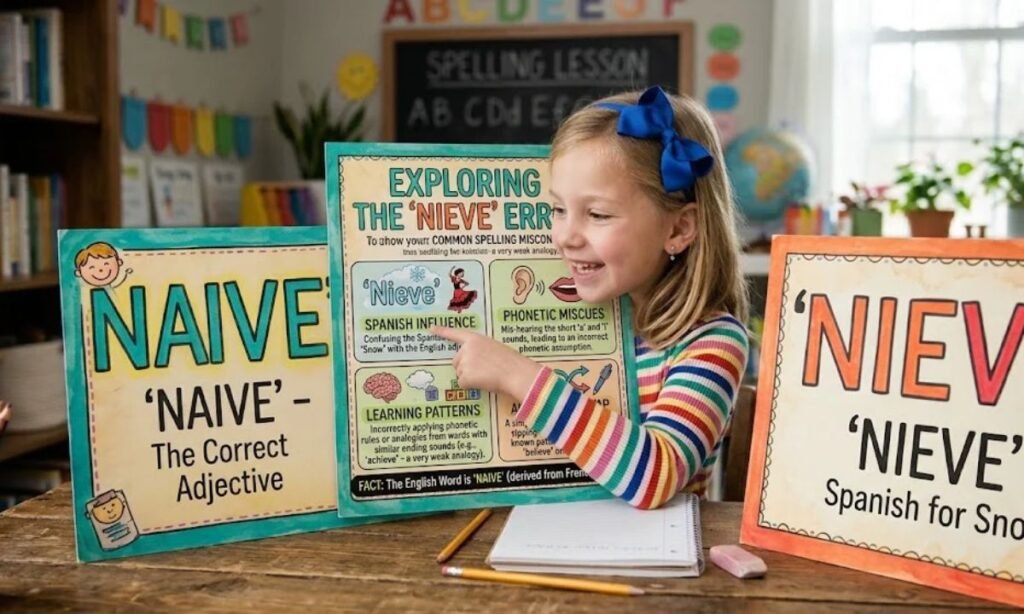
This is a very common error, and it makes sense. There are a few reasons.
- The “ie” pattern. English has many words like believe, relieve, and achieve. The brain expects i before e in a similar spot.
- Sound. The word sounds like “nye-EEV” or “nah-EEV,” and the letters do not match that sound in a clear way.
- French roots. The word came from French, where spelling rules differ from standard English patterns.
- Fast typing. Swapping two letters next to each other is one of the easiest typing slips.
The good news is that the word has no tricky exceptions. It always follows the same spelling.
Where the Word Comes From
“Naive” came into English from French. In French, naïve is the feminine form of naïf, which comes from the Latin nativus, meaning “natural” or “native.”
The original idea was something like “natural” or “unspoiled.” Over time, the meaning shifted toward “simple, innocent, and lacking experience.”
This also explains the two dots. In French, the mark over the i (called a diaeresis) shows that the a and the i are pronounced as separate sounds: na-ive.
Naive or Naïve: Which Should You Use?
Both spellings are correct. The version with two dots, naïve, keeps the French mark. The version without dots, naive, is the standard form in most modern English writing.
For everyday use, naive is the safer choice. It is easier to type, and most style guides accept it. Use naïve if you are following a style that keeps the accent or if you want to match older writing.
Whichever one you choose, stay consistent within the same document.
How to Pronounce Naive
The most common pronunciation is nah-EEV. Some speakers say ny-EEV. Both are accepted.
Notice there are three letters, then a split: na-ive. The a and the i do not blend into one sound. That small detail is the reason the spelling is easy to get wrong when you write it from sound alone.
Related Words: Naively, Naivety, and Naiveté
The word has a few close relatives. Here is how each one works.
| Word | Type | Example |
| naive | Adjective | “A naive question.” |
| naively | Adverb | “She naively trusted the stranger.” |
| naivety | Noun | “His naivety surprised everyone.” |
| naiveté | Noun (variant) | “Her naiveté was charming.” |
Naivety and naiveté both mean the state of being naive. Naivety is the more common form in modern writing. Naiveté keeps the French accent mark.
Is “Naive” a Bad Word?
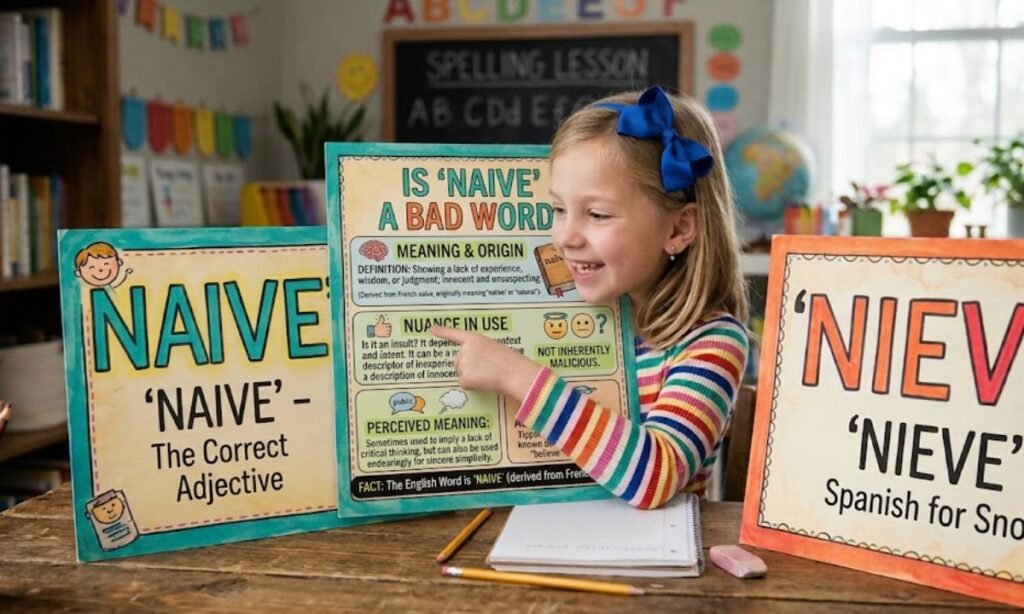
Not exactly. “Naive” is not rude on its own, but its tone depends on context.
- Gentle tone: “She has a naive charm.” (innocent, sweet)
- Critical tone: “That was a naive decision.” (lack of good judgment)
- Condescending tone: “You are so naive.” (can sound insulting)
When you describe someone’s behavior, it is usually safer to talk about the idea or action instead of the person. Saying “That plan seems naive” sounds kinder than “You are naive.”
Synonyms and Example Sentences
Here are some close synonyms: innocent, gullible, trusting, inexperienced, unsuspecting, green, and credulous. Each has a slightly different shade. “Gullible” is the most negative, while “innocent” is the softest.
Example sentences:
- It was naive of me to think the shipping would be free.
- He made a naive assumption about the contract.
- The young intern was naive about workplace politics.
- She naively believed every promise the salesman made.
- It is naive to expect perfect weather on a mountain trip.
You may also meet the word in tech. In data science, a “naive Bayes” model is a simple method that assumes each feature works independently. In that field, “naive” describes a simplifying assumption, not a person.
Common Mistakes to Avoid
1. Spelling it “nieve.” Wrong: “That was a nieve idea.” Right: “That was a naive idea.”
2. Swapping the vowel order. Wrong: “naiev” or “niave” Right: naive
3. Forgetting the “-ly” for the adverb. Wrong: “She naive trusted him.” Right: “She naively trusted him.”
4. Misspelling the noun. Wrong: “naivity” Right: naivety (or naiveté)
5. Mixing styles in one document. Pick naive or naïve and use it everywhere.
Easy Ways to Remember the Spelling
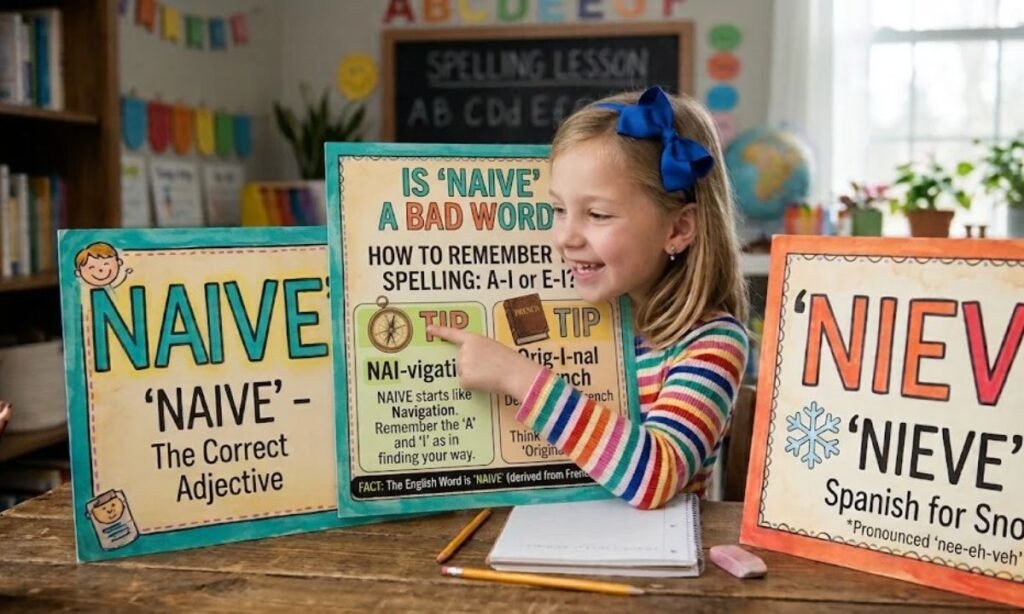
- Split it in two. Say na + ive. The word has a clear “na” start and an “ive” ending, with no tricky ie combination.
- A comes first. In naive, the a is followed by i. Think “AI” like artificial intelligence, then add “ve.”
- Skip the believe pattern. The words believe and relieve have “ie.” Naive does not.
- Spanish snow. If you picture snow, that is nieve in Spanish. It is not what you want when you mean innocent.
Frequently Asked Questions
What is a naive person?
A naive person is someone who is trusting, inexperienced, or unrealistic about how the world works. They may believe things too easily or expect only good outcomes. The word describes a lack of experience, not a lack of intelligence.
Is naive a bad word?
It is not a bad word, but it can sound critical or condescending depending on the sentence. “A naive question” is mild. “You are so naive” can feel insulting. Use it carefully when talking about people.
What does “naive girl” mean?
It describes a girl or young woman who is innocent, trusting, or inexperienced. The tone depends on the speaker. It can sound sweet or dismissive. For a respectful tone, describe the situation rather than labeling the person.
Is it naive or naïve?
Both are correct. Naive is the common modern spelling. Naïve keeps the French accent mark. Choose one and stay consistent.
Conclusion
The choice between Naive or Nieve is easy once you know the rule. Naive is correct, naïve is an accepted variant, and nieve is a Spanish word for snow, not an English one.
Remember the split: na + ive. Check it once before you hit send, and your writing will look sharp every time.