
You finish cleaning the kitchen and send your roommate a proud text: “I just sweeped the floor.” Then you stop. Does that look right? Is it sweeped or swept? That tiny pause is the problem, because irregular verbs love to catch confident writers off guard.
The wrong form can make a simple message look sloppy. Here is the good news: there is one correct answer, a clear pattern behind it, and a few easy tricks to lock it in.
The Forms of “Sweep” at a Glance
Verbs have a few main forms. Here is how “sweep” works in each one.
| Form | Word | Example |
| Base form | sweep | I sweep the porch every morning. |
| Third person singular | sweeps | She sweeps the stairs first. |
| Past tense | swept | We swept the garage yesterday. |
| Past participle | swept | The room has been swept. |
| -ing form | sweeping | He is sweeping the patio now. |
Notice that the past tense and past participle are the same word. That makes this verb easier than some others, like “go, went, gone.”
Is “Sweeped” a Real Word?
Not in standard English. Major dictionaries do not list “sweeped” as an accepted past form of “sweep,” and editors will correct it in formal writing, school work, and published text.
You may still hear it in casual speech or see it in quick messages. That is usually because the speaker is applying the most common rule in English: add -ed to make the past tense. The instinct is logical, but “sweep” belongs to a different group of verbs.
So if you wrote “sweeped” before, you made a very understandable mistake. Just switch to “swept” from now on.
Why “Sweep” Is an Irregular Verb
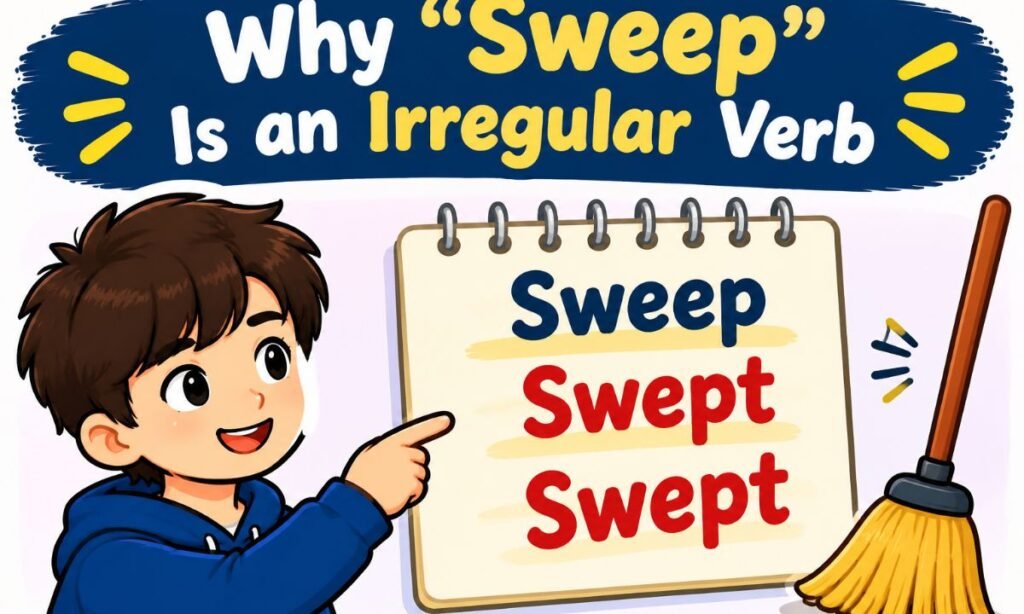
Most English verbs are regular. You add -ed and you are done: walk, walked; paint, painted.
Irregular verbs break that pattern, and they often do it in groups. “Sweep” belongs to a small family of verbs that end in -eep and change to a short vowel plus -t in the past:
- keep → kept
- sleep → slept
- creep → crept
- weep → wept
- sweep → swept
Say them aloud and you can hear the shift. The long “ee” sound shortens to a quick “eh,” and a t lands at the end. That family habit is much older than modern spelling rules, which is why it feels natural to say “slept” and “kept” but sounds odd to say “sleeped” or “keeped.”
Once you see “sweep” as part of this group, “swept” stops being a random exception.
Sweeped vs Swept: Side-by-Side Comparison
| Feature | Swept | Sweeped |
| Standard English | Yes | No |
| Past tense of sweep | Yes | Not accepted |
| Past participle of sweep | Yes | Not accepted |
| Follows the -eep pattern | Yes | No |
| Safe for school and work | Yes | No |
| Example | She swept the porch. | She sweeped the porch. |
The table leaves no room for doubt. In every situation, swept wins.
How to Use “Swept” Correctly
“Swept” works in three common grammar patterns.
1. Simple past tense
Use it for an action that is finished.
- I swept the kitchen after dinner.
- The wind swept across the field.
2. Perfect tenses (with have, has, or had)
Use it as the past participle.
- She has swept the floor twice today.
- By the time we arrived, they had already swept the hall.
3. Passive voice (with be)
Use it when the focus is on the thing being swept.
- The street was swept before the parade.
- The classroom is swept every evening.
A quick check: if you can put “have” or “was” before the word, you want the past participle, which is still swept.
“Swept” Beyond Cleaning

“Sweep” is not only about brooms. Its meaning stretches to describe fast, wide, or complete movement, and “swept” follows along.
- Moving quickly and widely: A wave of excitement swept through the crowd.
- Winning everything: The team swept the series in four games.
- Carrying something away: The flood swept the bridge downstream.
- Moving with grace or force: She swept into the room and took her seat.
It also appears in common phrases:
- Swept away: carried off by force or emotion (“He was swept away by the music.”)
- Swept up in: caught in an event (“They got swept up in the excitement.”)
- Swept under the rug: hidden or ignored (“The problem was swept under the rug.”)
- Swept off her feet: overwhelmed by romance or admiration
- Clean sweep: a total victory
In all of these, the past form stays swept.
Example Sentences
At home
- I swept the garage and found my old bike.
- He has swept the porch every day this week.
- The floor was swept, mopped, and ready for guests.
At school and work
- The custodian swept the hallway before the first bell.
- We swept the workshop at the end of each shift.
- The company swept the industry awards this year.
In news and sports
- A storm swept across the coast overnight.
- The home team swept the weekend series.
- A new trend has swept the fashion world.
Incorrect examples, for learning
- I sweeped the floor. (Should be “swept.”)
- The room was sweeped yesterday. (Should be “swept.”)
- She has sweeped twice already. (Should be “swept.”)
Common Mistakes to Avoid
1. Adding -ed automatically
This is the most common slip. If you are unsure, check whether the verb belongs to the -eep group (keep, sleep, creep, weep, sweep). If it does, think “short vowel plus t.”
2. Overcorrecting regular -eep verbs
Not every verb ending in -eep is irregular. Some are regular and do take -ed: beep → beeped, peep → peeped, seep → seeped, and steep → steeped. So the “-eep to -ept” pattern is a strong habit, not a universal law. When in doubt, check a dictionary.
3. Using different forms for past tense and past participle
Some irregular verbs split these two forms. “Sweep” does not. Past tense and past participle are both swept, so you never need a third form.
4. Writing “swepted”
This double ending shows up when writers try to fix “sweeped” and overshoot. Stop at swept.
5. Using “sweeped” in formal writing
Even if you hear it in casual speech, avoid it in emails, essays, and reports.
Easy Ways to Remember

Trick 1: Match it with “slept.” If you would say “I slept,” you would say “I swept.” Both follow the same sound pattern.
Trick 2: Remember the “sleep, keep, sweep” trio. These three common verbs share the same rule, so you can learn them as a set: sleep → slept, keep → kept, sweep → swept.
Trick 3: Say the sentence aloud. “I sweeped the floor” sounds clumsy next to “I swept the floor.” Your ear often knows before your eyes do.
Trick 4: Keep it to one form. For the past tense and the past participle, you only need to remember one word: swept.
Frequently Asked Questions
Is sweeped grammatically correct?
No. Sweeped is not accepted in standard English. The correct past tense and past participle of “sweep” is swept.
Is it correct to say “I sweeped”?
No. Say “I swept.” You may hear “I sweeped” in casual speech, but writers and editors treat it as an error.
What is the difference between sweep and swept?
Sweep is the base form, used for the present tense or after words like “to” or “will.” Swept is the past tense and past participle. For example: “I sweep the floor every day,” and “I swept the floor yesterday.”
What does swept mean?
Swept is the past form of “sweep.” It can mean cleaned with a broom, moved quickly across an area, carried away by force, or won everything in a contest. Context makes the meaning clear.
Conclusion
The sweeped or swept question has a one-word answer: swept. It is the past tense and the past participle, it belongs to the same family as “kept,” “slept,” and “crept,” and it works for both cleaning and bigger ideas like storms, trends, and winning streaks.
Keep “sweeped” out of your writing, remember the short-vowel-plus-t pattern, and you can describe any clean floor or clean sweep with confidence.

Alexander John grammar content writer with 4 years of experience creating accurate, engaging, and SEO-friendly content. I specialize in spelling differences, commonly confused words, vocabulary, grammar rules, and writing tips. My goal is to simplify English for learners through clear explanations, practical examples, and helpful articles.