
You are leaving a review for a hotel that kept you awake all night, and you want to say the street outside was loud. Then you freeze. Is it noisey or noisy? That tiny extra letter can make a sharp complaint look sloppy, and spell checkers do not always catch it in captions, usernames, or quick texts. The good news is that the noisey or noisy question has a clear answer, and one simple spelling rule fixes it for good.
What Does “Noisy” Mean?
Noisy describes a person, place, or thing that produces a lot of sound, especially sound that is loud, constant, or hard to ignore.
It carries a few related senses:
- Loud or full of sound: a noisy street, a noisy engine
- Likely to make a racket: a noisy group of kids
- Cluttered or distracting: a noisy chart, noisy data
The word is pronounced NOY-zee. It has two syllables, and the stress falls on the first one. The “oy” matches the sound in “boy” and “toy,” and the ending sounds like the “zee” in “breezy.”
Grammatically, noisy is an adjective, so it describes a noun. You can put it before the noun (“a noisy room”) or after a linking verb (“the room is noisy”). The spelling is the same in American and British English, so there is no regional split to worry about.
Is “Noisey” a Real Word?
For everyday writing, no. Noisey is not an accepted spelling in standard English. Look it up in a major dictionary and you will be sent to noisy.
You may still see “noisey” in a few places:
- Social media handles and usernames
- Band names, blog names, and other brands that pick unusual spellings on purpose
- Typos in fast messages
A brand can spell its name any way it likes, and that does not change the rule for regular writing. In emails, essays, reports, and reviews, use noisy.
| Feature | Noisy | Noisey |
| Correct in standard English | Yes | No |
| Part of speech | Adjective | Not recognized |
| Listed in dictionaries | Yes | No |
| Safe for school, work, and publishing | Yes | No |
| Comparative form | noisier | none |
| Superlative form | noisiest | none |
Why Is It Spelled “Noisy” Without an E?
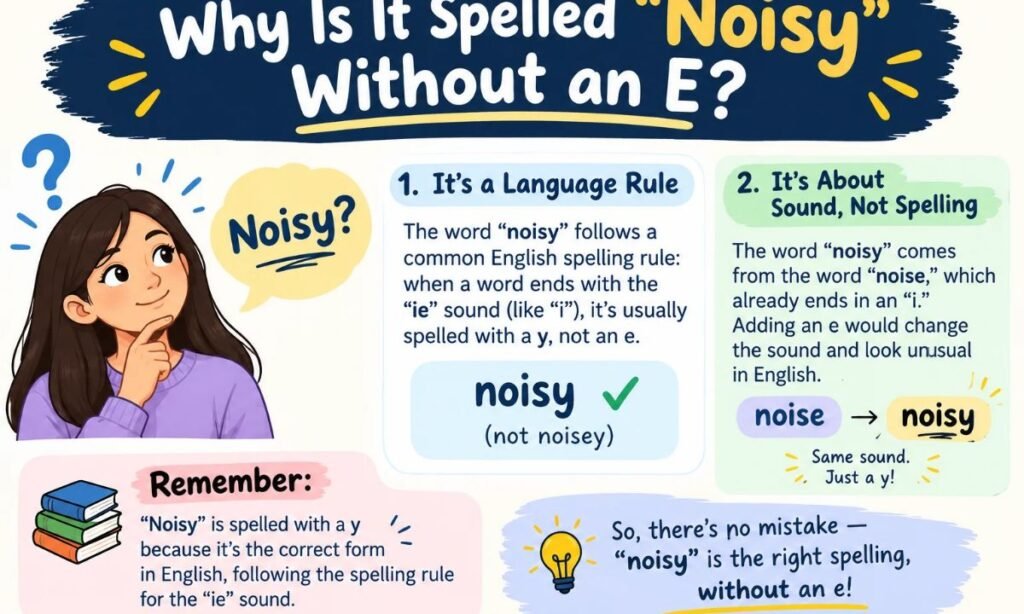
This is the part most guides skip, and it is the key to never missing the spelling again.
The noun is noise, and it ends in a silent e. English has a long-standing habit: when you add the suffix -y to a word that ends in a silent e, you usually drop the e first. The suffix turns a noun into an adjective, and the e steps aside to make room.
| Base word | Drop the e, add -y | Adjective |
| noise | nois + y | noisy |
| smoke | smok + y | smoky |
| bone | bon + y | bony |
| shade | shad + y | shady |
| slime | slim + y | slimy |
| ice | ic + y | icy |
Nobody writes “shadey” or “slimey” in formal English, and the same logic applies to “noisey.” A few words do keep the e, such as gluey and homey, but noisy is not one of them.
Why Do People Write “Noisey”?
Almost every misspelling has a reason, and knowing it makes the fix stick. Here are the three most common causes.
1. Keeping the silent e. Writers picture “noise” and simply tack a y on the end. They forget the e should disappear.
2. Mixing it up with -ey words. English has plenty of words that end in -ey, such as “money,” “honey,” “key,” and “monkey.” The ending looks familiar, so the brain accepts “noisey” without a fight.
3. Spelling by sound. The ending sounds like “zee,” and some people imagine a longer spelling to match. English spelling does not always follow sound, which is why this trap works so well.
The mistake is common and harmless in a quick text, so there is no need to feel bad about it. Fix it once and move on.
Easy Ways to Remember the Spelling
Pick whichever trick suits you:
- The drop rule: Noise loses its e before -y, just like smoke becomes smoky.
- The plain ending: The word ends in a simple y, with no extra letters before it.
- The pair trick: Think “noisy toys.” Both words share the same “oy” in the middle, and neither has a stray e.
- The typing drill: Type “noisy, noisier, noisiest” three times. Your fingers will remember the pattern better than your eyes will.
Noisy, Noisier, Noisiest: Word Forms to Know
A second common mistake hides here. When you add endings to noisy, the final y changes to i. This is the standard rule for words that end in a consonant plus y.
- Noisy (adjective): The room is noisy.
- Noisier (comparative): This room is noisier than the hallway.
- Noisiest (superlative): That was the noisiest night of the year.
- Noisily (adverb): The kids ran noisily down the stairs.
- Noisiness (noun): The noisiness of the traffic kept her awake.
| Wrong | Right |
| noisey | noisy |
| noiseyer | noisier |
| noiseyest | noisiest |
| noisely | noisily |
| noicy | noisy |
When you are unsure, remember that the i takes over whenever a suffix follows.
Noisy in a Sentence: Real-Life Examples
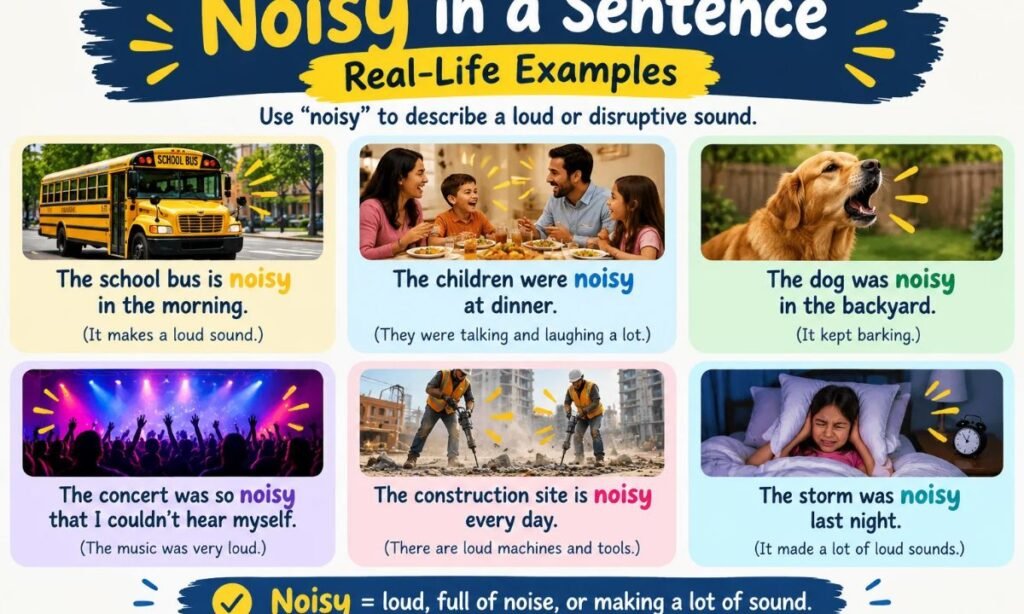
Seeing a word in action helps it stay in your memory.
At home
- The dishwasher is so noisy that we have to pause the movie.
- Our neighbor’s rooster is noisy every morning at dawn.
At work
- The open office gets noisy right after lunch.
- I took the call in my car because the café was too noisy.
At school
- The cafeteria was noisier than usual on the last day of exams.
- Please do not be noisy in the library.
In reviews and messages
- The room was clean, but the street outside was noisy at night.
- Sorry for the noisy background, I am at the airport.
With other word forms
- The old fan grew noisier every week until we replaced it.
- The market was the noisiest place we visited on the trip.
Noisy vs Nosy: Do Not Mix Them Up
Another look-alike often shows up beside this topic: nosy. It has nothing to do with sound. Nosy means overly curious about other people’s business.
| Word | Meaning | Example |
| Noisy | Making a lot of sound | The party next door is noisy. |
| Nosy (also spelled nosey) | Too curious about others | My nosy coworker asked how much I paid for my car. |
Here is the twist. For the curious word, both nosy and nosey are accepted spellings, with nosy being more common. So the extra e that is wrong in “noisey” is acceptable in “nosey.” That quirk is exactly why people get confused.
A quick memory aid: nosy comes from nose, because a nosy person pokes their nose into things. Noisy comes from noise.
Noisy Beyond Sound: Data, Science, and Everyday Speech
The word has grown past its original meaning, and you may meet it in other settings.
In data and statistics, “noisy” describes information that contains random errors or irrelevant details. A noisy dataset is harder to read because the useful signal is buried under clutter. That is where the phrase “signal-to-noise ratio” comes from.
In electronics and photography, a noisy signal or image contains unwanted interference, such as static in audio or grain in a dark photo.
In everyday speech, people call a place noisy when it feels crowded, busy, or chaotic. “My group chat is so noisy today” is a perfectly natural sentence.
In every one of these uses, the spelling stays the same: noisy.
Words Related to Noise
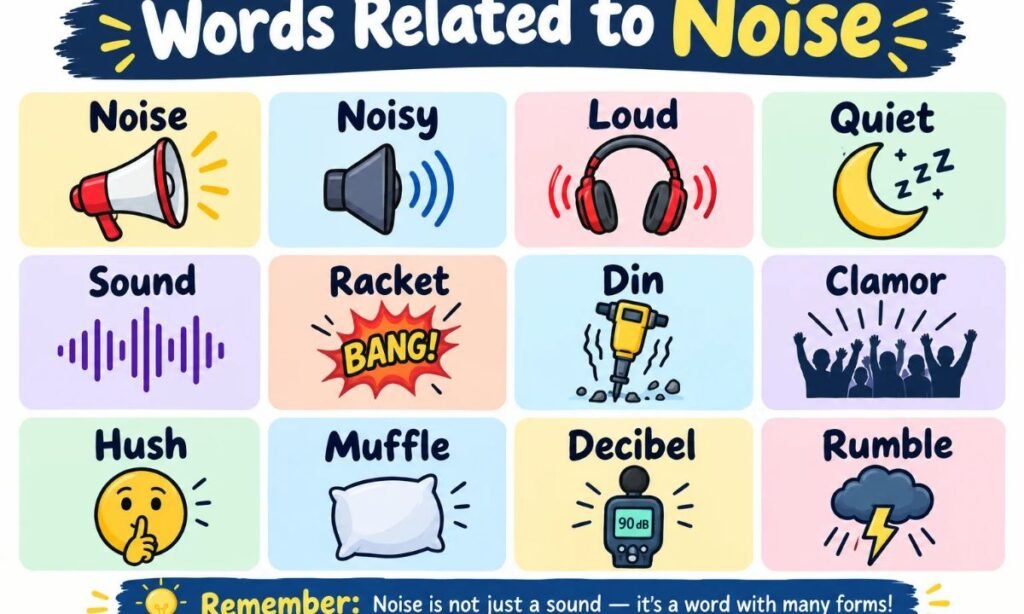
Using the same adjective again and again makes writing feel flat. These alternatives add variety:
- Loud: high in volume, the most general choice
- Rowdy: noisy and disorderly, usually about people
- Boisterous: lively and energetic, often in a happy way
- Deafening: so loud it is almost painful
- Clamorous: full of loud, confused sound
- Raucous: harsh and rough in sound
- Rambunctious: wild and full of energy
Choose the one that matches the mood. “The boisterous crowd cheered” feels friendly. “The raucous crowd jeered” feels rough. For the opposite idea, reach for quiet, silent, hushed, or peaceful.
Frequently Asked Questions
Is noisy or noisey correct?
Noisy is correct. Noisey is a misspelling and should be avoided in schoolwork, professional writing, and any text where accuracy matters.
Is noisey a word?
No. Standard English dictionaries do not list noisey as a word. It shows up mostly as a typo, or as a deliberate stylized spelling in names and usernames.
Why is noisy spelled without an e?
English usually drops a silent e before adding the suffix -y. That is why noise becomes noisy, smoke becomes smoky, and bone becomes bony.
What is the difference between noisy and nosy?
Noisy means making a lot of sound. Nosy means being too curious about other people’s affairs. The curious word can also be spelled nosey, but “noisey” is never correct for the sound-related meaning.
Final Thoughts
The noisey or noisy question has one clear winner. Noisy is the correct, dictionary-approved spelling, and it follows a rule you already use in words like smoky, bony, and shady: drop the silent e before adding -y. Remember the matching forms noisier, noisiest, and noisily, and you will dodge the second set of mistakes too.
Next time your cursor hovers over that extra e, delete it with confidence. Let the only noisy thing in your life be the neighbor’s party, not your spelling.

Alexander John grammar content writer with 4 years of experience creating accurate, engaging, and SEO-friendly content. I specialize in spelling differences, commonly confused words, vocabulary, grammar rules, and writing tips. My goal is to simplify English for learners through clear explanations, practical examples, and helpful articles.