
You are texting a friend about dinner and type, “I perfer pizza.” The red squiggle appears, or worse, it does not. So which is right, perfer or prefer? Letter swaps like this are easy to make because your fingers move faster than your spell check.
One small slip can make a quick message look rushed. Good news: only one of these spellings exists in standard English, and a simple trick keeps it straight for good.
What “Prefer” Means
Prefer is a verb. It means to choose or like one option more than another.
- Choosing between options: I prefer tea to coffee.
- Stating a wish or habit: She prefers to work in the morning.
- Expressing a request: I would prefer that you call me first.
Words with a similar meaning include favor, choose, like better, and would rather. The noun form is preference, and the adjective is preferable.
The word comes from Latin roots meaning “to carry before,” which fits the idea well. When you prefer something, you place it ahead of the other choices.
Is “Perfer” a Real Word?
No. “Perfer” is not a valid English word. If you see it in a message, an essay, or a social post, it is a misspelling of “prefer.”
There is one small footnote. “Perfer” is a form of a Latin verb that means “endure,” and you may find it in Latin quotations. That has nothing to do with English usage. In an English sentence, “I perfer” is always a mistake.
You will not find “perfer” listed as a variant spelling the way you might with “usable” and “useable.” There is no second correct option here, which makes this an easy one to settle.
Why People Write “Perfer”
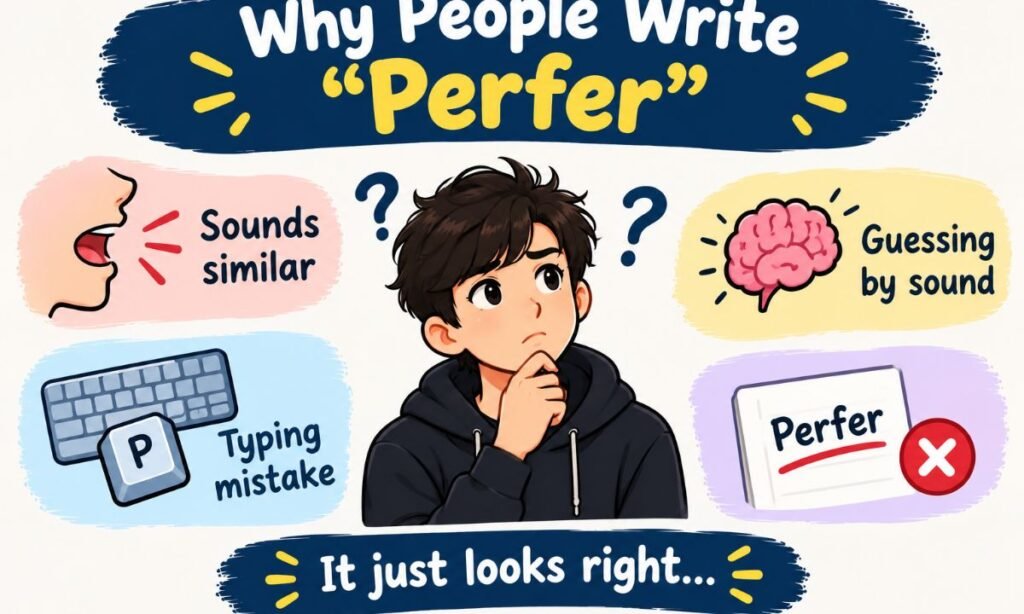
A few things push writers toward the wrong spelling.
1. The letters sit close together. “Pre” and “per” use the same three letters. When you type quickly, two of them can easily trade places. Linguists call this kind of swap metathesis, and it happens in speech and writing all the time.
2. “Per” is a very common beginning. Words like person, perfect, perform, and perhaps all start with “per.” Your brain may auto-complete the pattern.
3. Pronunciation is quick and soft. People often say “prefer” as “prih-FUR,” and the first syllable can blur into “per.” Your ear does not clearly signal which letter comes first.
None of this makes the mistake serious. It simply explains why so many people make it.
Prefer vs Perfer: Side-by-Side Comparison
| Feature | Prefer | Perfer |
| Correct in English | Yes | No |
| Part of speech | Verb | Not a valid word |
| Meaning | To like one thing better | None in English |
| Pronunciation | prih-FUR | Not applicable |
| Related forms | Preferred, preferring, preference, preferable | None |
| Safe for emails and school | Yes | No |
| Typical cause of error | N/A | Swapping “r” and “e” |
If you ever feel stuck, this table has one rule: prefer is the only option.
How to Use “Prefer” in Sentences
“Prefer” is flexible, but it follows a few common patterns.
Prefer + noun + to + noun
- I prefer hiking to running.
- He prefers books to movies.
Prefer + to + verb
- She prefers to take the train.
- We prefer to meet in person.
Prefer + verb-ing
- I prefer walking to driving.
- They prefer working from home.
Both “prefer to do” and “prefer doing” are correct. The meaning is nearly identical, though “prefer to do” often sounds a little more natural for a specific situation.
Would prefer
- I would prefer a window seat.
- We would prefer not to wait.
“Would prefer” is polite and slightly softer than “prefer.” It works well in emails and customer service messages.
Prefer + over
- Many shoppers prefer this brand over cheaper ones.
This pattern is also correct, especially when you are naming the option that wins.
“Prefer To” vs “Prefer Than”
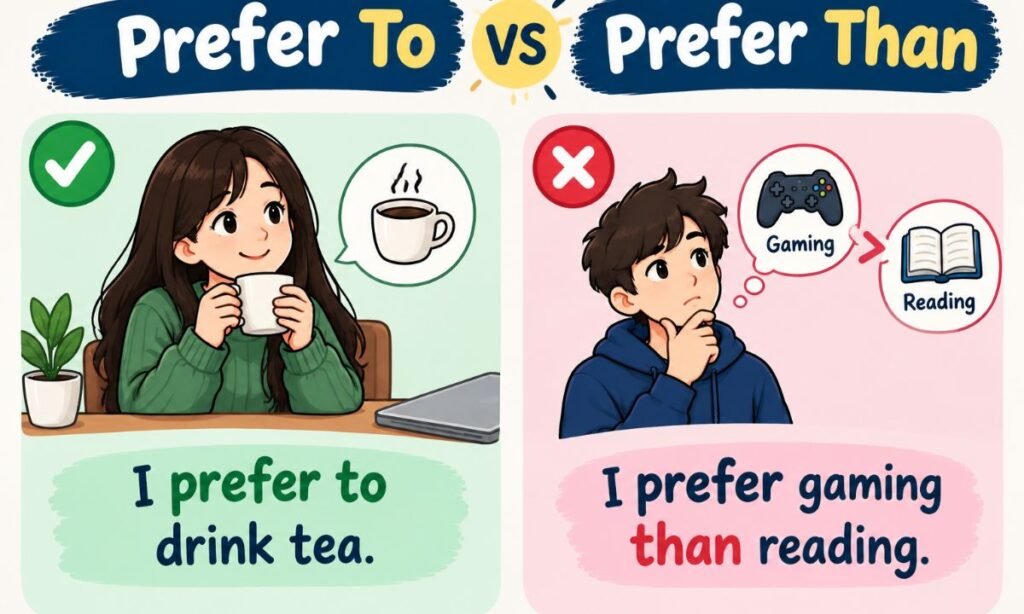
Many learners ask which preposition goes with “prefer.” The short answer: “prefer than” is not standard English.
Use “prefer X to Y” when you compare two nouns or verb-ing forms.
- Correct: I prefer coffee to tea.
- Incorrect: I prefer coffee than tea.
When you compare two full actions, use “prefer to do X rather than (do) Y.”
- Correct: I prefer to walk rather than drive.
- Incorrect: I prefer to walk than drive.
A helpful reminder is that “prefer” already has the comparison built into it, so “than” is unnecessary.
Prefer, Preferred, Preferring, and Preference
Once you know the base spelling, the other forms follow a clear pattern.
- Prefer: present tense (I prefer tea.)
- Prefers: third person singular (She prefers tea.)
- Preferred: past tense and adjective (He preferred tea. Her preferred method is email.)
- Preferring: the -ing form (They are preferring a quiet table.)
- Preference: noun (My preference is the blue one.)
- Preferable: adjective meaning “better” (A short meeting is preferable to a long one.)
One detail trips people up. “Prefer” doubles its final r in preferred and preferring because the stress falls on the last syllable (pre-FER). But in preference and preferable, the stress moves to the front, so the r stays single.
That is why preferred has two r’s, while preference has just one.
Example Sentences
In emails and work
- I prefer to send updates by email so everything stays in one place.
- Would you prefer a morning or afternoon call?
- Our preferred vendor offers free shipping.
In daily conversation
- I prefer my coffee black.
- Do you prefer the beach or the mountains?
- She would prefer to stay home tonight.
On social media
- Hot take: I prefer rainy days to sunny ones.
- Which do you prefer, cats or dogs?
At school
- Many students prefer studying in small groups.
- The author clearly prefers simple language.
Incorrect examples, for learning
- I perfer pizza. (Should be “prefer.”)
- Which do you perfer? (Should be “prefer.”)
Common Mistakes to Avoid
1. Swapping the “r” and the “e”
This is the main error. Say to yourself “pre” at the start, not “per.”
2. Using “prefer than”
Use “prefer X to Y” or “prefer to do X rather than Y.”
3. Writing “prefered” with one r
The past tense is preferred, with two r’s. The same goes for “preferring.”
4. Doubling the r in “preference”
“Preference” has one r in the middle. The stress shifts, so the spelling stays shorter.
5. Trusting spell check blindly
Most tools catch “perfer” now, but a fast typo can still slip through in handwritten notes, forms, and quick messages.
Easy Ways to Remember the Spelling
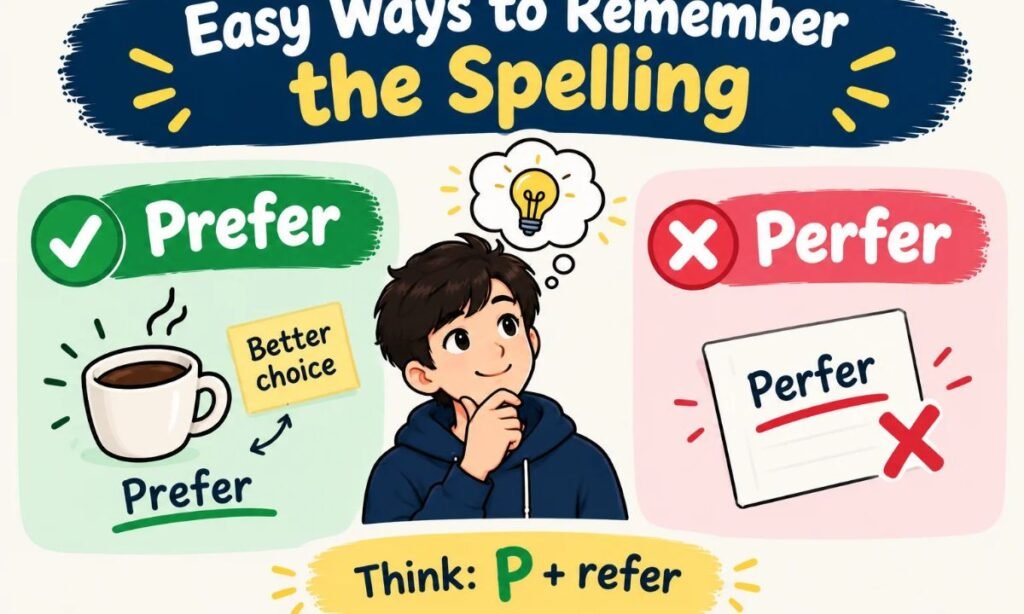
Trick 1: Think “pre.” To prefer something is to put it before other choices. “Pre” means “before,” just like in preview, prepare, and predict.
Trick 2: Match it with “preference.” If you can spell “preference,” you can spell “prefer.” They start the same way.
Trick 3: Say it slowly once. Say “PRE-fer” with a clear pre sound, then go back to your normal speed.
Trick 4: Remember there is only one choice. Unlike spelling pairs where both forms are accepted, prefer is the only correct option.
Frequently Asked Questions
What is the meaning of perfer?
“Perfer” has no meaning in standard English. It is a typo for prefer, which means to like one thing better than another. The only exception is Latin, where “perfer” is a verb form meaning “endure,” but that is unrelated to English writing.
What is the difference between prefer and preferred?
Prefer is the present tense, as in “I prefer tea.” Preferred is the past tense (“She preferred tea”) and also works as an adjective (“our preferred option”). Remember to double the r in preferred.
How do you use prefer correctly?
Use “prefer” with a noun, a verb-ing form, or “to” plus a verb. For example: “I prefer tea,” “I prefer walking,” or “I prefer to walk.” To compare two things, use “prefer X to Y.”
What is the difference between prefer to and prefer than?
“Prefer to” is correct and standard. “Prefer than” is not. Say “I prefer tea to coffee,” or “I prefer to stay in rather than go out.”
Conclusion
The perfer or prefer question has a one-word answer: prefer. “Perfer” is simply a letter swap, and it does not exist as an English word. Keep the “pre” start in mind, remember that preferred doubles its r while preference does not, and use “prefer X to Y” instead of “prefer than.”
With those few habits, you can write about your favorite tea, your ideal meeting time, or your go-to pizza topping without a second thought.

Alexander John grammar content writer with 4 years of experience creating accurate, engaging, and SEO-friendly content. I specialize in spelling differences, commonly confused words, vocabulary, grammar rules, and writing tips. My goal is to simplify English for learners through clear explanations, practical examples, and helpful articles.