
You are typing a caption, a text, or a quick email, and your fingers freeze. Is it “realest or realist”? Both look right, both sound almost identical, and one wrong letter can change your whole message. That tiny vowel swap trips up plenty of confident writers.
The good news is that these two words have nothing in common beyond their root. Once you see what each one does in a sentence, you will never second-guess the choice again.
What Does Realist Mean?
A realist is someone who deals with life as it is, not as they wish it were. They look at facts, weigh the odds, and make plans based on what is likely to happen.
The word comes from “real” plus the suffix -ist, which names a person who follows a certain view or practice. Think of artist, optimist, or pessimist. The same pattern gives us “realist.”
Here are the main ways people use it:
- As a noun: “My sister is a realist, so she always checks the budget first.”
- As an adjective: “The film takes a realist approach to war.”
- In the arts and philosophy: a style or school of thought built around depicting or understanding the world as it truly is.
Notice that “realist” describes a person or an approach. It never compares one thing to another.
What Does Realest Mean?
Realest comes from the adjective “real” plus the ending -est, which makes a superlative. It works like “tallest,” “oldest,” or “purest.” If something is the most real in a group, it is the realest.
The standard comparison chain looks like this:
| Form | Word |
| Base | real |
| Comparative | realer (or “more real”) |
| Superlative | realest (or “most real”) |
So realest is grammatically correct. You will find it in everyday speech, song lyrics, and social media posts far more often than in formal reports, but it is a legitimate word. If you want a more formal tone, “most genuine” or “most authentic” can replace it.
Example: “That was the realest thing anyone said at the meeting.”
Realest vs Realist: Side-by-Side Comparison
This table sums up the difference between realest and realist.
| Feature | Realist | Realest |
| Part of speech | Noun (also adjective) | Adjective (superlative) |
| Core meaning | A person who sees things as they are | Most real, genuine, or authentic |
| Suffix | -ist (a person or follower of a view) | -est (the highest degree) |
| Describes | People, art styles, philosophies | Qualities, people, moments, things |
| Typical tone | Neutral and practical | Casual, emotional, or slangy |
| Example | “She is a realist about money.” | “He is the realest friend I have.” |
| Pronunciation hint | Often three syllables (REE-uh-list) | Two syllables (REE-lest) |
A Simple Trick to Tell Them Apart
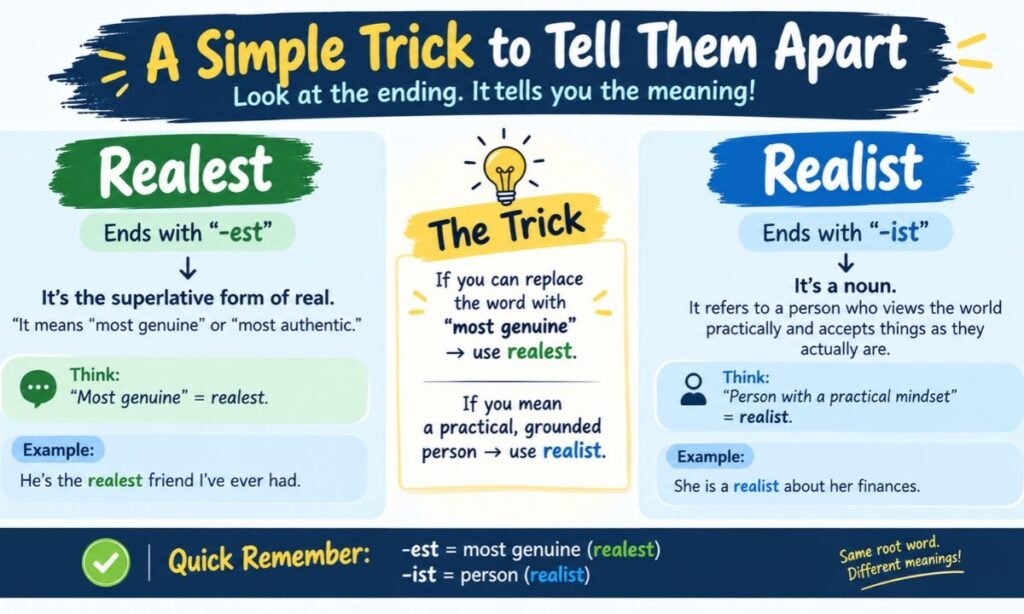
The last three letters do all the work. Ask yourself one question: am I naming a type of person, or comparing degrees of realness?
- -ist = a person or follower. Compare it to artist, activist, and optimist.
- -est = the most. Compare it to biggest, smartest, and kindest.
A quick test also helps. Swap in “most genuine.” If the sentence still makes sense, you want realest. Swap in “practical person.” If that fits, you want realist.
- “She is the (most genuine) person I know.” → realest
- “She is a (practical person), not a dreamer.” → realist
Realest in Slang and Social Media
Online, realest has taken on a life of its own. It grew popular through hip-hop culture and now shows up everywhere, from captions to comment sections. In this slang sense, it usually points to loyalty, honesty, and being true to yourself.
Common ways you will see it:
- “The realest”: a person who is honest and does not put on an act.
- “Realest one”: the most trustworthy friend in the group.
- “Speaking the realest”: saying something blunt but true.
- “Keep it real”: the root idea behind the whole trend, meaning stay authentic.
A quick caution. In slang, “realest” carries praise and personality. In a business email or school essay, it may feel too casual. Match the word to your audience.
Realist vs Realistic: Another Common Mix-Up
People often confuse realist with realistic too, so it is worth separating them.
- A realist is a person (or a viewpoint).
- Realistic is an adjective that describes something believable or achievable.
| Word | Use | Example |
| Realist | Describes who someone is | “As a realist, he expected delays.” |
| Realistic | Describes a plan, goal, or image | “That is a realistic deadline.” |
You can be a realist and still set big goals. The difference is that a realist asks, “What will it take to get there?” A dreamer skips that question.
Realist in Art, Philosophy, and Politics

Many sources skip this part, but it explains why “realist” shows up in more places than casual conversation.
- Art and literature: Realism is a movement that began in the 1800s. Realist painters and writers focused on ordinary life and everyday people instead of idealized scenes.
- Philosophy: A realist believes the world exists independently of what we think about it.
- International relations: A realist focuses on power, national interest, and security instead of ideals.
In each field, the word keeps the same core idea: looking at reality directly. “Realest” never appears in these formal fields because it is a comparison, not a label.
Example Sentences for Both Words
Seeing real sentences helps the difference stick.
Realist examples:
- “I am a realist, so I packed an umbrella even though the forecast looked sunny.”
- “The coach was a realist about the team’s chances this season.”
- “A good manager is part dreamer and part realist.”
- “The novel is known for its realist style.”
Realest examples:
- “That was the realest conversation we have had in years.”
- “She is the realest person in my circle.”
- “Of all the movies this year, this one felt the realest.”
- “He gave me the realest advice I ever got.”
Common Mistakes with Realest and Realist
Here are the errors writers make most often, along with quick fixes.
1. Using “realist” when you mean “most real.”
- Wrong: “He is the realist friend I have.”
- Right: “He is the realest friend I have.”
2. Using “realest” when you mean a practical person.
- Wrong: “I am a realest about my goals.”
- Right: “I am a realist about my goals.”
3. Confusing “realist” with “realistic.”
- Wrong: “That is a very realist plan.”
- Right: “That is a very realistic plan.”
4. Thinking British and American English spell them differently. They do not. Both varieties use realist and realest with the same spelling. The mix-up is about meaning, not region.
5. Overusing “realest” in formal writing. It is correct, but in reports, essays, and cover letters, “most authentic” or “most genuine” often reads better.
Related Words and Opposites
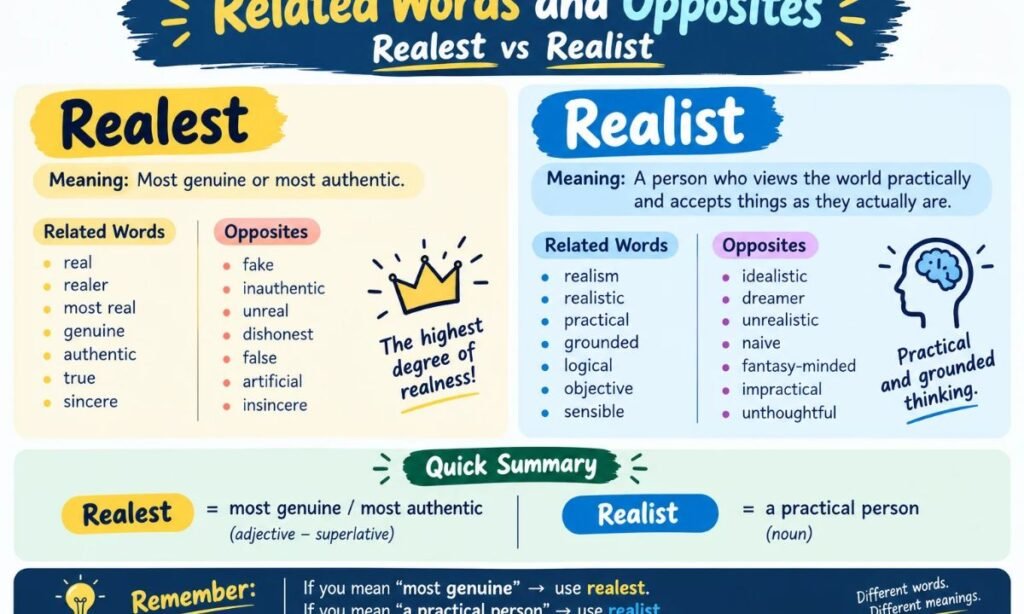
Building a wider vocabulary makes it easier to pick the right word every time.
Synonyms for realist: pragmatist, practical person, down-to-earth thinker, skeptic (in some contexts).
Opposites of realist: idealist, dreamer, romantic.
Synonyms for realest: most genuine, most authentic, most honest, truest, most sincere.
Opposites of realest: fakest, phoniest, least authentic.
Using these alternatives can also keep your writing from sounding repetitive, especially in longer pieces.
Frequently Asked Questions
Is “realest” a real word?
Yes. Realest is the standard superlative form of “real.” It is common in informal speech and writing, and in formal writing you can use “most real” or “most genuine” if you prefer.
Is “realist” a noun or an adjective?
Both. As a noun, it means a person who accepts things as they are. As an adjective, it describes a style or approach, such as a “realist painter” or “realist fiction.”
What is the difference between realest and realist?
Realest compares degrees and means “most real or authentic.” Realist names a person (or viewpoint) that deals with life practically. One is a comparison, and the other is a label.
Does “realest” mean something different in slang?
In slang, realest usually means the most honest, loyal, or authentic person or moment. It is a compliment, often heard in music and social media, such as “You are the realest.”
Conclusion
The choice between realest or realist comes down to a simple question: are you describing a person who sees life as it is, or comparing how real something is? Use realist for the person, the viewpoint, or the art style. Use realest when you want to say “most genuine” in a casual or expressive way.
Remember the suffix trick: -ist names a type of person, and -est means the highest degree. Keep that in mind, and both words will fall into place the next time you write.

Alexander John grammar content writer with 4 years of experience creating accurate, engaging, and SEO-friendly content. I specialize in spelling differences, commonly confused words, vocabulary, grammar rules, and writing tips. My goal is to simplify English for learners through clear explanations, practical examples, and helpful articles.
Pingback: Yours or Your’s: Which Spelling Is Correct?
Pingback: Useable or Usable: Which Spelling Is Correct?
Pingback: Usage or Useage: Which Spelling Is Correct?
Pingback: Course or Ofcourse: Which Spelling Is Correct?
Pingback: Say vs Said: What's the Difference and When to Use Each?
Pingback: Lieing or Lying: Which Spelling Is Correct?
Pingback: Impatient vs. Inpatient: What’s the Difference?
Pingback: Resignate or Resonate: Which Word Is Correct?
Pingback: Flier vs Flyer: Which Spelling Is Correct? Meaning & Examples
Pingback: Goodmorning or Good Morning: Which Spelling Is Correct?
Pingback: Repore or Rapport: Which Spelling Is Correct?
Pingback: Accomodation vs Accommodation: Which Spelling Is Correct?
Pingback: High School or Highschool: Which Spelling Is Correct?
Pingback: Bear or Bare: Which Word Is Correct? Meaning & Examples
Pingback: Potatoes or Potatos: Which Spelling Is Correct?
Pingback: Finaly or Finally: Which Spelling Is Correct?
Pingback: Layed or Laid: Which Spelling Is Correct?
Pingback: Wich or Which: Which Spelling Is Correct?
Pingback: Unphased vs Unfazed: Meaning, Difference & Correct Spelling
Pingback: Kaylee McGhee White Measurements, Height & Biography (2026)