
You are typing a product description, and your spell checker stays quiet. Then you pause: is it useable or usable? Both look fine, and a wrong guess could make your writing seem careless.
Good news: this tiny spelling question has a simple answer, and once you see the logic, you will never second-guess it again. This guide settles it in plain English, with real examples you can copy.
What “Usable” Means
Usable is an adjective. It describes something that can be used, is fit for use, or works well enough to be useful.
It shows up in three common ways:
- Physical condition: The old drill is still usable.
- Practical value: The notes were messy, but a few ideas were usable.
- Design and technology: The app is clean, fast, and usable.
That third meaning is why the word is so popular in tech. When people talk about a “usable interface” or a “usable product,” they mean something easy and practical to work with, not just something that technically functions.
Is “Useable” a Real Word?
Yes. “Useable” is a real word, and major dictionaries list it as an accepted variant of “usable.” It is not a typo, and it does not mean something different.
The catch is how it is treated. Dictionaries present it as the secondary spelling, and most editors and proofreaders will change it to “usable” without a second thought. Think of it as a side door: it gets you inside, but nobody treats it as the main entrance.
So if you have written “useable” before, relax. You did not make an error. You picked the rarer option.
Why Two Spellings Exist
English has a common rule: when you add -able to a word that ends in a silent e, you usually drop the e.
- love → lovable
- like → likable
- move → movable
- size → sizable
- use → usable
Following that pattern, “usable” is the natural result. So why does “useable” exist at all?
Because English also has exceptions. Some words keep the e to protect the sound of the letter before it, as in notice → noticeable (the e keeps the c soft) and manage → manageable (the e keeps the g soft). Some writers keep the e in “use” out of the same instinct, or to make the root word easier to spot. But “use” does not need that protection, so the shorter spelling wins.
Usable vs Useable: Side-by-Side Comparison
| Feature | Usable | Useable |
| Part of speech | Adjective | Adjective |
| Meaning | Able to be used | Able to be used |
| Status | Standard, preferred | Accepted variant |
| Frequency in writing | Far more common | Much less common |
| Follows the drop-the-e rule | Yes | No |
| American English | Preferred | Rare |
| British English | Preferred | Seen occasionally |
| Safe for formal writing | Yes | Better to avoid |
| Related noun | Usability | Usability (same word) |
The meaning is identical. The real difference is how common each spelling is and how polished each one looks to readers and editors.
US vs UK English: Does the Region Matter?
Many spelling debates split along the Atlantic: color vs colour, center vs centre. This one does not.
Usable is the preferred form in both American and British English. You may spot “useable” a little more often in British writing, but it is still the minority choice on both sides.
So if you are wondering how to spell “usable” in the UK, the answer is the same: usable. You do not need to switch spellings for different audiences, which makes life easier.
Which One Should You Use?
Use usable in almost every situation:
- School and academic work: Teachers and style guides expect “usable.”
- Business emails and reports: It looks clean and professional.
- Websites and product pages: It matches how most people type and search.
- Software and design documents: The related term “usability” follows the same pattern.
- Publishing and editing: Use “usable” unless the publisher’s style sheet says otherwise.
There is one situation where “useable” makes sense: when you are quoting someone, matching an existing brand name, or following a client’s or publisher’s style guide that requires it. Outside of that, there is no practical benefit.
The most important rule is consistency. Do not write “usable” in one paragraph and “useable” in the next. Pick one and stick with it.
Example Sentences
Seeing the word in action makes the choice easier.
In everyday life
- The tent had a small tear, but it was still usable.
- Is this coupon still usable, or did it expire yesterday?
- After the storm, only half the road was usable.
At work
- Please send the report in a usable format, like a spreadsheet.
- The survey gave us plenty of usable feedback.
- We need a usable draft by Friday, not a perfect one.
In technology and design
- The new checkout page is far more usable than the old one.
- A usable website loads quickly and makes sense at first glance.
- The team tested the prototype to see if it was truly usable for beginners.
The variant spelling (for recognition only)
- The cabin has two useable rooms.
You may read a sentence like that and understand it perfectly. It is correct, just less common.
Related Words: Unusable, Reusable, and Usability

The same spelling logic covers the whole word family, so learning the pattern once gets several words right.
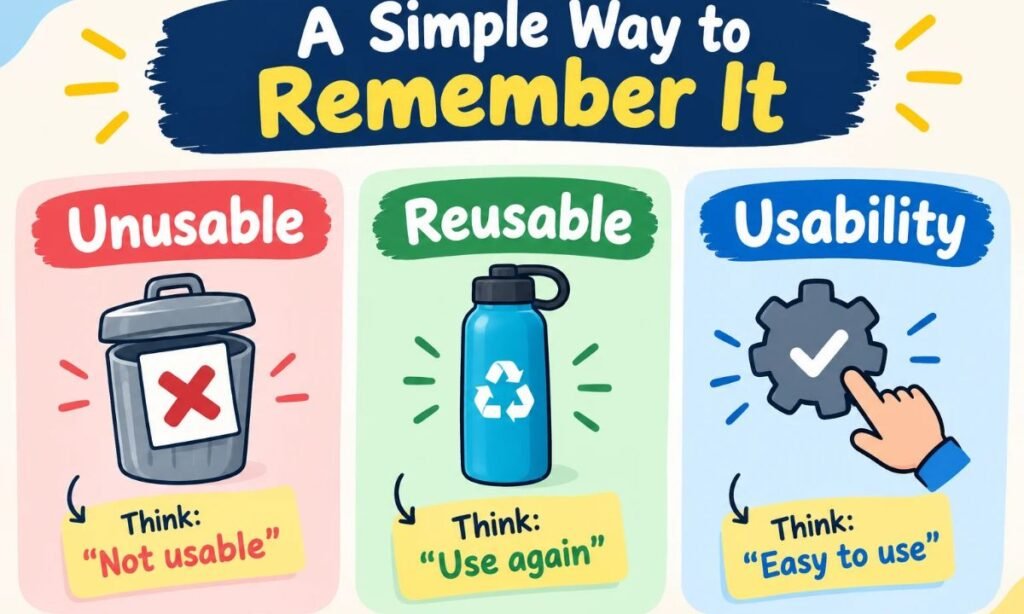
- Unusable: not able to be used (The cracked screen made the phone unusable.)
- Reusable: able to be used again (Reusable bags cut down on waste.)
- Usability: how easy and practical something is to use (The usability of the app improved after the update.)
- Usable product, usable solution, usable interface: common phrases in business and tech writing
Writers rarely type “unuseable,” and “reusable” is far more common than “reuseable.” Choosing “usable” keeps your spelling consistent across all of these words.
Usable vs Useful: Do Not Mix Them Up
These words overlap but are not the same.
- Usable means something can be used.
- Useful means it provides real benefit.
A tool can be usable but not useful if it works but does nothing you need. A tip can be useful but not usable if you cannot act on it. In product and design writing, the best result is both: something people can use and want to use.
Common Mistakes to Avoid
1. Treating “useable” as a serious error
It is not an error. If someone corrects you, they are applying a preference, not a hard rule. Switch to “usable” and move on.
2. Mixing both spellings in one piece
Switching back and forth makes writing look unedited. Choose one spelling and apply it everywhere, including headings, captions, and image text.
3. Breaking the pattern in related words
Writing “usable” but then “reuseable” is inconsistent. Keep the whole word family on the same rule.
4. Overthinking the choice
Readers rarely notice a small spelling variant. Pick the standard option and get back to your message.
A Simple Way to Remember It
If you can drop the e in “love” to make “lovable,” you can drop the e in “use” to make “usable.” When in doubt, cut the e.
For a quick three-step check:
- Are you adding -able to a word that ends in a silent e?
- Is the e needed to keep a c or g soft, as in “noticeable”?
- If not, drop it. That gives you usable.
Frequently Asked Questions
Which is correct, useable or usable?
Both are accepted, but usable is the standard and preferred spelling. “Useable” is a recognized variant that appears far less often. For school, work, and published writing, use “usable.”
What does it mean to be usable?
Something that is usable can be used, is in working condition, or is practical to use. In design and technology, it also means easy to use, as in a usable app or a usable website.
How do you spell “usable” in the UK?
The UK spelling is also usable. Unlike many words that differ between American and British English, this one does not change by region. “Useable” appears occasionally in British writing, but it is still the less common form.
What is a useable?
“Useable” is an alternate spelling of the adjective “usable,” meaning able to be used. It is not a noun and carries no different meaning. If you see it in a sentence, read it exactly as you would read “usable.”
Conclusion
The useable or usable question has one simple answer: choose usable. It follows the common rule of dropping the silent e before -able, it is preferred in the US and the UK, and it matches related words like “unusable,” “reusable,” and “usability.”
“Useable” is a real word and an accepted variant, so there is no need to panic if you have used it before. Stay consistent, follow any style guide you are given, and use the standard form when unsure. One small spelling choice settled, and you can get back to writing.

Alexander John grammar content writer with 4 years of experience creating accurate, engaging, and SEO-friendly content. I specialize in spelling differences, commonly confused words, vocabulary, grammar rules, and writing tips. My goal is to simplify English for learners through clear explanations, practical examples, and helpful articles.