
You are typing the last line of an important email, and your cursor stops. Finaly or finally? That missing letter can make a careful message look rushed, and phone keyboards do not always catch it.
Many confident writers skip the second L without noticing, then wonder why a reader paused. The fix is simple. There is a clear spelling rule behind it, plus a few memory tricks that make the right version stick for good.
What Does “Finally” Mean?
“Finally” is an adverb, so it tells you when or how something happens. It has three main uses:
- After a long wait or effort: “The package finally arrived.”
- As the last item in a sequence: “Finally, add the salt.”
- To signal a closing point: “Finally, I want to thank my team.”
There is also a less common sense, “in a decisive way.” You will see it mostly in formal or legal writing: “The case was finally settled by the court.”
Why “Finally” Has Two L’s
The double L comes from a rule you already use every day. The word starts with the adjective final, which ends in L. To turn most adjectives into adverbs, English adds -ly. You keep the L from “final” and add “ly” after it.
final + ly = finally
The same pattern shows up in many common words:
- real → really
- usual → usually
- total → totally
- casual → casually
- special → specially
“Finaly” breaks this pattern, which is why it looks a little off once you know what to check.
One exception is worth knowing. “Full” becomes “fully,” not “fullly.” It is the odd one out, not the rule.
Where the Word Comes From
“Final” entered English through Old French and traces back to the Latin word finalis, meaning “of the end.” Latin finis meant “end” or “boundary.” That same root sits behind “finish,” “finite,” and “finale.” Every one of these words is about endings, and “finally” is no different.
Finally vs Finaly: Side-by-Side Comparison
| Feature | Finally | Finaly |
| Correct spelling | Yes | No |
| Letters | f-i-n-a-l-l-y | f-i-n-a-l-y |
| Part of speech | Adverb | Not a recognized word |
| Meaning | After a long time, at the end, in conclusion | None |
| Built from | final + ly | Missing one L |
| Safe in formal writing | Yes | Never |
| In texts and social posts | Correct | Reads as a typo |
If you remember only one row, make it the first one.
How to Use “Finally” in a Sentence
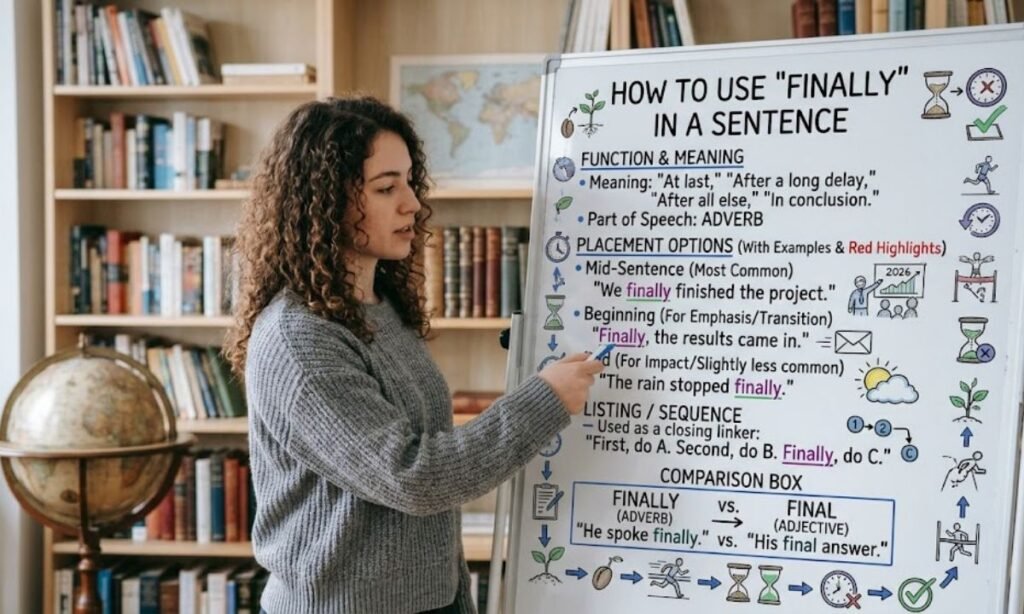
Where you place “finally” changes the feel of the sentence a little.
At the start of a sentence, followed by a comma. Use this to introduce the last step or point. “Finally, let the dough rest for ten minutes.”
Before the main verb. This is the most natural spot for “after a long time.” “She finally finished her degree.”
After “have” or “be.” “We have finally reached the top.” “He is finally home.”
At the end of a sentence. This works, but it sounds more emphatic. “The rain stopped, finally.”
A quick tip: when “finally” opens a sentence, add a comma after it. In the middle of a sentence, you usually do not need one.
Example Sentences From Real Life
Seeing a word in context helps more than a definition, so here are examples from everyday writing.
In emails
- “I finally received the signed contract, so we can move forward.”
- “Finally, please let me know if Friday works for the meeting.”
In news headlines
- “City council finally approves new bridge plan.”
- “After years of delay, the road has finally reopened.”
On social media
- “Finally got my driver’s license!”
- “My phone finally updated. Only took all night.”
In daily conversation
- “Are we finally leaving?”
- “He finally said sorry.”
In school writing
- “Finally, the author argues that real change takes time.”
Incorrect vs. correct (for learning)
| Incorrect | Correct |
| I finaly finished my homework. | I finally finished my homework. |
| Finaly, the bus arrived. | Finally, the bus arrived. |
| She finnaly called me back. | She finally called me back. |
Why People Misspell It
This mistake is common, and it rarely means someone cannot spell. Here are the usual causes.
- Fast typing. Double letters are easy to skip when your fingers are moving quickly.
- Pronunciation. In everyday speech, “finally” is said fast and the two L sounds blend into one. Your ear hears one L, so your hand writes one.
- Trusting autocorrect. Tools fix many typos, but not all of them, especially in subject lines, file names, and short texts.
- Look-alike words. “Final” and “finale” each have one L, which can pull your brain toward a single L.
- A word that looks almost right. “Finaly” looks close enough that the eye skims past it.
You may also see “finnaly,” “finnally,” and “finnaly” in the wild. All of them are wrong. The only correct form is finally.
Easy Tricks to Remember the Spelling
You do not need to memorize a rule when a good trick is available. Pick the one that clicks for you.
- The “final + ly” trick. Say the word in two pieces: final, then ly. Write “final” first and the double L happens on its own.
- The “ally” trick. The ending of “finally” is the word ally. Fin-ALLY. An ally has two L’s, and so does this word.
- The syllable trick. Break it into fi-nal-ly. The middle chunk ends in L, and the last chunk starts with one. The two L’s meet in the middle.
- The proofread trick. Before you send anything, search your draft for “fina” and check each match. It takes seconds.
How to Pronounce “Finally”
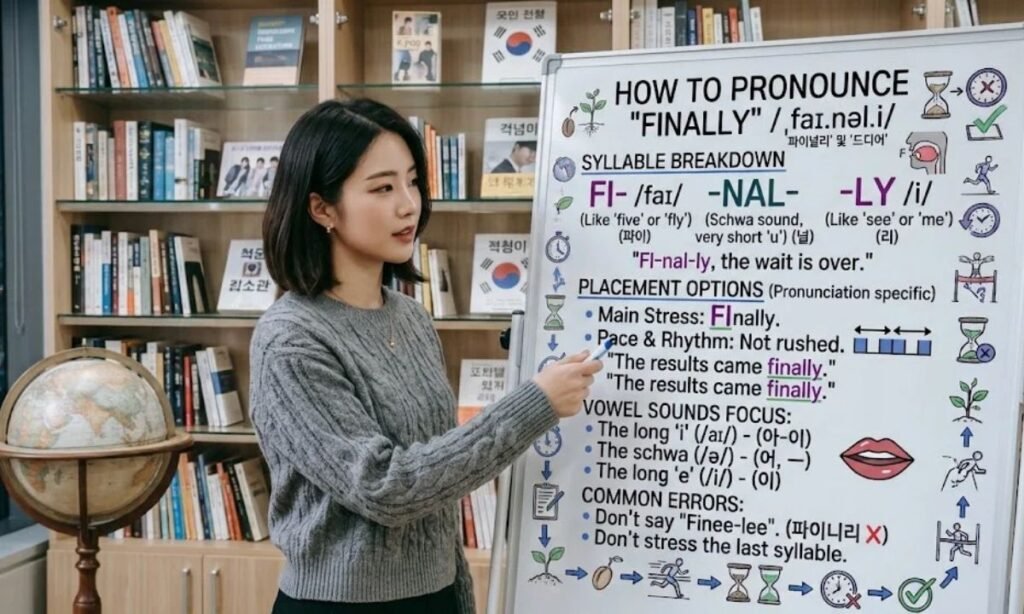
In American English, “finally” is usually said FY-nuh-lee, with three syllables.
- FY rhymes with “high”
- nuh is a short, relaxed sound
- lee ends the word
Some speakers use two syllables, FINE-lee, especially in casual speech. The spelling stays the same either way, which is part of why pronunciation can lead you astray.
Synonyms for “Finally” and When to Use Them
“Finally” is a good word, but you may want some variety. The best replacement depends on what you mean.
| If you mean | Try | Example |
| After a long wait | at last, eventually | “At last, the results are in.” |
| The last step in a list | lastly, to conclude | “Lastly, rinse with cold water.” |
| In the end, after changes | ultimately, in the end | “Ultimately, she chose to stay.” |
| For certain and for good | once and for all, definitively | “The matter was settled once and for all.” |
Do not use “finally” and “lastly” together to close the same list. Pick one.
Finally vs Final vs Finale
These three words share a root, so they are easy to blur together. Each one does a different job.
- Final is an adjective, and in school or sports it can also be a noun. “The final answer.” “She studied for the final.”
- Finale is a noun for the closing part of a show or event. “The fireworks finale was loud.”
- Finally is an adverb that describes when or how something happens. “They finally agreed.”
Here is a simple test. If you can swap in “at last” or “in the end,” you need finally. If you are naming the closing part of a show, you need finale.
Can You Use “Finally” in Formal Writing?
Yes. “Finally” is fully acceptable in essays, reports, business emails, and academic papers. It works best for two things:
- Marking the last point in a list or argument.
- Showing that something happened after a delay.
Do not overuse it. In a long paper, one “finally” near the end is plenty. When a more precise word fits, such as “ultimately” or “in conclusion,” use that instead. And always recheck the spelling before you submit, since a typo in formal writing stands out far more than in a text.
Other Words That Follow the Same Rule
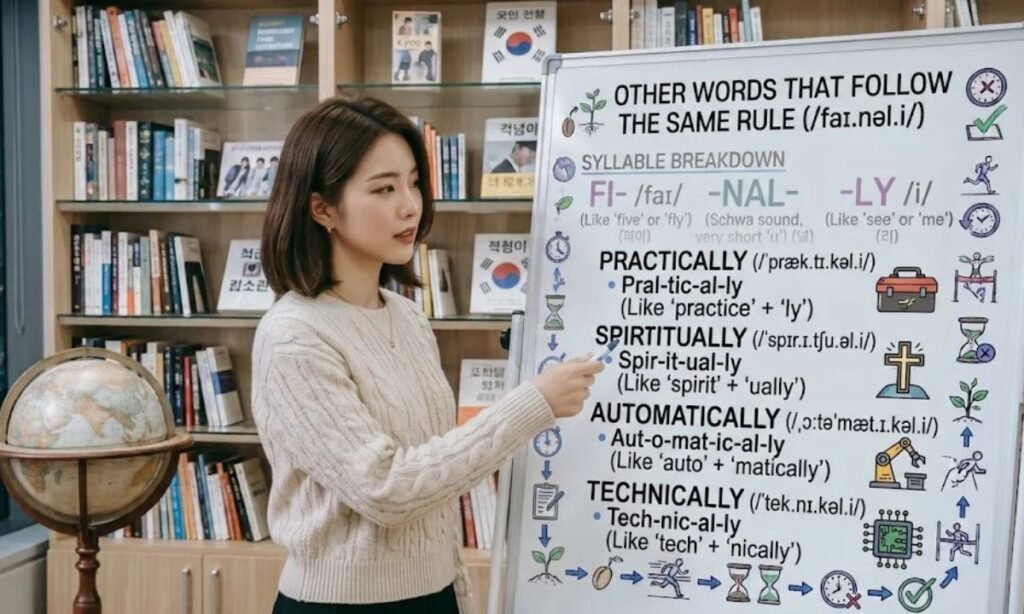
Once you see the pattern, you can spell a whole group of words correctly. An adjective ending in L plus “-ly” gives you a double L.
- accidental → accidentally
- actual → actually
- final → finally
- general → generally
- normal → normally
- personal → personally
- practical → practically
Other commonly misspelled English words with tricky double letters include “accommodate,” “occasionally,” “embarrass,” and “necessary.” Checking double letters is one of the best habits you can build for clean writing.
Frequently Asked Questions
Is “finaly” ever correct?
No. “Finaly” is not a standard English word. The only correct spelling of the adverb is “finally,” with two L’s. If you see “finaly,” treat it as a typo.
Why does “finally” have two L’s?
It is built from the adjective “final,” which already ends in L, plus the ending “-ly.” Both letters stay, so you get final + ly = finally.
What is the easiest way to remember how to spell finally?
Remember that it ends in the word ally: fin-ALLY. You can also think “final + ly,” which gives you the double L automatically.
Can I use “finally” at the start of a sentence?
Yes. When “finally” opens a sentence, follow it with a comma. For example: “Finally, we can start the meeting.” This is correct in both casual and formal writing.
Final Thoughts
The answer to finaly or finally is simple: write finally, with two L’s. It comes from “final” plus “-ly,” and that pattern gives you the double L every time. Keep the “ally” trick handy, slow down when you type fast, and you will not have to wonder about it again.