
Picture the rental shop sign, the packing list, or the trip booking form. You type “two pairs of skis,” then stop. The word ends in I, so surely the plural needs something extra, right? Maybe it is skis or skiis?
One wrong letter on a booking form or a gear listing can look sloppy, and ski season is no time to second-guess yourself. Here is the quick answer, the simple rule behind it, and the related spellings that trip people up too.
Why the Plural Is “Skis”
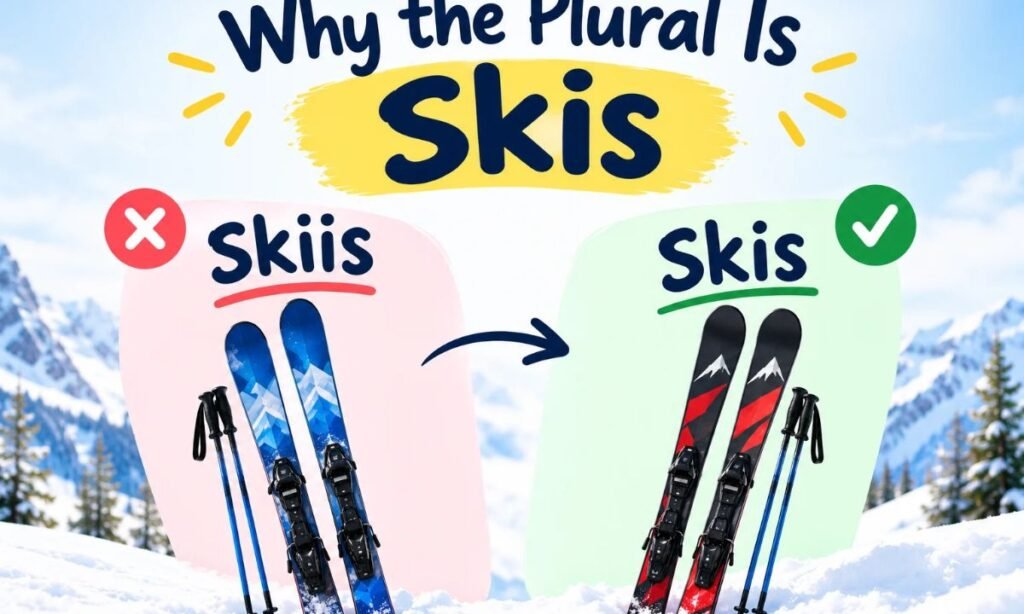
Most English nouns form the plural by adding s. Ski follows that regular pattern.
ski + s = skis
You do not double the I, and you do not add an apostrophe. Nothing about the spelling changes. Many other words that end in I work the same way:
| Singular | Plural |
| ski | skis |
| taxi | taxis |
| kiwi | kiwis |
| bikini | bikinis |
| alibi | alibis |
| safari | safaris |
If you can pluralize “taxi,” you can pluralize “ski.” The word is not special, and no extra I is needed.
What Ski and Skis Mean
Ski is both a noun and a verb.
As a noun, a ski is a long, narrow strip, usually made of wood, plastic, or composite materials, that attaches to a boot and lets a person glide over snow. Since skis are used in pairs, people often say “a pair of skis.”
As a verb, to ski means to travel or play on skis.
- “She skis every weekend in winter.”
The word came into English from Norwegian, and it goes back to an Old Norse word that meant a piece of split wood or a snowshoe. That origin explains why the spelling is short and plain. Nothing in the history of the word asks for a second I.
Skis vs Skies: A Sound-Alike Trap
Sometimes the mix-up is not about a double I at all. Skis and skies look similar and are easy to swap in a quick message.
| Word | Meaning | Pronunciation | Example |
| skis | Equipment for gliding on snow | SKEEZ | He packed two pairs of skis. |
| skies | Plural of sky | SKYZ | The skies cleared by noon. |
The vowel sound is the giveaway. Skis rhymes with “keys.” Skies rhymes with “eyes.” If you are talking about snow gear, you want skis.
Skis or Skiis in British and American English
You can relax here. The spelling is the same in every English-speaking region. Both American and British English use skis.
| Feature | American English | British English |
| Plural of ski | skis | skis |
| Verb forms | ski, skis, skied, skiing | ski, skis, skied, skiing |
| Person who skis | skier | skier |
| Accepted use of “skiis” | No | No |
Whether you write for readers in Colorado, the Alps, or the Himalayas, the plural stays skis.
Skis vs Ski’s: Where the Apostrophe Goes
The apostrophe mistake is just as common as the extra I.
- Skis (no apostrophe) is the plural. It means more than one ski.
- Ski’s (with an apostrophe) shows possession for one ski, or it is a contraction of “ski is.”
- Skis’ (apostrophe after the s) shows possession for more than one ski.
| Form | Meaning | Example |
| skis | plural | I bought new skis. |
| ski’s | belongs to one ski | The ski’s edge is damaged. |
| skis’ | belongs to several skis | The skis’ bindings need adjusting. |
A good test: if nothing belongs to the skis, there is no apostrophe. “The shop sells skis” needs none.
Skiing, Skier, and Skied: Why the Double I Appears Elsewhere
Here is the real reason people write “skiis.” They see two I’s in skiing and assume the plural works the same way. It does not.
Skiing is ski + ing. The root already ends in I, and the ending begins with I. Nothing is dropped, so you get two I’s side by side. The extra letter comes from the ending, not from the plural.
| Word | How it is built | Spelling |
| ski | base word | ski |
| skis | ski + s | skis |
| skied | ski + ed | skied |
| skiing | ski + ing | skiing |
| skier | ski + er | skier |
Notice that skier has only one I before the E. Writing “skiier” is a common mistake, and it comes from the same confusion. The ending is -er, not -ier.
The past tense is also skied, not “skiied.” Add -ed to ski, and you get skied.
Common Spelling Mistakes With Ski Words
| Incorrect | Correct | What went wrong |
| skiis | skis | Extra I added to the plural |
| ski’s (for plural) | skis | Unneeded apostrophe |
| skiies | skis | Treated like a word ending in Y |
| skiier | skier | Extra I before -er |
| skiied | skied | Extra I before -ed |
| skii | ski | Extra I in the base word |
| skies (when you mean skis) | skis | Two different words |
Most of these come from the same source: the word skiing, which genuinely has two I’s. Learn that one exception, and the others make sense.
Easy Ways to Remember the Spelling
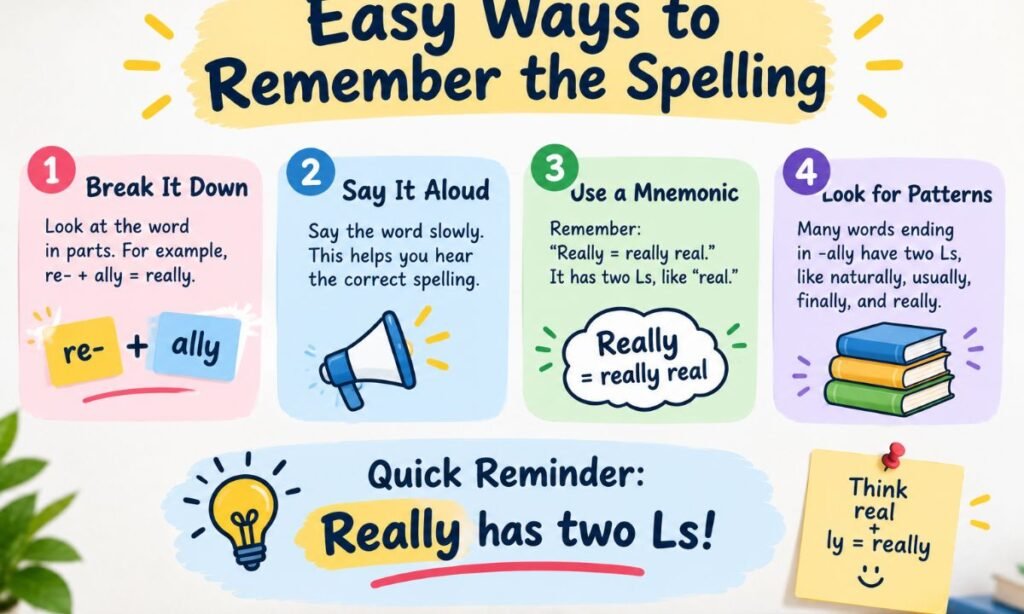
You do not need a chart on your fridge. A few quick habits do the job.
- Treat it like taxi. If “taxis” looks right to you, “skis” is right too.
- Remember one ski, two skis. The plural adds a single letter, the S.
- Save the double I for skiing. Two I’s belong only where -ing attaches directly to the base word.
- Say it out loud. “Skeez” has just one vowel sound before the Z. There is no room for a second I.
Pick one rule, and it will stick well before the first snowfall.
Types of Skis and Their Correct Spellings
Searchers often look for ski gear terms too, so here is a quick reference. Notice that “skis” in each term has only one I.
| Type | What it is for |
| Alpine skis | Downhill skiing at resorts |
| Cross-country skis | Gliding on groomed or backcountry trails |
| Backcountry skis | Skiing in unmarked, off-piste terrain |
| Freestyle skis | Tricks, jumps, and terrain parks |
| Water skis | Skiing behind a boat on water |
| Ski boots | Footwear that locks into the bindings |
| Ski poles | Poles used for balance and pushing |
In compound words, only the first word is spelled with ski. The second word follows its own plural rule. For example, ski resorts, ski boots, and ski lifts all use the plain word “ski” with no S, because it works like an adjective describing the noun after it.
Skis in Everyday Examples
These sentences show how to use the word in common situations.
- “Please confirm the rental of two pairs of skis for Saturday.”
News writing
- “Officials said the avalanche buried several skis and poles near the lift.”
Social media
- “New skis, new season. Let’s go!”
Product listing
- “Lightweight alpine skis with adjustable bindings.”
Formal writing
- “The company manufactures skis for both recreational and competitive use.”
Verb use
- “He skis better than he runs.”
- “They skied until sunset.”
Frequently Asked Questions
Is “skiis” a real word?
No. Skiis does not appear in standard dictionaries. It is a misspelling of skis. The only time you would use it is when quoting someone’s error on purpose.
What is the plural of ski?
The plural is skis. Add a plain S to ski. No apostrophe, no extra letter.
Is it skier or skiier?
The correct spelling is skier. The ending is -er, added directly to ski. “Skiier” is a common typo.
Why does skiing have two I’s?
Because it is built from ski + ing. The base word ends in I and the ending starts with I, so both letters stay. This does not carry over to the plural, which is only skis.
Conclusion
The answer to skis or skiis is clear: skis. You form the plural by adding a simple S, the same way you would for taxi or kiwi. The double I belongs to skiing, where the ending -ing attaches to a root that already ends in I. Everywhere else, including skier, skied, and skis, a single I does the job.
Keep the apostrophe for possession, not for plurals, and watch the sound-alike word skies. With those few points in mind, your next packing list, rental form, or caption will be error free.

Alexander John grammar content writer with 4 years of experience creating accurate, engaging, and SEO-friendly content. I specialize in spelling differences, commonly confused words, vocabulary, grammar rules, and writing tips. My goal is to simplify English for learners through clear explanations, practical examples, and helpful articles.