
You are typing a quick message, and a red line appears under a word you swear is right. You read it again: useing. It looks fine, but something nags at you. This useing or using doubt hits writers at every level, because the word follows a spelling rule that most of us learned years ago and forgot. One extra letter can quietly weaken a resume, an email, or a school essay. Let’s clear it up so you never hesitate on this word again.
What Does “Using” Mean?
Using is the present participle of the verb use. It describes an action that is happening, or an action that explains how something is done. Its core meaning is to employ something for a purpose.
You will see it in three common jobs:
- Continuing action: She is using a new laptop this week.
- Method or tool: He fixed the shelf by using a level and a drill.
- Gerund (acting like a noun): Using a calendar keeps me on schedule.
The same word handles all three. The spelling never changes.
Is “Useing” a Real Word?
No. Useing does not appear in major dictionaries such as Merriam-Webster or Oxford. It is not a British variant, a dialect form, or an older spelling that survived somewhere. It is simply what you get when the -ing ending is added to “use” without following the normal spelling rule.
Spell checkers flag it, and most editors will fix it without comment. Still, in a cover letter or a school paper, a missed correction can make a good piece of writing look rushed.
The Spelling Rule Behind “Using”
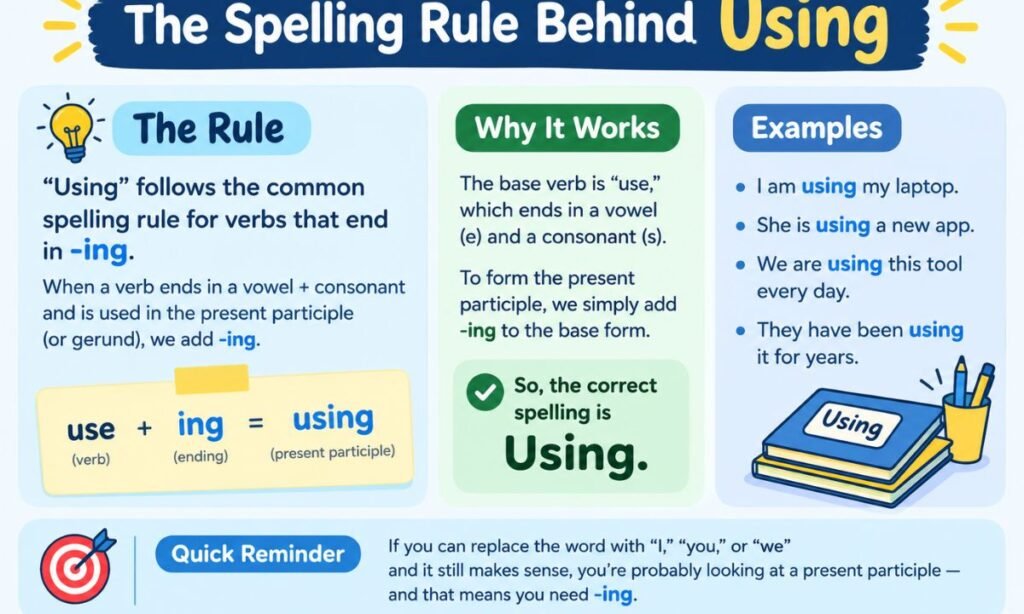
Here is the rule in one line: when a word ends in a silent e, drop the e before adding a suffix that starts with a vowel. The suffix -ing starts with the vowel I, so the e goes away.
Look at how it works step by step:
- Start with the base verb: use
- Spot the silent e at the end
- Remove the e: us
- Add the ending: us + ing = using
Why does English bother? Two vowels in a row from a dropped letter would look cluttered, and the vowel sound stays the same anyway. The U in “using” is still pronounced like the word “you,” because the I that follows keeps it long.
Other Words That Follow the Same Rule
Once you see the pattern, you will notice it everywhere. These verbs all drop the silent e before -ing.
| Base verb | With -ing |
| use | using |
| make | making |
| take | taking |
| write | writing |
| drive | driving |
| hope | hoping |
| close | closing |
| save | saving |
If you would never write “makeing” or “writeing,” you already know the rule. “Useing” breaks it for the same reason those two do.
When the Silent E Stays
Some verbs keep the e, and that is where people get nervous. The exceptions are small and easy to memorize.
- Verbs ending in double e or oe: see becomes seeing, agree becomes agreeing, flee becomes fleeing. The e is part of a vowel pair, not a silent letter.
- Verbs that would be confused with another word: dye becomes dyeing so it does not look like “dying.” Singe becomes singeing so it does not look like “singing.”
- The verb “be”: it becomes being.
“Use” is not on this list. It has a single silent e, so the e drops. If you want a quick test, ask: does the word end in a lone silent e? If yes, drop it.
Using vs Usage vs Use To
Searchers who type “useing or using” often have related questions about nearby words, so here is how they separate.
Usage is a noun. It means the way something is used, or how much of it is used. Data usage rose last month. It is not a replacement for “using.”
Use to vs used to is a different trap. For past habits, used to is the standard form. We used to live near the coast. In questions and negatives with “did,” many writers use “use to”: Did you use to play piano? Some style guides accept both in that setting, so check what your audience expects.
Useable vs usable is a spelling cousin. Both appear in dictionaries, and “usable” is the more common choice in American English. Notice that “usable” drops the e, just like “using.”
Is It “By Using” or “By Use”?
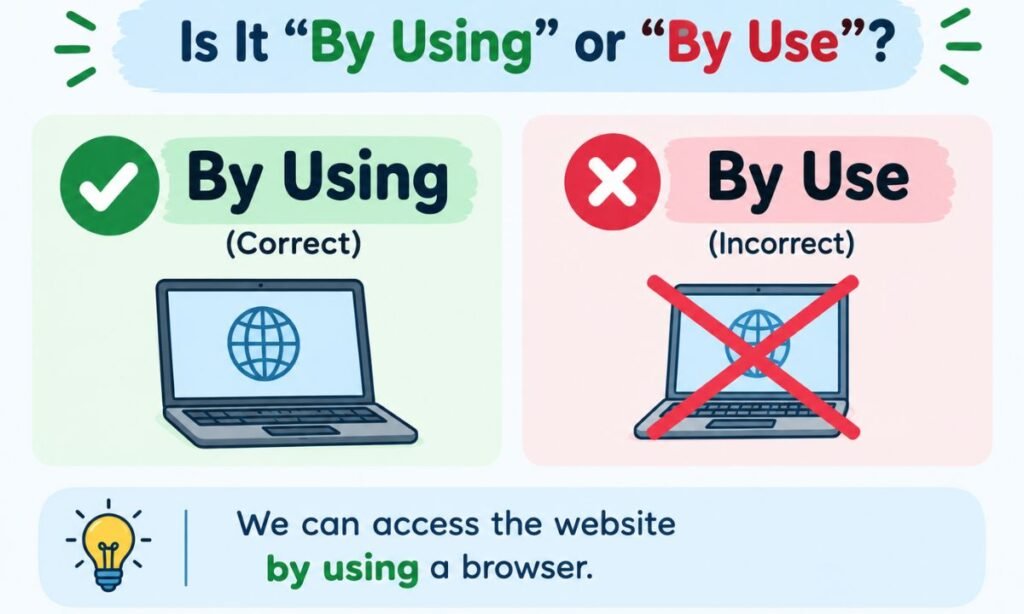
Both can be correct, but they work differently.
By using is followed by the thing you employ, so it acts like a verb. You can lower costs by using recycled boxes.
By use of is more formal and is followed by a noun phrase. The results were achieved by use of a new method.
In everyday writing, by using sounds natural and keeps sentences active. Reach for it first unless the tone is very formal.
Where the Word Comes From
Use entered English from Old French user, which traces back to Latin usus, meaning the act of using or practice. The -ing ending is an old English suffix that forms participles and gerunds.
The mix of a French-derived root and an English ending explains the pattern. English spelling often shows its past in odd places, but the drop-the-e rule for -ing is one of the most consistent ones we have.
British English vs American English
There is no difference. Both American and British English spell the word using. The pronunciation is also the same, usually YOO-zing.
Where the two varieties do split on -ing spellings, it involves a few specific words. For example, Americans write aging while British writers often write ageing. That is a short list of exceptions and has nothing to do with “using.”
Common Mistakes With Using
Here are the errors people make most often, with the fix for each.
- Keeping the silent e: writing “useing.” Fix: drop the e and write using.
- Confusing use and using in sentences: “She use a pen.” Fix: add the right form, She uses a pen or She is using a pen.
- Mixing up use and used: “I am use to this.” Fix: I am used to this.
- Writing “usuing” or “usein”: a slip caused by fast typing. Fix: read the word slowly once, letter by letter.
- Over-trusting autocorrect: a tool might fix the spelling, but it will not fix a wrong form such as “he using” without “is.” Fix: proofread for the helping verb as well.
How to Remember the Correct Spelling

You only need one trick that clicks.
- Say it out loud with a break: us-ing. If you hear the break after the S, there is no room for an e.
- Compare it to words you know: if you write “making” and “taking,” then “using” fits the same set.
- Think of the e as a quiet guest: it leaves the room before the -ing arrives.
- Picture “use” with the e crossed out: then add the ending.
One more tip: when typing, finish the word before you add -ing and ask yourself whether the base ends in a silent e. That two-second check is enough.
Using in Real Sentences
Examples help the spelling feel natural.
Email: Thanks for using our online booking form.
Resume: Improved team reporting by using shared dashboards.
School: The students answered the questions by using evidence from the text.
Social media: Anyone else using the new update? It is much faster.
Casual speech: I am using my sister’s charger until mine arrives.
Instructions: Stir the sauce using a wooden spoon.
Frequently Asked Questions
Is “useing” ever correct in any form of English?
No. Useing is not correct in American, British, Australian, or Canadian English. Always write using.
What part of speech is “using”?
Using is the present participle of the verb “use.” It can act as part of a verb phrase (is using), as a gerund that works like a noun (Using a map helps), or as a participle in a phrase (Using a ruler, she drew the line).
Why is “using” spelled without an e?
English drops a silent e before a suffix that begins with a vowel. Since -ing begins with I, the e from “use” disappears, giving using.
Does autocorrect catch “useing”?
Most word processors and phone keyboards flag and fix it automatically. Still, autocorrect can miss related errors such as a wrong verb form or missing helping verb, so a quick proofread is still worth it.
Final Verdict: Useing or Using?
The answer is using. “Useing” is a misspelling that comes from forgetting to drop the silent e before -ing. Use the same rule you apply to make, take, write, and drive, and you will spell it right every time.
Next time the red line appears, you will know exactly why.

Alexander John grammar content writer with 4 years of experience creating accurate, engaging, and SEO-friendly content. I specialize in spelling differences, commonly confused words, vocabulary, grammar rules, and writing tips. My goal is to simplify English for learners through clear explanations, practical examples, and helpful articles.