
Your boss asks for the report by Friday, and the title on page one reads “Anual Sales Summary.” Something looks off, but you can’t say what. That small itch is the anual or annual problem, and it trips up careful writers every day.
One missing letter can make a polished document look rushed. The fix is easy once you know why the word has two n’s, and this guide walks you through it in plain terms.
What Does Annual Mean?
Annual works as both an adjective and a noun. The adjective is far more common.
- Adjective: happening once every year. Example: “The annual picnic is in June.”
- Adjective: covering or measured over a year. Example: “Her annual salary is listed in the contract.”
- Noun (plants): a plant that completes its life cycle in one growing season. Example: “Marigolds are annuals.”
- Noun (publications): a book or report published once a year. Example: “The school printed its annual in May.”
Most people meet the word in phrases like annual report, annual meeting, annual income, and annual checkup. In every one of them, the spelling stays the same.
Is Anual a Word?
The confusion has a clear source. In Spanish, anual is the correct word for “annual,” and it is spelled with one n. If you speak Spanish or grew up around it, your eye may accept “anual” without a second thought. English borrowed the same Latin root but kept the double n.
That makes “anual” a fair mistake, not a careless one. It just doesn’t belong in English writing.
Anual vs Annual at a Glance
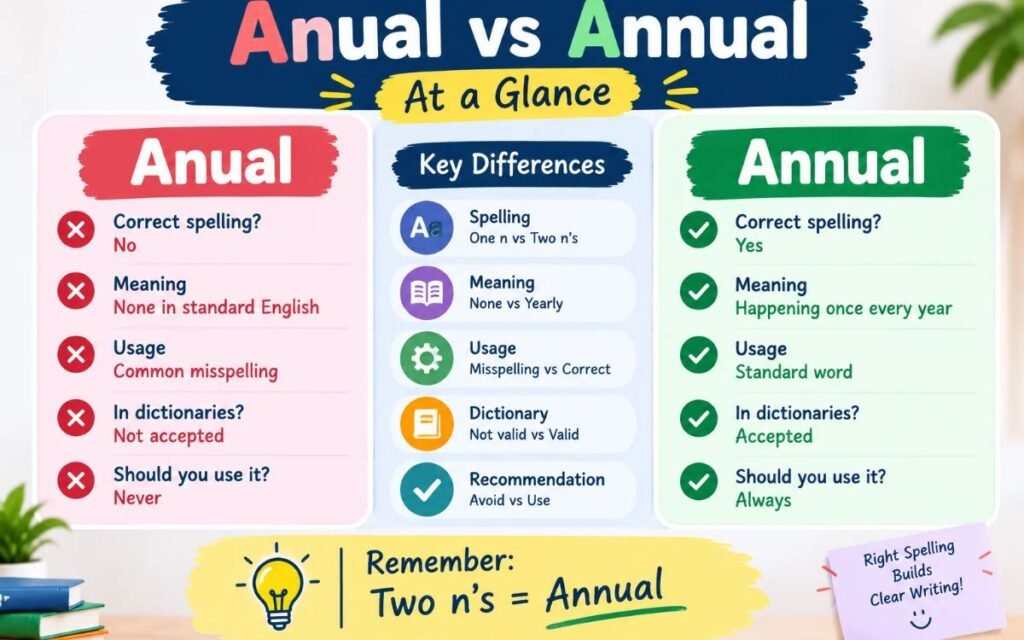
| Feature | Annual | Anual |
| English spelling | Correct | Incorrect |
| Number of n’s | Two | One |
| Part of speech | Adjective, noun | Not recognized in English |
| Accepted in dictionaries | Yes | No (Spanish only) |
| Safe for formal writing | Yes | No |
| Example | “The annual review starts today.” | “The anual review starts today.” (wrong) |
Why Annual Has Two N’s
The word comes from the Latin annus, meaning “year.” The Latin adjective built on it was annualis, and the double n came along into English.
You can see the same root in many familiar words:
- anniversary (a yearly date)
- annuity (a payment made yearly)
- annals (records kept year by year)
- perennial (lasting through the years)
Every one of these keeps the double n or carries the “enn” sound from the same root. If you can spell anniversary, you already know how to spell annual. They are family.
How to Remember the Spelling
A few small tricks help the double n stick.
- Link it to anniversary. Both words describe the calendar, and both use two n’s.
- Think “an” plus “nual.” Say it slowly as an-nu-al. The pause in the middle is the second n.
- Picture a year with two rows. Twelve months, two n’s. It sounds silly, and that is exactly why it works.
- Check for the Spanish trap. If your first instinct is one n, ask yourself whether you are thinking in Spanish.
Annual vs Annually vs Annuals
| Word | Part of speech | Example |
| Annual | Adjective or noun | “Our annual fundraiser raised money.” |
| Annually | Adverb | “The board meets annually.” |
| Annuals | Plural noun | “We planted annuals along the fence.” |
The rule is simple. Use annual to describe a noun, and use annually to describe an action. You would say “an annual inspection” but “inspected annually.”
Both spellings keep the double n. Writers sometimes fix the first n and then drop one in “annually” by accident, so check both.
Annual vs Yearly: Are They the Same?
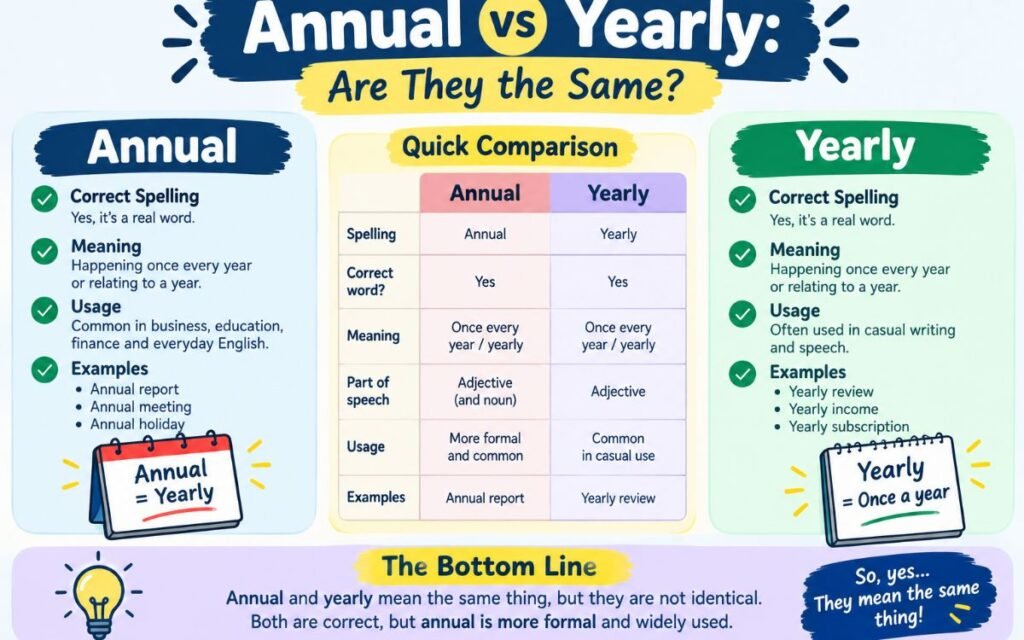
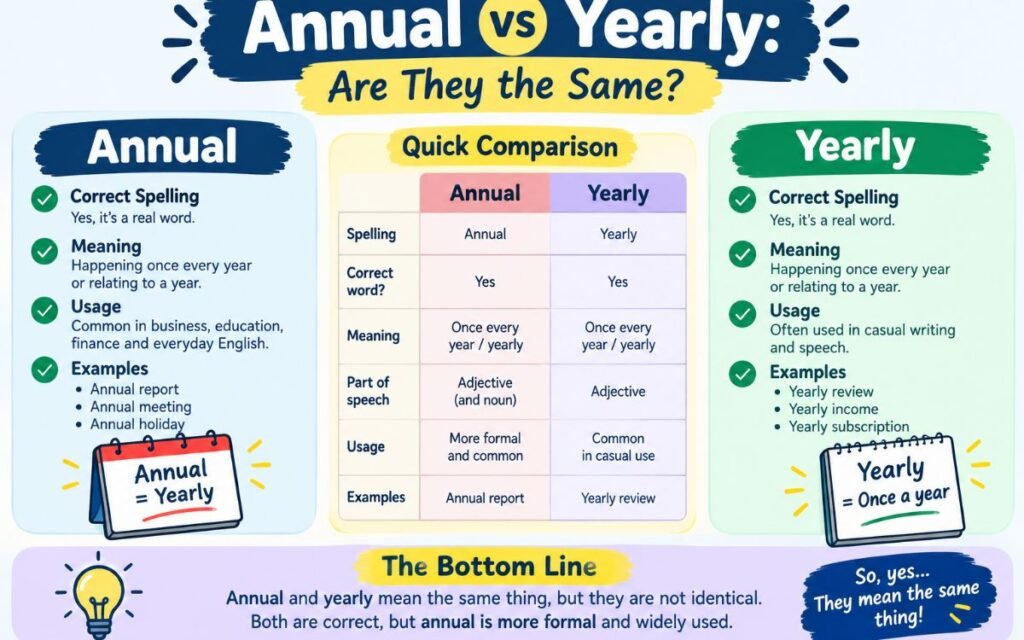
Annual sounds a bit more formal. It fits reports, contracts, business documents, and official events. Yearly sounds more casual and works well in everyday speech.
| Situation | Better choice |
| Financial statement | Annual report |
| Family trip | Yearly trip (or annual, both work) |
| Legal or HR document | Annual leave, annual review |
| Casual conversation | Yearly checkup |
Neither one is wrong in most cases. If you are unsure, choose annual for professional writing.
Annual vs Biannual vs Biennial
This trio is a bigger source of confusion than the anual or annual spelling itself.
- Biannual means twice a year. Semiannual means the same thing and is less confusing.
- Biennial means once every two years.
Because “biannual” and “biennial” look so similar, many writers avoid them. If clarity matters, write “twice a year” or “every two years” instead. Your readers will thank you.
Does Annual Mean a Full Year?
Not always a calendar year. Annual describes a cycle of twelve months, but that cycle may start on any date.
For example, an annual subscription might run from March 5 to March 4. A company’s annual budget might follow a fiscal year that begins in July or October. Annual tax filing, on the other hand, usually follows a set calendar for each country.
So when you see “annual,” think “a twelve-month period.” Check the document if the start and end dates matter.
Example Sentences Using Annual
Work and business
- “The annual report will be released next week.”
- “She received an annual bonus for her performance.”
- “Employees get 20 days of annual leave.”
Money and personal life
- “His annual income increased after the promotion.”
- “We pay the annual fee in January.”
- “Schedule your annual checkup before the end of the year.”
Community and events
- “The town holds its annual parade on the Fourth of July.”
- “Our annual meeting starts at 6 p.m.”
Gardening
- “Zinnias are annual flowers, so you replant them each spring.”
Mistakes to Avoid
- Writing anual. The classic error. Add the second n.
- Writing anually. The same problem in the adverb form. It should be annually.
- Using annual for something twice a year. That would be semiannual.
- Mixing up annual and perennial in gardening. An annual lives one season. A perennial returns year after year.
- Trusting only the spell checker. Some tools accept “anual” if the language is set to Spanish, so confirm your language setting.
If you write for a global team, this last point matters. A document set to the wrong language can quietly pass the wrong spelling.
When to Use Annual in Your Writing
Reach for annual whenever you describe something that repeats every year or covers a full year. Good matches include:
- reports, reviews, and budgets
- meetings, events, and celebrations
- fees, subscriptions, and salaries
- plants that live for one season
Avoid it when the timing is less than a year or more than a year. For those, use words like monthly, quarterly, biennial, or every five years.
Frequently Asked Questions
How do you spell annual?
It is spelled A-N-N-U-A-L, with two n’s in the middle. The adverb is annually, also with two n’s.
Which is correct, annually or annual?
Both are correct, but they do different jobs. Annual is an adjective, as in “annual review.” Annually is an adverb, as in “reviewed annually.”
What is the difference between annual and yearly?
They mean the same thing in most cases. Annual sounds more formal and suits business writing, while yearly sounds more casual and suits everyday speech.
Is annual a full year?
Annual refers to a twelve-month cycle, but it does not always follow the calendar year. Fiscal years and subscription periods can begin on any date.
Conclusion
The anual or annual question has one clear answer. Annual is the correct English spelling, and anual is a misspelling that mostly comes from the Spanish word. The double n comes from the Latin root annus, the same source as anniversary and annuity.
Remember the small rules too. Use annual for describing nouns, annually for actions, and yearly when you want a softer tone. Spell it right, and your reports, emails, and notices will look as polished as they should.