
You type a heartfelt message for a friend’s big win. Your finger hovers over send, and then you freeze. Is it congratulations or congradulations? One letter looks off, and now your warm message feels risky.
Spell it wrong on a graduation card or a work email, and the typo steals attention from the good news. The fix is simple, and once you see why the word is built the way it is, you will not second-guess it again.
Why the Correct Spelling Has a T
Congratulations has a clear history. It traces back to the Latin verb congratulari, which combines con (together) and gratulari (to show joy). That verb grew out of gratus, meaning pleasing or thankful.
That same root gave English several familiar words:
- grateful
- gratitude
- gratuity
- gratify
- congratulate
Every one of them keeps the “grat” chunk. None of them uses “grad.” So when you write congratulations, you are really writing a word about shared joy and gratitude, which is a nice thing to remember when you are sending good wishes.
Why So Many People Write “Congradulations”
The mistake is not random. Three things push people toward the D.
1. Pronunciation. In everyday American speech, the “t” before “u” often sounds like “ch,” and many speakers soften it further. The middle of the word can sound like con-GRAJ-uh-lay-shuns, which hints at a D or J sound.
2. The word “graduation.” Congratulations and graduation show up together all the time, especially in May and June. The brain links them, and “grad” sneaks into the wrong word. Graduate and graduation come from a different Latin root, gradus, meaning step.
3. Spell check habits. Fast typing on a phone leads to guesses. Autocorrect usually fixes the error, but not always, especially in social media captions or text boxes without a spell checker.
So the typo makes sense. It is still a typo.
How to Pronounce Congratulations

Say it in five beats: kuhn-GRACH-uh-LAY-shunz.
- The main stress falls on the second syllable (“GRACH”).
- A secondary stress lands on “LAY.”
- The “t” in the middle sounds like “ch” in standard American English.
If you say the middle part as “GRAD,” you will probably spell it that way too. Train your ear to hear “GRACH,” and your fingers will follow with the T.
What Congratulations Means
Congratulations is an expression of happiness for someone else’s success, good luck, or milestone. You use it when something good has happened to another person and you want them to know you are glad about it.
It works for many moments:
- Finishing school or a degree
- Landing a new job or promotion
- Getting engaged or married
- Welcoming a baby
- Buying a first home
- Winning a competition
- Reaching a personal goal, like finishing a marathon
Notice that the word is almost always plural. People say “Congratulations!” and not “Congratulation!” when greeting someone. The singular form does exist, but it is rare and tends to appear in formal phrases like “a word of congratulation.”
Congratulations in British and American English
Here is some good news for anyone writing across borders. There is no spelling difference between British and American English for this word. Both use congratulations.
| Feature | American English | British English |
| Spelling | congratulations | congratulations |
| Verb | congratulate | congratulate |
| Informal short form | congrats | congrats |
| Accepted use of “congradulations” | No | No |
So you do not need to adjust it for your audience. Whether you write for readers in Chicago, London, Sydney, or Lahore, the spelling stays the same.
Common Congratulations Spelling Mistakes
Besides “congradulations,” a few other misspellings pop up. Here is a quick fix chart.
| Incorrect | Correct | What went wrong |
| congradulations | congratulations | D used instead of T |
| congratulation (as a greeting) | congratulations | Missing the plural S |
| congrajulations | congratulations | J used to match the sound |
| congratulatons | congratulations | Missing the “i” |
| congradulate | congratulate | Same D mistake in the verb |
| congratulashions | congratulations | Spelled by sound |
| congrat’s | congrats | Wrong apostrophe |
The same logic applies to related words. The verb is congratulate, never “congradulate,” and the adjective is congratulatory, never “congradulatory.”
Easy Ways to Remember the Spelling
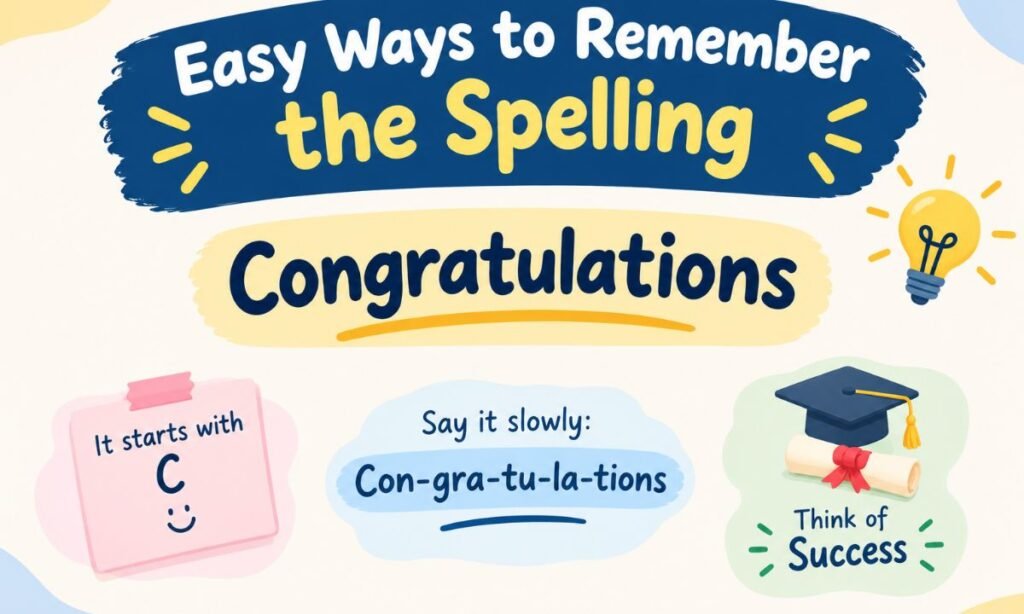
You do not need a long rule. A few quick tricks are enough.
- Think “rat.” Spot the word RAT hiding inside congRATulations. A rat has a T. A “grad” does not belong here.
- Link it to “grateful.” If you can spell grateful, you can spell congratulations. Both share “grat.”
- Split it into chunks. Write it as con + grat + u + la + tions. Say each part out loud once.
- Remember the meaning. You are sharing joy and gratitude with someone, not handing them a diploma.
- Keep graduation separate. Graduation has a D because it is about steps (grades). Congratulations has a T because it is about joy.
Pick the one that sticks for you and use it every time.
Congratulations vs Congrats
Congrats is the casual, shortened form. Both are correct, but they fit different situations.
| Situation | Better choice |
| Text to a close friend | Congrats |
| Social media comment | Congrats or Congratulations |
| Work chat (Slack, Teams) | Either, depending on your team |
| Email to a client | Congratulations |
| Formal letter or card | Congratulations |
| Speech or announcement | Congratulations |
A good rule: if you would say it at a party, “congrats” is fine. If you would say it at a ceremony or put it in writing for someone senior, use the full word.
One small detail: “congrats” has no apostrophe. Do not write “congrat’s.”
How to Use Congratulations Correctly in a Sentence
Related word forms
| Word | Part of speech | Example |
| congratulations | noun (usually plural) | Congratulations to the whole team! |
| congratulation | noun (singular, rare) | She received a word of congratulation. |
| congratulate | verb | I want to congratulate you on your promotion. |
| congratulatory | adjective | He sent a congratulatory note. |
On or for?
The standard pattern is congratulations on + the achievement.
- Congratulations on your new job.
- Congratulations on your success.
- I congratulated her on winning the award.
Using “for” is less common and can sound off to many readers. If you want the safest choice, use “on.”
Punctuation tips
- Add a comma before a name: Congratulations, Maya!
- Use an exclamation mark when you want warmth. Use a period for a calmer tone.
- Capitalize the C at the start of a sentence or greeting. In the middle of a sentence, keep it lowercase.
Congratulations Message Examples You Can Use
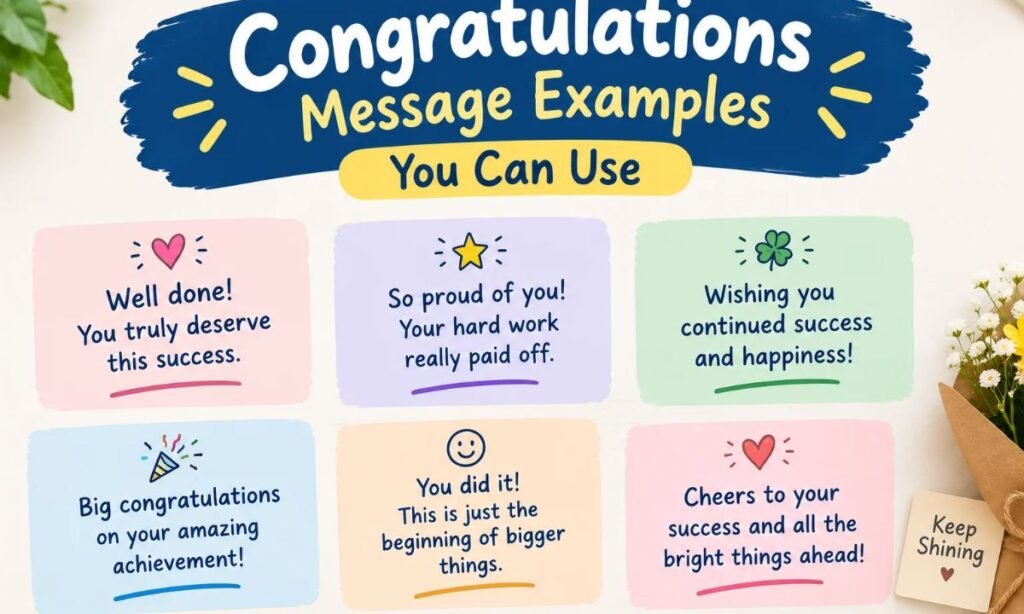
Here are short, natural messages for common moments. Copy them or change them to fit your voice.
Congratulations on your new job
- Congratulations on the new role! They are lucky to have you.
- Big congratulations on your new job. You earned this.
Congratulations on your success
- Congratulations on your success. Your hard work really paid off.
- So proud of you. Congratulations on hitting the goal!
Congratulations on graduation
- Congratulations, graduate! Your hard work got you here.
- Congratulations on your graduation. The next chapter looks bright.
Congratulations on your achievement
- Congratulations on your achievement. It could not have gone to a better person.
- This is a big milestone. Congratulations, and enjoy every minute of it.
Formal email
Dear Ms. Carter,
Congratulations on your appointment as Regional Director. Your leadership has made a real difference to our partnership, and we look forward to working with you in your new role.
Best regards, Daniel Reed
Social media caption
Congratulations to our amazing interns on completing the summer program! 🎉
Each one uses the correct spelling and keeps the tone matched to the moment.
Frequently Asked Questions
Is “congradulations” ever correct?
No. Congradulations is not accepted in standard dictionaries or style guides. It is a phonetic misspelling of congratulations. The only time you would use it is when quoting someone’s error on purpose.
How do you spell congratulations?
Spell it c-o-n-g-r-a-t-u-l-a-t-i-o-n-s. Remember the T after the “a” and the plural S at the end when you use it as a greeting.
Why do people write “congradulations” instead of “congratulations”?
Pronunciation and association cause most of the confusion. The “t” in congratulations often sounds like “ch” or even “j” in casual speech, and the word “graduation” sits right next to it in many celebratory messages. The brain borrows the D from “grad” without noticing.
Can I use “congrats” in professional writing?
Yes, in many cases. Congrats is fine for quick chat messages and friendly emails with colleagues. For formal letters, client emails, announcements, and anything going to senior leaders, write out congratulations.
Conclusion
The answer to congratulations or congradulations is clear: congratulations, with a T, every time. The word comes from a Latin root about joy and gratitude, not from “grad” or “graduate.” The spelling is the same in American and British English, and the verb and adjective forms follow the same pattern (congratulate, congratulatory).
Next time you write a card, post, or email, picture the RAT hiding in congRATulations, and the spelling will fall into place. Then send your good wishes with confidence.

Alexander John grammar content writer with 4 years of experience creating accurate, engaging, and SEO-friendly content. I specialize in spelling differences, commonly confused words, vocabulary, grammar rules, and writing tips. My goal is to simplify English for learners through clear explanations, practical examples, and helpful articles.