
A coworker says the new slogan doesn’t “resignate” with her. You nod, then freeze. Is that a word? The resignate or resonate mix-up catches plenty of confident writers, because the two look alike and blur together in fast speech.
Use the wrong one in an email, essay, or cover letter, and readers notice. Here is the quick fix, plus the logic that keeps you from mixing them up again.
What Does Resonate Mean?
Resonate is a verb with two main senses.
1. To connect emotionally or feel relevant. This is the sense most people mean. When an idea, story, or message resonates with you, it feels true, meaningful, or personal.
- Her speech resonated with the whole audience.
- That song resonates with me because it reminds me of home.
2. To produce or amplify a sound or vibration. This is the original, physical meaning. A guitar body resonates when its strings play. A large hall resonates when sound bounces around inside.
- The bell resonated through the valley.
- The empty room made every footstep resonate.
Both senses share one idea: something echoes back. A sound echoes in a space, and a message echoes in a person’s mind or heart.
Is Resignate a Real Word?
No. Resignate does not appear as a standard word in major English dictionaries, and style guides do not recognize it. If you see it in writing, treat it as an error.
This matters because the mistake can change how readers see you. A typo in a casual text is harmless. In a resume, report, or published article, it can undercut an otherwise strong message.
If you meant the idea of “connecting with someone,” the word you want is resonate. If you meant “quitting a job,” the word you want is resign.
Why Do People Write Resignate?
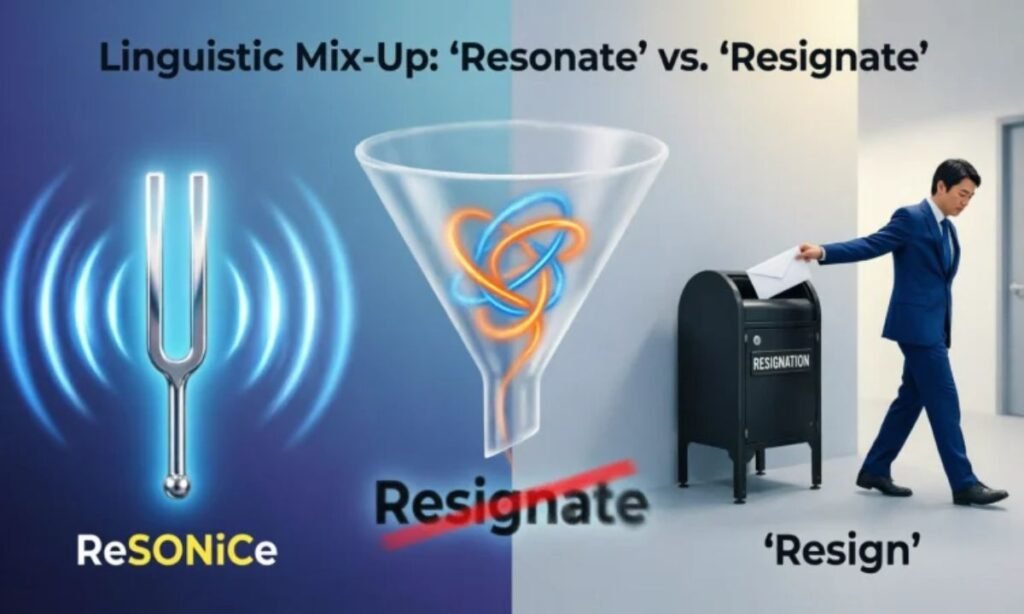
The error is easy to understand once you look at how the brain handles similar words.
- Sound-alike endings. “Resonate” and words like “designate,” “resign,” and “resignation” share a similar rhythm and many of the same letters.
- Fast speech. In casual talking, the middle of “resonate” can blur, so it sounds closer to a word starting with “resi-.”
- Pattern guessing. English has many words ending in “-ate,” so “resignate” feels plausible, even though it is not real.
- Repeated exposure to the error. Once people see a wrong spelling a few times online, it starts to look normal.
None of this means you are bad at spelling. It means two nearby words are competing in your memory.
Resonate vs. Resign: The Words Behind the Confusion
The word people often confuse with resonate is actually resign. Here is how the related family of words works.
| Word | Part of speech | Meaning | Example |
| Resonate | Verb | To connect with someone or echo in sound | The message resonated with parents. |
| Resonance | Noun | The quality of connecting or echoing | The story has real emotional resonance. |
| Resonant | Adjective | Deep, echoing, or emotionally powerful | She has a resonant voice. |
| Resign | Verb | To quit a job or position | He decided to resign on Friday. |
| Resignation | Noun | The act of quitting, or calm acceptance | She handed in her resignation letter. |
| Resigned | Adjective | Accepting something unpleasant | He gave a resigned shrug. |
| Resignate | Not a standard word | Common error | Avoid it. |
The pattern is simple. Anything about sound, echo, or connection uses the “reson-” spelling. Anything about quitting or acceptance uses “resign.”
Where Do These Words Come From?
A little word history makes the difference stick.
Resonate comes from the Latin resonare, which means “to sound again” or “to resound.” The pieces are re- (again) and sonare (to sound). You can still hear the family resemblance in words like “sonic,” “sonar,” and “sound.”
Resign comes from the Latin resignare, which relates to unsealing or canceling. That path leads to the idea of giving up a role or position.
So the two words come from different roots. One is built around sound. The other is built around letting go. Once you know that, “resignate” has no place to belong.
How to Use Resonate in a Sentence

Resonate works in several common patterns.
Resonate with someone (the most common):
- Your story will resonate with first-time homebuyers.
- That advice didn’t resonate with me.
Resonate in or through a place (sound sense):
- The organ music resonated through the church.
A message, brand, or idea that resonates:
- The campaign resonated because it felt honest.
Resonate as a casual agreement (informal):
- “I resonate with that.” This is widely used in conversation, though some editors prefer “That resonates with me” in formal writing.
Notice how the word usually takes the preposition with when it describes a person’s reaction.
Can You Say “I Resonate With That”?
Yes, it is common in speech and informal writing, and many speakers use it naturally. Some style-minded readers consider the more traditional pattern, where the idea is the subject, to sound smoother.
- Everyday talk: “I resonate with that.” Fine.
- Polished writing: “That idea resonates with me.” Usually better.
Both versions use the correct word. The only real mistake is swapping in “resignate.”
Resonate vs. Relate vs. Connect
Writers also wonder how resonate differs from similar verbs. Here is a simple guide.
- Resonate: An idea feels deeply true, moving, or meaningful. It carries emotional weight.
- Relate: You see your own experience in someone else’s. It is more about similarity.
- Connect: You feel a link, which can be emotional or practical.
Compare these two sentences:
- “I relate to her struggle.” You have been through something similar.
- “Her speech resonated with me.” It stirred something in you, even if you have not lived it.
Choose resonate when the effect is strong and lingering, not just a quick nod.
Synonyms for Resonate
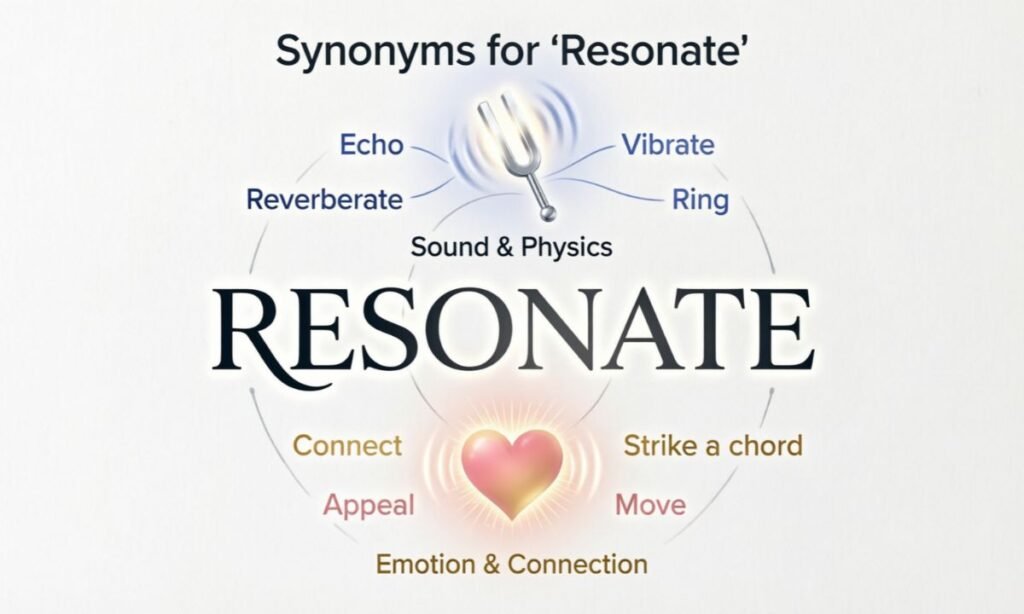
If you want variety, these alternatives fit different situations.
For emotional connection:
- strike a chord
- ring true
- hit home
- speak to someone
- move someone
For sound or echo:
- echo
- reverberate
- resound
- ring out
Use these sparingly. In most writing, plain resonate is clear and professional.
Easy Ways to Remember the Right Word
Try one of these memory tricks:
- Think “sound.” Resonate has the same son as “sonic” and “sonar.” If something echoes, it resonates.
- Think “sign off.” Resign has the word “sign” in it, like signing a letter to quit.
- Say the word slowly. Break it into REZ-uh-nayt. If it doesn’t feel like that rhythm, you may be heading toward the wrong word.
- Run a quick check. Ask yourself: Am I talking about connection or quitting? Connection means resonate. Quitting means resign.
Common Mistakes to Avoid
Writing “resignate” for “resonate.” This is the main error. Replace it every time.
Using “resonate” when you mean “resign.” If someone leaves a job, they resign. They do not resonate.
Forgetting the preposition. Say “resonate with,” not “resonate to” or “resonate for,” unless you mean a sound or vibration responding to something specific.
Overusing it in marketing copy. Writers often claim a message will “resonate with customers” without saying why. Name the specific audience and the feeling you expect.
Confusing resonate with relate. Remember that resonating is deeper and more emotional.
FAQs
Is it resonate or resignate?
It is resonate. Resignate is not a standard English word, and dictionaries do not list it. Always use resonate when you mean something connects with you or echoes.
What does the word resignate mean?
Resignate has no accepted meaning in standard English. It usually appears as a mistaken form of “resonate,” or as a blend with “resign” or “resignation.”
Can you say “I resonate with that”?
Yes. It is common in everyday speech and informal writing. In more formal writing, many people prefer “That resonates with me,” where the idea is the subject.
What does resonate mean in feelings?
When something resonates emotionally, it feels meaningful, true, or personally moving. A song, speech, or story that resonates leaves a lasting impression because it connects with your experience or values.
Conclusion
The resignate or resonate question has a firm answer. Resonate is the real word, and it covers both emotional connection and physical echo. Resignate is a slip, often caused by confusion with “resign.”
Remember the sound link: if something echoes or strikes a chord, it resonates. If someone is leaving a job, they resign. Keep those two ideas apart, and your writing will stay clear, polished, and confident.
Pingback: Good Morning vs Goodmorning: Which Spelling Is Correct?
Pingback: Monkeys or Monkies: Which Spelling Is Correct?
Pingback: Usage or Useage: Which Spelling Is Correct?