
Your plumber says he’ll be there soon. Your boss promises feedback soon. Three hours later, you’re still refreshing your phone. So, how long is soon, really? The trouble is that everyone carries a different clock in their head, and nobody tells you which one they’re using.
That gap causes missed plans, awkward follow-ups, and plenty of quiet frustration. This guide explains what soon means, how long it usually lasts, and how to read it correctly in any situation.
What Does “Soon” Mean?
Dictionaries define soon as “in a short time” or “before long.” It points to the near future without naming a specific moment.
The word has an interesting past. In Old English, the ancestor of “soon” meant “immediately.” Over the centuries its meaning loosened, and today “soon” suggests that something will happen shortly, but not necessarily right now.
That history explains a lot. Some people still hear “soon” as “very quickly,” while others hear it as “sometime in the near future.” Both readings are normal.
Why Soon Has No Exact Time Limit
“Soon” is a relative time expression. Its length depends on what is being measured.
Think about it this way:
- A pizza that will arrive soon means about 30 minutes.
- A package that will arrive soon might mean a few days.
- A baby that will arrive soon could mean a few weeks.
- A new phone model that is coming soon might mean a few months.
The scale changes, but the feeling stays the same: “not long from now, compared with how long this kind of thing normally takes.”
So the better question is not “how long is soon?” but “how long is soon for this?” Context sets the scale, and the speaker’s habits fine-tune it.
How Long Soon Lasts in Different Situations
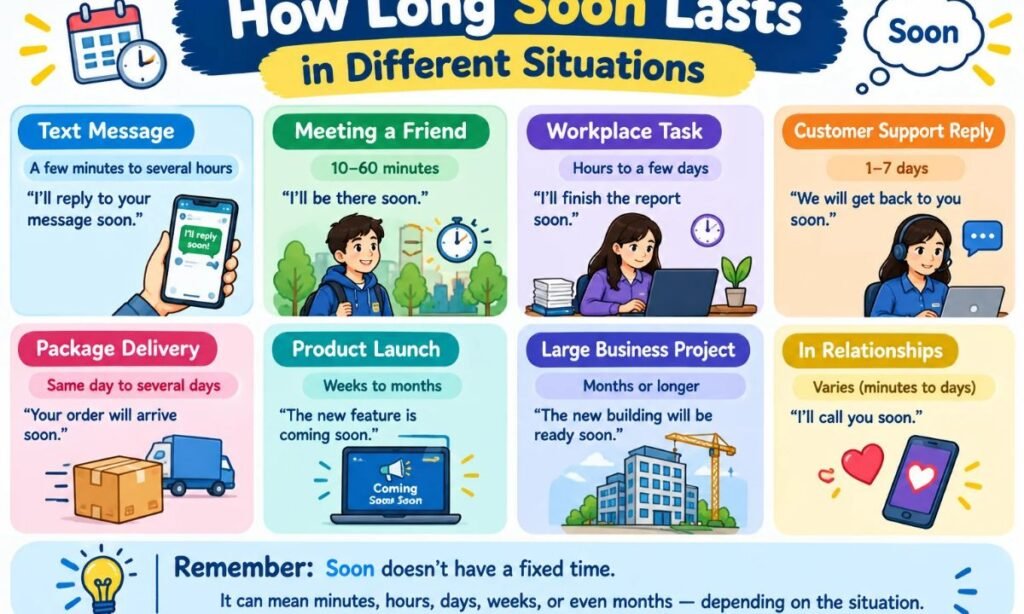
Here is a practical guide to what people usually mean. These are everyday patterns, not official standards.
| Situation | What “soon” usually means | Example |
| Casual text from a friend | 5 minutes to a few hours | “I’ll be there soon.” |
| Food delivery or a ride | 5 to 45 minutes | “Your driver will arrive soon.” |
| Work email from a colleague | A few hours to 2 business days | “I’ll send the report soon.” |
| Customer support reply | 1 to 3 business days | “We’ll update you soon.” |
| Shipping and orders | 2 to 7 days | “Your order will ship soon.” |
| Product launches | Weeks to a few months | “New features coming soon.” |
| Medical results or appointments | Days to a couple of weeks | “The doctor will call you soon.” |
Notice how the same word stretches from minutes to months. The only constant is that the speaker expects the event to happen sooner than “later” would suggest.
Soon in Text Messages
Texting is where “soon” feels the shortest. When a friend writes “omw, be there soon,” they usually mean within 5 to 20 minutes. If they say “I’ll call you soon,” expect a call within a few hours, or by the end of the day.
A few patterns help:
- “Soon” with a location (“almost there, soon”) means minutes.
- “Soon” with a plan (“let’s hang out soon”) is often vague and may mean weeks.
- “Soon!” with an exclamation usually signals enthusiasm, not a deadline.
If you need a real answer, ask a friendly follow-up like, “Soon like 10 minutes or soon like tonight?” Most people appreciate the clarity.
Soon at Work and in Professional Emails
In offices, “soon” tends to mean hours to a couple of business days. It rarely means “right now,” because people who can act immediately usually say so.
Here are examples of how it plays out:
- “I’ll review your draft soon.” Expect feedback within a day or two.
- “We’ll share the results soon.” Could be days, or even a week or two.
- “The update will go live soon.” Check the team calendar, because it often means “no firm date yet.”
The risk at work is false confidence. A manager may say “soon” and mean this afternoon, while you assume this week. If a deadline matters, politely ask for one: “Do you have a rough date in mind?”
Soon in Relationships

This is where “soon” gets emotional. In dating and family life, the word carries hope, and sometimes avoidance.
- “I’ll introduce you to my parents soon.” Could mean a few weeks, or it could be a gentle way to delay.
- “We’ll get married soon.” Couples often use this for anything from a few months to a couple of years.
- “I’ll visit soon.” Without a date, this often means “I want to, but haven’t planned it.”
A useful rule: “soon” without a date or action is a feeling, not a plan. When the answer matters, ask for a timeframe. It is not pushy, just clear.
Soon vs Shortly, Later, Immediately, and Eventually
People often mix these words up. Here is how they compare.
| Word | Typical meaning | Rough timeframe | Example |
| Immediately | Right now, no delay | Seconds to a minute | “Call me immediately.” |
| Shortly | Very soon, slightly more formal | Minutes to a few hours | “The doctor will see you shortly.” |
| Soon | In the near future | Minutes to days | “We’ll talk soon.” |
| Later | At some point after now | Hours to days, undefined | “I’ll do it later.” |
| Eventually | After a long or uncertain wait | Weeks, months, or longer | “He’ll finish it eventually.” |
So how long is shortly? It is usually a touch shorter and more formal than “soon.” You’ll hear it in announcements, medical offices, and customer service (“Your call will be answered shortly”).
The biggest difference between “soon” and “later” is expectation. “Soon” promises closeness in time. “Later” promises nothing except that it is not now.
How to Read “Soon” Correctly
Who is speaking? Someone who is reliable and prompt likely means a short wait. Someone who is often late probably doesn’t.
- What is the task? A reply to a text is quick. A report, a repair, or a delivery takes longer.
- What words surround it? “Very soon,” “real soon,” and “any minute” shorten the window. “Hopefully soon” and “soon-ish” stretch it.
- What is the situation? If someone is already on the way, soon means minutes. If nothing has started yet, it could mean much longer.
How soon is “very soon”? Usually it means a noticeably shorter wait than plain “soon,” but it still has no fixed number. Think minutes to a day or two, depending on context.
Why People Say “Soon” Instead of Giving a Time

Vague words are not always evasive. There are several honest reasons people use “soon.”
- They don’t know yet. If a delivery depends on traffic or weather, a precise time would be a guess.
- They want to stay flexible. “Soon” avoids a promise they might break.
- It sounds friendlier. “I’ll call you at 4:03” feels stiff, while “I’ll call you soon” feels natural.
- It manages expectations. It signals progress without committing to a deadline.
Sometimes, though, “soon” is a polite way to avoid a direct answer. Tone and track record usually reveal which one it is.
Common Mistakes With the Word “Soon”
Because the word is so flexible, a few errors come up again and again.
Assuming everyone’s soon matches yours. Your “soon” might be 10 minutes, and someone else’s might be next week.
Using “soon” when the deadline matters. If a client needs a delivery date, “soon” creates stress. Give a day or a range.
Reading “soon” as a promise. It describes intent, not a guarantee. Treat it as a good-faith estimate.
Using “soon” repeatedly without updates. Saying “soon” three times over two weeks erodes trust. Share a fresh update or a real date instead.
Mixing it up with “immediately.” If you mean now, say now.
Better Ways to Say “Soon”
When clarity matters, swap “soon” for something more specific. Here are options by situation.
For a precise answer:
- “Within the hour.”
- “By end of day.”
- “By Friday.”
- “In about 15 minutes.”
For an honest range:
- “Sometime this week.”
- “In the next few days.”
- “Within two to three business days.”
For uncertainty:
- “I’ll update you by Thursday, even if I don’t have an answer yet.”
- “I expect it to be ready this month, but I’ll confirm.”
Example swap:
- Vague: “I’ll send the contract soon.”
- Clear: “I’ll send the contract by Wednesday afternoon.”
The second version removes guesswork and makes you look organized. It also gives the other person something to plan around.
Frequently Asked Questions
How long would you say “soon” is?
For most everyday situations, soon falls between a few minutes and a couple of days. In casual conversation, it leans toward minutes or hours. In professional or formal settings, it often stretches to days. There is no official number, so context decides.
What qualifies as soon?
Anything that happens in the near future relative to the situation qualifies as soon. A reply to a text can be soon after five minutes, while a repair appointment can be soon after three days. What counts as “near” depends on how long that kind of thing normally takes.
How far away is soon?
Soon is usually not far: minutes, hours, or a few days away. If the event is weeks or months away, people tend to say “in a few weeks” or “later this year,” although “soon” is still used for big events like product launches or weddings.
How many days is “very soon”?
“Very soon” typically means within a day or two, and often much sooner. Because the phrase has no fixed definition, it can range from a few minutes to a few days depending on the situation. If you need certainty, ask for a specific date.
Conclusion
So, how long is soon? It can be five minutes or five weeks, depending on who says it and what they are talking about. The most dependable approach is to use context as your guide: the topic, the speaker, the surrounding words, and the setting.
When timing matters, don’t guess. Ask for a rough time, or offer one yourself. A single clear sentence beats a week of wondering.