
You are posting vacation photos from a mountain path, and the caption is almost ready. Then you freeze. Does that long, exhausting walk get a “c” or not? Treck or Trek trips up plenty of confident writers because the extra letter looks believable.
One wrong caption, email, or travel blog title can quietly undercut an otherwise strong message. Here is the short version, followed by everything you need to spell this word correctly every time.
What Does Trek Mean?
Trek describes a long and often tiring journey. Most people picture hikers on a rugged mountain route, but the word stretches further than that.
It works in two ways:
- Literal meaning: a long trip over difficult ground, such as a multi-day walk through mountains, forests, or desert.
- Figurative meaning: any journey that feels longer or harder than it should, even if it is only across town.
The word carries a sense of effort. A quick stroll to the corner store is not a trek. Hauling groceries up six flights of stairs after the elevator breaks? That is a trek, at least emotionally.
Why People Write “Treck” (and Why It Is Wrong)
The mistake makes sense once you see where it comes from. English has plenty of words where a “ck” ending carries a short “eh” sound: check, deck, neck, wreck, speck. Since “trek” rhymes with all of them, the brain tries to fit it into the same pattern.
Add the fact that “trek” is a short word you may read more often than you write, and the extra “c” slips in easily.
There is one more source of confusion. German has a word spelled “Treck,” which refers to a column of travelers or wagons. Readers who have seen it in German texts may carry the spelling over to English. In English, though, the “c” has no place in the word.
Where the Word Trek Comes From
Trek came into English from Afrikaans, the language of South Africa, which borrowed it from Dutch. The Dutch verb trekken means to pull or to travel. In South Africa, the word became tied to journeys made by ox wagon.
The best known example is the Great Trek of the 1830s and 1840s, when thousands of Dutch-speaking settlers left the Cape Colony and moved inland. English speakers picked up the word during the nineteenth century and gradually used it for any hard, extended journey.
That history explains the spelling. The root is trekken, with a “k,” so the English word keeps the “k” and has no reason to take a “c.”
Trek vs. Treck at a Glance
| Feature | Trek | Treck |
| Standard English spelling | Yes | No |
| Meaning | A long, difficult journey | None in standard English |
| Part of speech | Noun and verb | Not applicable |
| Origin | Dutch and Afrikaans trekken | Misspelling (also a German word) |
| Correct in formal writing | Yes | No |
| Past tense | Trekked | Not applicable |
Trek as a Noun and a Verb

Trek works as both a noun and a verb, which helps when you are building sentences.
- Noun: The trek to base camp took five days.
- Verb: We plan to trek through Patagonia next spring.
Here are the common forms you may need:
| Form | Example |
| trek | They trek every summer. |
| treks | She treks to the village each week. |
| trekked | We trekked for six hours. |
| trekking | Trekking in the Himalayas is popular. |
| trekker | Every trekker needs sturdy boots. |
Notice that trekked and trekking double the “k.” That is the standard rule for short words that end in a consonant after one vowel, as in stop → stopped and plan → planned. The “c” never appears anywhere in this word family.
Trek vs. Hike vs. Walk
People often wonder whether “trek” is just a fancy word for “hike.” They overlap, but the difference is real.
| Word | Typical length | Terrain | Common feel |
| Walk | Short | Paved or easy | Casual, everyday |
| Hike | A few hours to a day | Marked trails | Recreational |
| Trek | Often multiple days | Rugged or remote | Demanding, adventurous |
A useful rule of thumb: hiking is usually a day activity on a trail, while trekking usually involves longer distances, tougher conditions, and sometimes carrying supplies for overnight stops. Many people still use the two words loosely, so the line is not strict. If you are unsure, “hike” is the safer word for short outings.
Example Sentences
Seeing the word in context locks in the spelling.
Literal use:
- The group began their trek across the desert at sunrise.
- She trekked through the jungle for three days to reach the waterfall.
- Trekking in Nepal attracts visitors from all over the world.
- Every trekker on the route carried a lightweight tent.
Figurative use:
- It was a long trek from the parking lot to the stadium entrance.
- After the flood, we had to trek through knee-deep water to reach the shop.
- My daily trek to the third floor wears me out.
Wrong versus right:
- Incorrect: We went on a treck through the mountains.
- Correct: We went on a trek through the mountains.
When Capital “Trek” Appears in Names
You will also meet Trek as a proper name. Star Trek is a well-known science fiction franchise, and Trek is a bicycle brand. These are names, so the capital T and the spelling stay as they are.
For everyday writing, use lowercase “trek” unless you are naming the franchise or the company. Even then, notice that the spelling is the same: no “c” appears.
Common Mistakes to Avoid
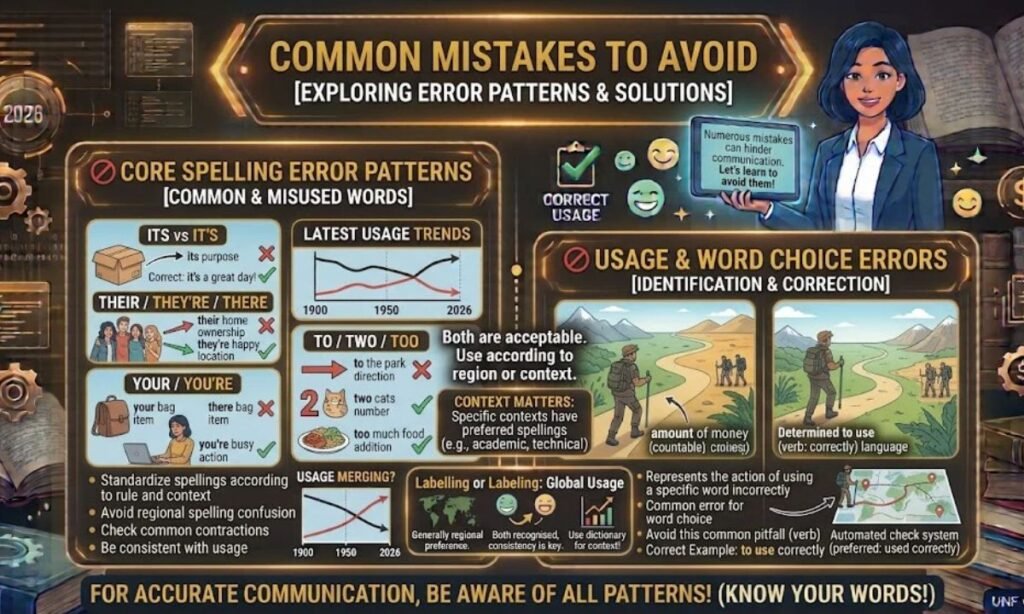
Adding a “c.” This is the big one. Writing “treck” or “trecking” is a spelling error in English. Use trek and trekking.
Writing “trecked.” The past tense is trekked, with two Ks.
Using “trek” for every walk. The word suggests effort and distance. Calling a ten-minute stroll a trek reads as an exaggeration, unless you are making a joke.
Misspelling it as “treak.” Some searchers type “treak,” which is also incorrect. The word has no “a” in it.
Confusing it with “track.” A track is a path or a record of movement. A trek is a journey. They sound different and mean different things, even though both involve a “k.”
How to Remember the Correct Spelling
A few small tricks make the spelling stick.
- Shorter is right. “Trek” is only four letters. If it feels like it needs more, it does not.
- K for kilometers. Treks cover long distances, and kilometers start with a K. Keep the K, skip the C.
- Match the word family. Trek, trekked, trekking, trekker. Say them in a row. Each one has a clean K, so “treck” will feel wrong.
- Link it to its roots. The Dutch word was trekken, so the K was there from the start.
Quick practice: pick the correct spelling.
- The family planned a long (trek / treck) across the island.
- They (trekked / trecked) for hours.
If you answered trek and trekked, you have it.
Where You Are Most Likely to See and Use the Word

The word shows up in more places than you might expect.
Travel and outdoor writing. Guidebooks, blogs, and tour descriptions use “trek” for multi-day routes, such as an Himalayan trek or a jungle trek.
News and feature stories. Reporters use it for long, difficult journeys, including migrations and expeditions.
Everyday conversation. People say “What a trek!” when a trip takes more effort than expected.
Social media captions. Hashtags like #trek and #trekking are common. Since hashtags spread quickly, a misspelled one such as “#treck” can split your post away from the larger conversation.
Emails and messages. A short, friendly line such as “It’s a bit of a trek, so wear comfortable shoes” is natural and clear.
In formal writing, keep the tone steady and use “trek” only when the journey truly is long or demanding.
Frequently Asked Questions
Is treck a real word in English?
No. Treck is not a standard English word. It is a frequent misspelling of trek. The only place “Treck” appears as a real word is in German, where it refers to a column of travelers or wagons.
How do you spell trek correctly?
The correct spelling is t-r-e-k. The past tense is trekked, and the ongoing form is trekking. None of these forms uses a “c.”
What does trek mean?
Trek means a long and difficult journey, usually on foot. As a verb, it means to make that kind of journey. People also use it casually for any trip that feels tiring or slow.
Is trekking the same as hiking?
Not exactly. Hiking usually means a shorter walk on marked trails, often finished in a day. Trekking usually means a longer, tougher journey that can last several days. In casual speech the two words overlap.
Conclusion
Treck or Trek has a simple answer: write trek. It comes from Dutch and Afrikaans, it means a long and demanding journey, and it keeps its K in every form, including trekked, trekking, and trekker. Use it for real adventures or for the annoying walk from the far end of the parking lot. Either way, leave out the extra “c.”