
You type “labelling,” and your spellchecker draws a red line. You switch to “labeling,” and a colleague in London circles it in a draft. Suddenly a simple word feels like a trap.
Labelling or Labeling is one of those spelling puzzles that looks bigger than it is, yet one wrong choice can make a polished page look careless. Good news: both spellings are correct, and the choice comes down to one thing. Here is how to pick without second-guessing.
What Does Labelling or Labeling Mean?
Both spellings come from the verb label and describe the same thing: attaching a label or assigning a name, category, or description to something.
The word works in two main ways:
- Physical use: putting a tag or sticker on an object, such as a jar, a package, or a box.
- Figurative use: describing or categorizing a person, idea, or group, often in a way that sticks.
Meaning does not change with spelling. “Food labeling” and “food labelling” refer to exactly the same practice. Only the regional spelling differs.
The Core Difference Between the Two Spellings
The difference is one letter. British English doubles the final L before adding -ing. American English keeps it single.
| Feature | Labelling | Labeling |
| Letter count | Two Ls in the middle | One L in the middle |
| English variety | British | American |
| Past tense | Labelled | Labeled |
| Person who labels | Labeller | Labeler |
| Common regions | UK, Ireland, Australia, New Zealand, India, South Africa | United States |
| Meaning | Identical | Identical |
| Pronunciation | Identical | Identical |
Both versions sound the same when you say them aloud: roughly “LAY-buhl-ing.” Only the look on the page changes.
Why English Has Two Spellings
The split goes back to how English spelling evolved on each side of the Atlantic.
The word label entered English from Old French, where it referred to a ribbon or strip. Over time it came to mean a small piece of material attached to something to identify it.
British English kept the habit of doubling a final consonant when adding endings like -ing and -ed. American English moved toward simpler spellings, partly thanks to Noah Webster, whose early nineteenth century dictionaries promoted forms such as “traveler” over “traveller.” Many of those simplified spellings stuck in the United States.
So neither spelling is a mistake or a modern invention. They are two long-running conventions that took different paths.
The Rule Behind the Extra L
The pattern is easy to spot once you see it:
- British English usually doubles a final L after a single vowel, even when the last syllable is unstressed: label → labelling, travel → travelling, cancel → cancelling.
- American English usually keeps it single when the last syllable is unstressed: label → labeling, travel → traveling.
American English does double consonants when the stress falls on the final syllable, as in begin → beginning or refer → referring. Since “label” stresses the first syllable, the American form stays single.
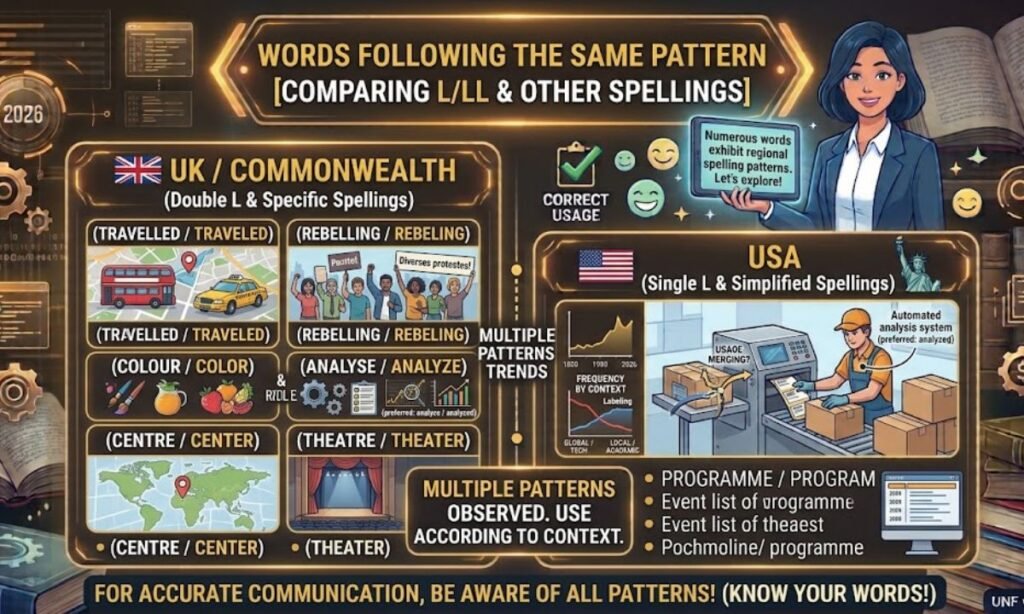
Other Words That Follow the Same Pattern
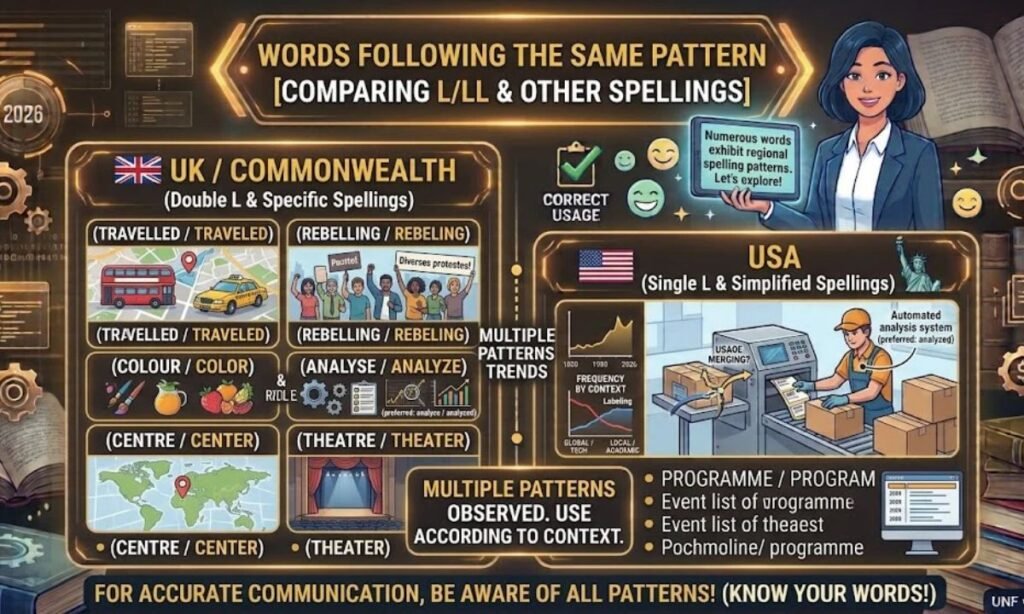
Once you understand “label,” a whole group of words falls into place. Each pair below uses the same rule.
| Base word | British English | American English |
| model | modelling | modeling |
| level | levelled | leveled |
| signal | signalling | signaling |
| fuel | fuelling | fueling |
| channel | channelled | channeled |
| travel | travelling | traveling |
If you remember one pair, you effectively remember them all. That is also why a writer who uses “modelling” in a British report should use “labelling” in the same document.
Which Spelling Should You Use?
Match the spelling to your reader, not to your own habit.
Use “labeling” if:
- Your audience is mainly in the United States.
- You are writing for an American publication, employer, school, or client.
- Your style guide follows US conventions, such as AP or Chicago.
Use “labelling” if:
- Your audience is mainly in the UK, Ireland, Australia, New Zealand, India, or South Africa.
- You are submitting work to a British publication or university.
- Your style guide follows British conventions.
Canada is a mixed case. Canadian writers often lean toward double-L forms such as “labelled” and “travelling,” but usage varies by publication. If you write for a Canadian outlet, check its style guide.
If your audience is global, choose one spelling and stay consistent. Readers forgive either version. They notice when a page switches back and forth.
Related Word Forms You May Also Need
The rest of the word family follows the same rule.
| Word form | British English | American English |
| Past tense | labelled | labeled |
| Present participle | labelling | labeling |
| Person who labels | labeller | labeler |
| Wrongly labeled | mislabelled | mislabeled |
| Wrong labeling (noun) | mislabelling | mislabeling |
| Label again | relabelled | relabeled |
| No label | unlabelled | unlabeled |
The plain noun and base verb, label, are the same everywhere. Only the forms with endings split.
Example Sentences
Seeing both spellings in context makes the pattern stick.
British English:
- The shop was fined for mislabelling its organic produce.
- She spent the afternoon labelling boxes for the move.
- The labelled diagram helped the whole class follow the lesson.
- Clear allergen labelling is a legal requirement for food sold in the UK.
American English:
- The company is accused of mislabeling its supplements.
- He spent the afternoon labeling boxes for the move.
- The labeled diagram helped the whole class follow the lesson.
- Clear allergen labeling is required on packaged foods sold in the US.
Figurative use:
- Labeling a child as “shy” can shape how they see themselves. (American)
- Labelling a child as “shy” can shape how they see themselves. (British)
Where the Spelling Choice Matters Most
For casual texting, nobody will mind. In some settings, consistency counts.
Product packaging and compliance. A US snack company writes “nutrition labeling.” A UK retailer writes “nutrition labelling.” Using the wrong variety makes regional documents feel off.
Academic writing. Universities usually expect one consistent variety. Check the department’s guidelines and match them.
Business and marketing copy. One spelling across your website, brochures, and emails looks professional. Mixed spellings look like a team that never proofread together.
Data and technology work. In machine learning, “data labeling” is common in American sources, while British and Commonwealth sources often write “data labelling.” Match your documentation.
Proper names and official titles. If a law, agency, or product uses a specific spelling in its name, keep it exactly as written, even if it differs from your usual style.
Spellchecker settings. In most apps, English (US) flags “labelling,” and English (UK) flags “labeling.” If your tool keeps underlining the wrong word, the language setting is usually the cause.
Common Mistakes to Avoid
Mixing both spellings in one document. Writing “labeling” in one paragraph and “labelled” in the next is the most frequent slip. Choose a variety before you start.
Calling one spelling wrong. Neither is an error. American dictionaries recognize “labelling” as a variant, and British writers regularly see “labeling” in international content. The only real problem is inconsistency.
Adding extra letters. Forms such as “lablelling” or “labbeling” are typos. The base word is label, so the ending attaches directly.
Applying the rule to only part of the family. Writing “labelling” but “labeled” in the same piece breaks the pattern. If you pick the British form, use labelled and labeller too.
Forgetting that the base word never changes. “Label” is the same in every variety, so you only need to decide when you add an ending.
Easy Ways to Remember the Difference
A few quick tricks make the choice automatic.
- Americans trim. American spelling is lighter, so it uses one L: labeling.
- Britain doubles up. British spelling adds weight, so it uses two Ls: labelling.
- Follow the family. If you already write “travelling” and “cancelled,” use “labelling.” If you write “traveling,” use “labeling.”
Quick practice: which one fits a sentence written for a Chicago newspaper? Labeling. And for a London magazine? Labelling. If you got both right, you are set.
Frequently Asked Questions
Is labelling or labeling correct?
Both are correct. “Labeling” is the standard American spelling, and “labelling” is the standard British spelling. The right choice depends on who will read your writing.
Is labelling one L or two?
“Labelling” has two Ls in the middle, which is the British form. “Labeling” has one L, which is the American form. The word “label” itself has just one L at the end.
Do labelling and labeling mean the same thing?
Yes. They share the same meaning, the same pronunciation, and the same uses. Only the spelling changes between British and American English.
Is labeling wrong in British English?
It is not a serious error, but it will look American to British readers. If you are writing for a UK audience, “labelling” is the safer and more natural choice.
Why does British English use a double L?
British English traditionally doubles a final consonant after a short vowel when adding endings like -ing and -ed, even when the syllable is unstressed. American English dropped that habit for many words, which created pairs such as labelling/labeling and travelling/traveling.
Conclusion
Labelling or Labeling is not a question of right versus wrong. It is a question of audience. Use labeling for American readers and labelling for British and most Commonwealth readers. Keep the whole word family consistent, from labeled to labeller, and set your spellchecker to the right language. Do that, and this one-letter difference stops being a problem.