
You are typing an email about a washing machine, and your phone suddenly swaps a word for a name. Now your note says to check the Manuel. Awkward. Mixing up Manuel or Manual is a tiny slip, but it can make a sentence look careless or just plain confusing.
The good news is that the fix takes about ten seconds. Once you know which word is a person and which is a book of instructions, you will not second guess it again.
What “Manual” Means
“Manual” is a regular English word with two main jobs.
As a noun, it means a book or guide that explains how to use something or how to do a task.
- The car manual says how often to change the oil.
- Every new employee gets a staff manual on day one.
As an adjective, it describes something done by hand or controlled by a person instead of a machine.
- Manual labor means physical work done with the hands and body.
- A manual transmission is a gearbox the driver shifts personally.
- A manual override lets a person take control from an automatic system.
So “manual” can be a thing you read or a way of doing something. Both meanings come back to human hands.
What “Manuel” Means
“Manuel” is a given name, common in Spanish, Portuguese, and French speaking cultures. It is a form of Emmanuel, which comes from the Hebrew name Immanuel, often translated as “God is with us.”
Because it is a proper noun, it always starts with a capital letter. You will see it as a first name, such as footballer Manuel Neuer, or in place names like Manuel Antonio National Park in Costa Rica. Sitcom fans may remember Manuel, the Spanish waiter in Fawlty Towers.
“Manuel” is not an English vocabulary word. You will not find it in a dictionary as something you read, do, or operate. It only shows up when you are talking about a person or a place named after one.
Manuel vs Manual at a Glance
| Feature | Manual | Manuel |
| Word type | Noun and adjective | Proper noun (first name) |
| Meaning | Instruction book, or done by hand | A person’s name |
| Capitalized? | Only at the start of a sentence or in a title | Always |
| Ending | -al | -el |
| Typical pronunciation | MAN-yoo-uhl | mah-NWEL (Spanish style) |
| Example | “Read the manual first.” | “Manuel is joining us for dinner.” |
| Used for | Guides, hand-operated things, physical work | People |
Where the Words Come From
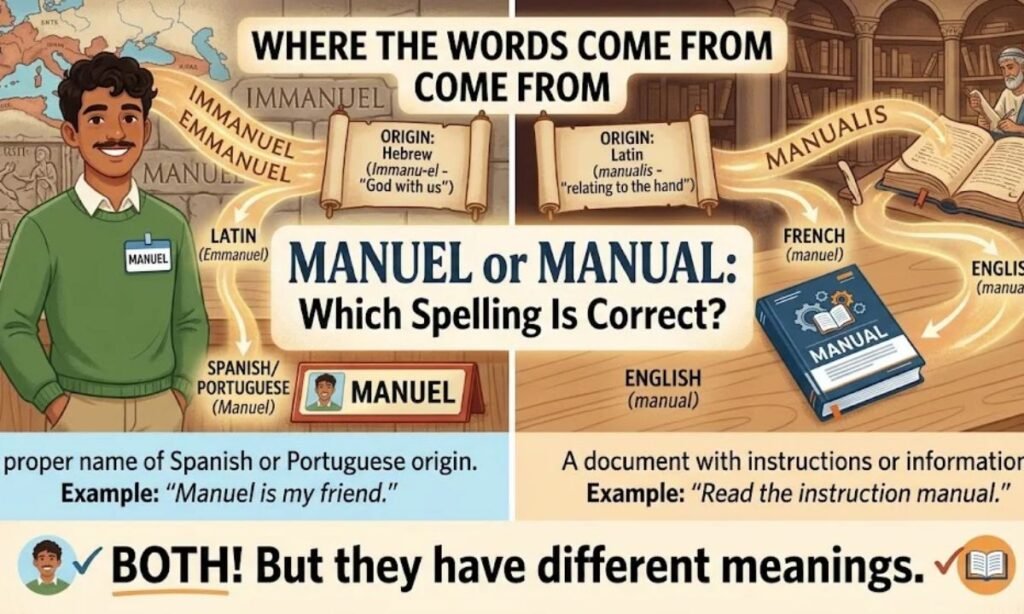
Both words look like cousins, but they took different paths.
“Manual” traces back to the Latin manualis, linked to manus, meaning “hand.” That is why the word still connects to hands today: manual work, manual controls, even a handbook small enough to hold.
“Manuel” developed as a shorter form of Emmanuel and spread through Spain, Portugal, France, and Latin America. Its -el ending matches other names like Samuel, Rafael, and Miguel.
One word is about hands. The other is about a name.
How to Pronounce Each Word
Sound is another quick way to tell them apart.
- Manual is pronounced MAN-yoo-uhl. It has three syllables, and the middle sounds like “you.”
- Manuel in Spanish is closer to mah-NWEL, with the stress on the second syllable. English speakers often say it in a similar way.
If you are talking about a real person named Manuel, say the name the way he says it. Asking is polite and perfectly normal.
Example Sentences
Seeing the words in context makes the difference stick.
Using “manual”:
- I lost the manual for my air fryer, so I looked it up online.
- She prefers a manual coffee grinder because it is quieter.
- The job involves a lot of manual work, like lifting and carrying.
- Switch the system to manual mode if the sensor fails.
- The pilot took manual control during landing.
Using “Manuel”:
- Manuel called to say he is running ten minutes late.
- I asked Manuel to send me the report by Friday.
- We are meeting Manuel and his sister at the station.
- The package is addressed to Manuel Garcia.
Here is a simple test. If you can swap the word with “guide” or “by hand,” use manual. If you can swap it with another first name like “Daniel,” use Manuel.
Why People Mix Them Up
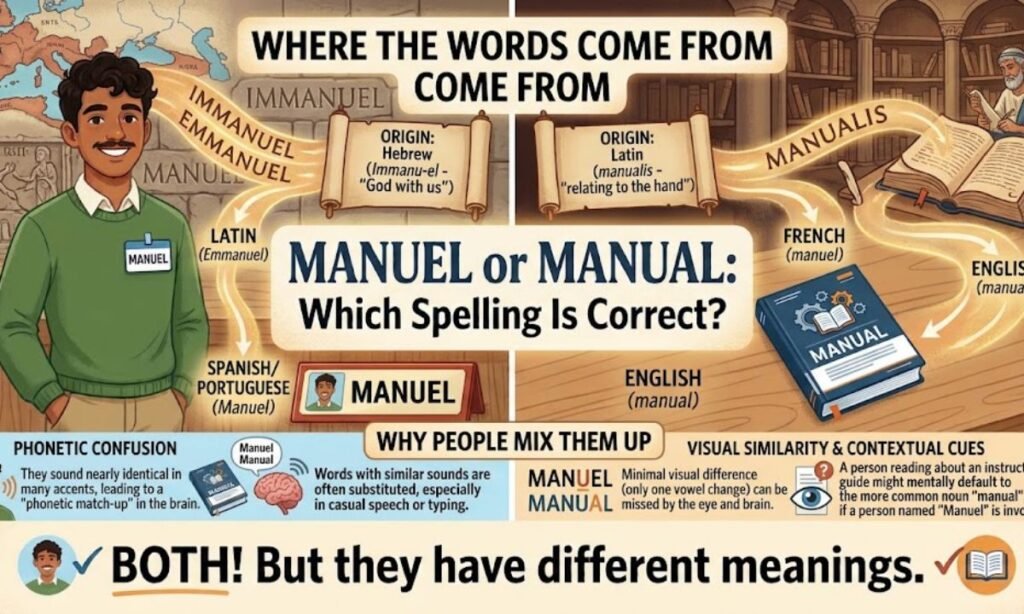
This confusion is very common, and there are good reasons for it.
- Similar look. Both words have six letters and start with “Manu.” Only the last two letters change.
- Similar sound. In fast speech, the ending can blur, especially on a noisy phone line.
- Autocorrect. If someone in your contacts is named Manuel, your phone may learn that spelling and suggest it everywhere.
- Spanish overlap. In Spanish, manual is also a real word (a handbook, or “by hand”), while Manuel is the name. People who use both languages can easily swap them.
- Typing speed. The “a” and “e” keys are not far apart, and one wrong letter changes the whole meaning.
Common Mistakes and How to Fix Them
1. Writing “manuel” for a guide. Wrong: “Please check the user manuel.” Right: “Please check the user manual.”
2. Writing “manual” for a person’s name. Wrong: “Manual is my neighbor.” Right: “Manuel is my neighbor.”
3. Forgetting the capital letter on the name. Wrong: “I met manuel yesterday.” Right: “I met Manuel yesterday.”
4. Capitalizing “manual” in the middle of a sentence. Wrong: “Open the Manual to page 12.” Right: “Open the manual to page 12.” Capitalize it only when it starts a sentence or is part of a title, like Owner’s Manual.
5. Trusting autocorrect too much. Autocorrect cannot tell whether you mean a person or a booklet. Reread any sentence with either word before you hit send.
Easy Ways to Remember the Difference
Pick the trick that works best for you.
- Hands trick. The Latin root manus means hand. Think “manual = by hand.”
- Name ending trick. Names like Samuel, Emmanuel, and Rafael end in -el. So does Manuel.
- Capital letter trick. If it needs a capital letter every time, it is a name.
- Replacement trick. Swap in “handbook.” If the sentence still makes sense, use manual.
Manual in Everyday Phrases
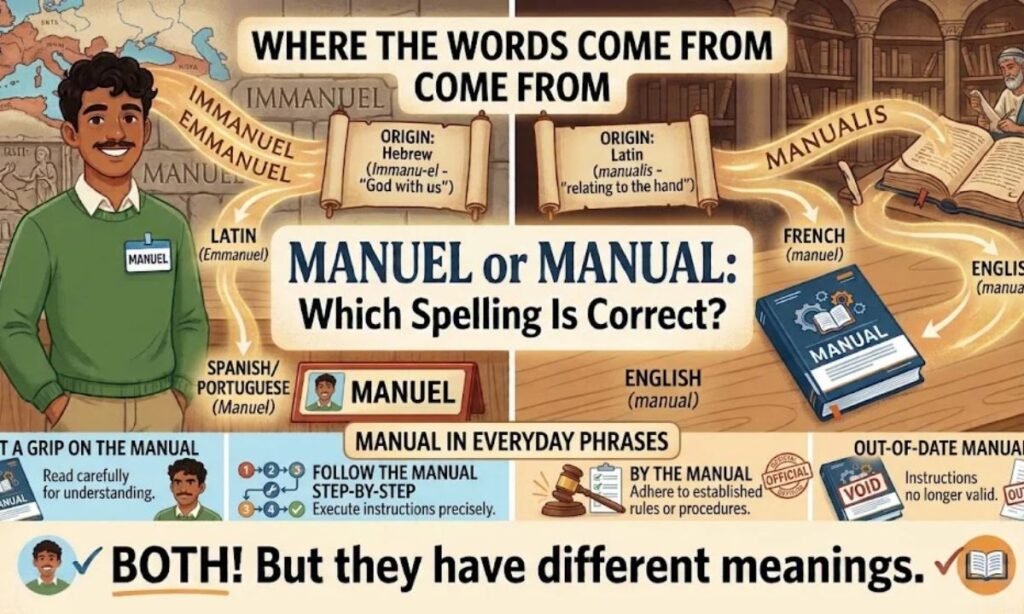
“Manual” appears in many common expressions. None of them ever use “Manuel.”
- User manual: the guide that comes with a product
- Instruction manual: step-by-step directions for a task
- Owner’s manual: the book that comes with a car or appliance
- Manual labor: work done mostly with the body, such as construction or farming
- Manual transmission: a gearbox the driver shifts
- Manual override: a control that lets a person take over an automatic system
- Manual testing: checking software by hand instead of using automated tools
- Manual (music): a keyboard on an organ that is played with the hands
Whenever the phrase involves a tool, a task, or a guide, the right spelling is manual.
Frequently Asked Questions
Is “Manuel” ever correct in English?
Yes, but only as a person’s name or part of a place name. It is not a regular vocabulary word. If you are not talking about someone called Manuel, the spelling you need is almost always manual.
What is the difference between Manuel and manual?
Manual is a common English word meaning an instruction book or something done by hand. Manuel is a first name used for people. Their meanings, capitalization, and pronunciation are all different.
Is “manual” a noun or an adjective?
It is both. As a noun, it means a guidebook, as in “the car manual.” As an adjective, it describes something done by hand or with human control, as in “manual labor” or “manual mode.”
How do you spell manual as in a book?
The correct spelling is m-a-n-u-a-l. It is the word for any instruction book, handbook, or guide, such as a user manual, an owner’s manual, or a training manual.
Conclusion
The difference between Manuel or Manual comes down to one question: are you talking about a person, or about a guide or something done by hand? If it is a person, write Manuel with a capital M. If it is a guide, a hands-on task, or a hands-on control, write manual.
Reread your sentence once before sending it, especially if your phone loves to autocorrect. That one quick check keeps your emails, essays, and messages clean and clear.