
You are writing a note about a boating trip, and your fingers type b-o-u-y. Something looks off, but the squiggly line isn’t helping, and now you are second-guessing a word you have seen a hundred times.
The buoy or bouy question trips up plenty of careful writers because the word does not look the way it sounds. One wrong letter order can make a sentence look careless. Here is the fix, plus a few tricks so you never have to look it up again.
What Does “Buoy” Mean?
A buoy is a floating device anchored in place or left to drift. It does a job on the water: it marks a hazard, a channel, a mooring spot, or a swimming zone. It can also carry instruments that measure waves, wind, and water temperature.
Buoy works as two different parts of speech:
- Noun: a floating marker or safety device. The red buoy marked the edge of the channel.
- Verb: to keep afloat, or to boost confidence and support. Strong sales buoyed the company’s third quarter.
Both meanings share one idea: staying up instead of sinking.
Is “Bouy” a Real Word?
No. Bouy does not appear as an entry in major dictionaries such as Merriam-Webster or Oxford. It is not a regional variant, a British spelling, or an old form that survived in some places. It is simply the letters of “buoy” in the wrong order.
Spell checkers will flag it, and editors will correct it. If you are writing a school paper, a work email, a boating guide, or a product listing, “bouy” signals a typo that readers notice quickly.
Why Do People Misspell Buoy as Bouy?
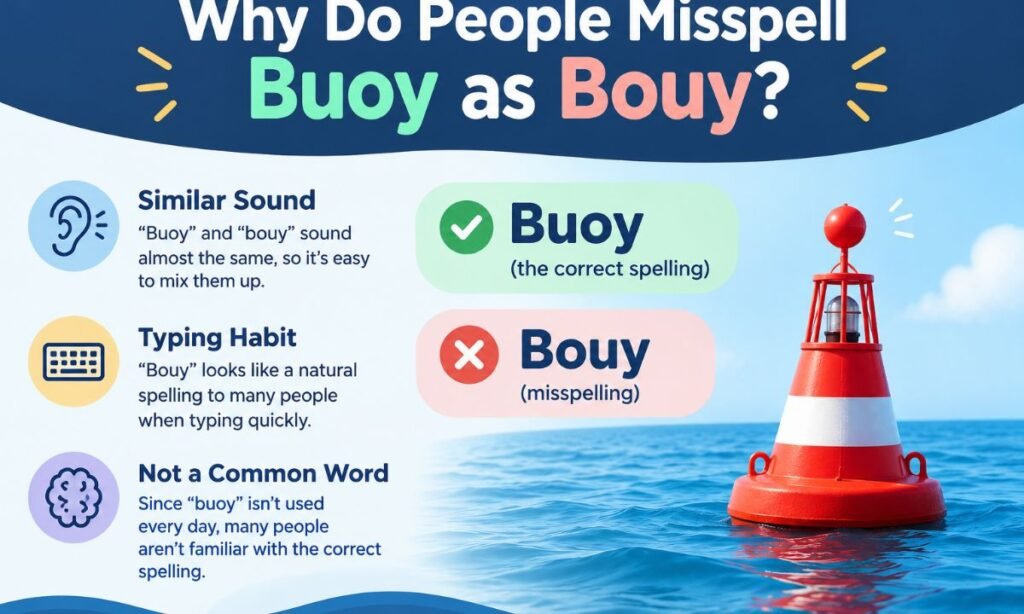
Three things push writers toward the wrong spelling.
The sound hides the spelling. English has many vowel pairs, and “uoy” is a rare one. Writers try to spell what they hear, and “boo-ee” or “boy” does not point toward U then O.
The shape looks familiar. Words like “bound,” “bough,” and “bouquet” start with B, O, U. Your eyes expect that pattern, so “bouy” feels natural even though it is wrong.
The word is not typed often. Most people write “buoy” a few times a year at most. Rare words are easy to scramble, because the spelling never gets locked into muscle memory.
The mistake is common and harmless once you know the pattern. Fixing it takes about ten seconds of practice.
How to Pronounce Buoy
Pronunciation is part of the confusion, because English speakers do not agree on it.
| Region | Common pronunciation | Sounds like |
| United States | BOO-ee | “boo” plus “ee” |
| United Kingdom | BOY | rhymes with “toy” |
| Australia | BOY (BOO-ee also heard) | varies by speaker |
Both versions are accepted. Many American speakers say BOO-ee, while British speakers often say BOY, which sounds just like the word “boy.” Canadians and Australians tend to use either one. The difference in sound has no effect on spelling, and neither pronunciation justifies the spelling “bouy.”
For related words, the same split appears. “Buoyant” is usually said BOY-unt in American English, and “buoyancy” is BOY-un-see.
The Origin of Buoy
The word came into English from Dutch and Old French. Historians trace it to Middle Dutch boeye and Old French boie, both of which referred to a float or a chain used to hold something in the water. English sailors took the word on board by the Middle Ages.
That history explains the odd spelling. Borrowed words often keep letter patterns from their source language, even after the pronunciation shifts. Over the centuries, English settled on “buoy” and the other order never became standard.
How to Remember the Correct Spelling
You do not need a perfect memory. You need one anchor that sticks.
- Split it into two syllables: bu + oy. The second half, “oy,” matches the end of “boy” and “toy.” The U comes first, then O, then Y.
- Think “U” before “O”: a buoy keeps you afloat. The U shows up early, just like a lifejacket you put on before you go out.
- Say it slowly in your head: b, u, o, y. Spell it out loud three times and the order tends to stay.
- Check for the link to “buoyant”: if you know “buoyant” starts with B-U-O, the base word follows the same pattern.
Pick the one that feels most natural and use it every time you type the word.
Buoy as a Noun and Verb: Forms and Examples
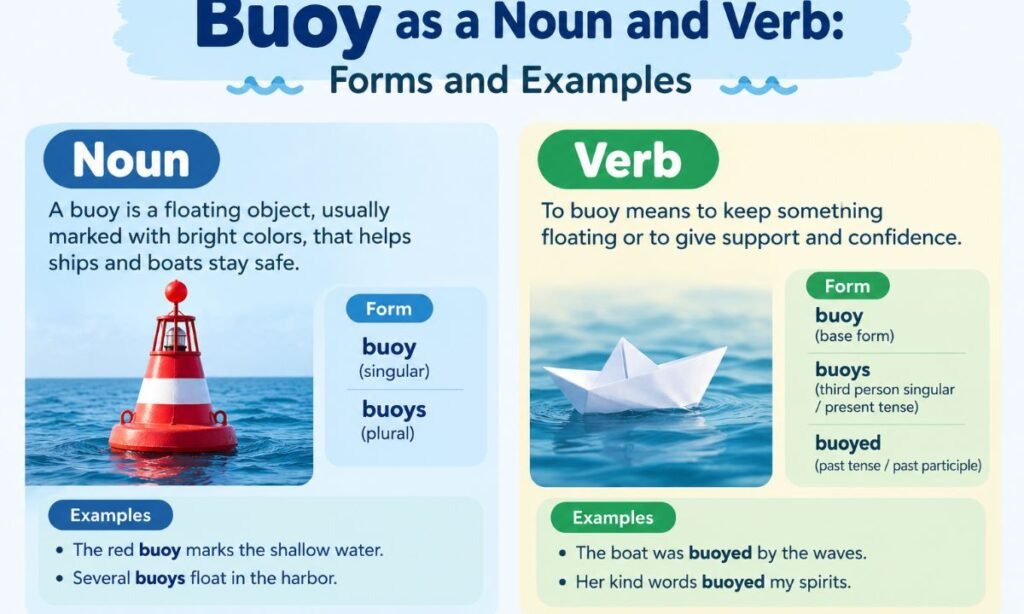
Many guides stop at the noun. The verb form shows up often in news and business writing, so it is worth knowing.
Noun Forms
- Singular: buoy
- Plural: buoys (not “buoies”)
The harbor has six buoys along the entrance channel.
Verb Forms
| Form | Spelling | Example |
| Base | buoy | Good news can buoy a tired team. |
| Third person | buoys | The report buoys investor confidence. |
| Past tense | buoyed | A kind message buoyed her spirits. |
| Present participle | buoying | Strong demand is buoying prices. |
The past tense is buoyed, not “buoyd” and not “bouyed.” Simply add -ed to the correct base word.
Common Expressions
- Buoy up: to support or lift. Her friends buoyed her up after the loss.
- Buoyed by: encouraged or boosted by something. He felt buoyed by the early results.
- Buoyant mood or market: cheerful, or rising and strong.
Types of Buoys and What They Do
Understanding the object helps lock in the word. Buoys are not all the same.
| Type | Purpose |
| Navigation buoy | Marks channels, hazards, and safe routes for boats |
| Mooring buoy | Gives boats a fixed spot to tie up without anchoring |
| Lifebuoy | A ring thrown to someone in the water to keep them afloat |
| Weather or data buoy | Carries sensors that record wave height, wind, and temperature |
| Swim buoy | Marks a safe swimming area or helps open-water swimmers stay visible |
In the United States, many channel markers follow the rule “red, right, returning.” When a boater comes back from the sea toward the harbor, red buoys should stay on the right side and green buoys on the left. Local conditions can vary, so always check the chart for your waters.
Buoy vs Similar Words
Several nearby words cause trouble, so here is how they separate.
Buoy vs Boy
These sound alike in British English, but they are unrelated. A boy is a young male. A buoy floats on water. The boy swam out to the buoy. Both words appear in that sentence and they never swap.
Buoy vs Buoyant and Buoyancy
Buoy is the object or the action. Buoyant is the adjective that describes something that floats or feels light and cheerful. Buoyancy is the noun for the upward force that keeps things afloat. All three begin with B-U-O.
Buoy vs Beacon
A buoy floats on the water. A beacon is a fixed signal, often a light on land or a tower, that guides ships and aircraft. Some beacons stand in the water on a permanent structure, but a buoy always floats.
Common Mistakes With Buoy
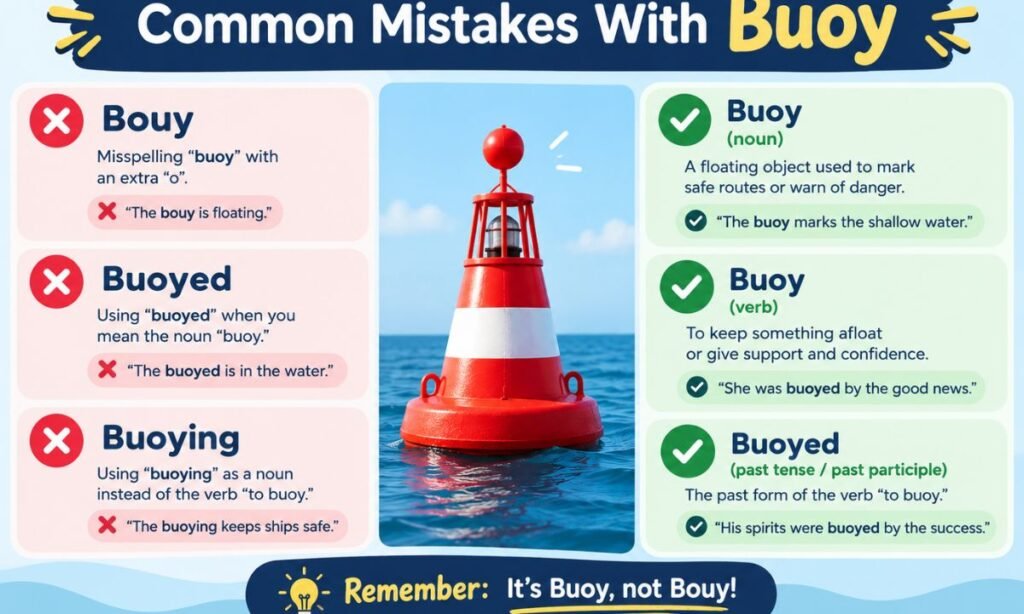
Here are the errors that show up most often, and the fix for each.
- Spelling by sound: writing “boy,” “booey,” or “bouy.” Fix: remember the U-O-Y order.
- Treating “bouy” as a variant: it is not British, not archaic, and not acceptable. Fix: use “buoy” everywhere.
- Wrong past tense: “bouyed” or “buoyd.” Fix: buoyed.
- Wrong plural: “buoies.” Fix: buoys.
- Mixing buoy with boy in speech-to-text: voice tools can swap them. Fix: proofread any dictated text near boating terms.
Buoy in Real Sentences
Seeing the word in context makes it stick faster.
Email: Please check that the mooring buoy is attached before we leave the dock.
News: Rising exports buoyed the region’s economy this quarter.
Social media: Spotted a seal resting on a buoy near the pier this morning!
Formal writing: The study used data from an offshore buoy to track wave patterns.
Everyday speech: A warm welcome can buoy a nervous new hire.
Frequently Asked Questions
Is “bouy” ever correct?
No. Bouy is a misspelling of buoy and is not accepted in standard English, whether American, British, or Australian. Always use “buoy.”
How do you pronounce buoy?
In American English it is usually BOO-ee. In British English it is usually BOY. Both are considered correct pronunciations, and the spelling stays the same.
What is the plural of buoy?
The plural is buoys. You simply add an S. The form “buoies” is incorrect.
What is the past tense of buoy?
The past tense is buoyed. It works for both meanings, as in “the crew buoyed the channel with markers” or “the news buoyed her mood.”
Final Verdict: Buoy or Bouy?
The answer is simple: buoy is correct and “bouy” is a typo. Use buoy for the floating marker, for the lifesaving ring, and for the verb that means to lift or support. Remember the bu + oy split, keep the U before the O, and the mistake will fade fast.
Next time your fingers type the wrong order, you will know it before the spell checker does.

Alexander John grammar content writer with 4 years of experience creating accurate, engaging, and SEO-friendly content. I specialize in spelling differences, commonly confused words, vocabulary, grammar rules, and writing tips. My goal is to simplify English for learners through clear explanations, practical examples, and helpful articles.