
You are typing a wedding invitation, a cover letter, or a thank-you card. You write “special ocassion,” and something looks off, but you can’t say why. That small flicker of doubt has slowed down plenty of confident writers.
The occasion or ocassion question keeps coming up because the word is easy to say and surprisingly easy to misspell. Let’s settle it in seconds, then give you a memory trick so you never second-guess it again.
W+hat Does Occasion Mean?
Occasion is a noun with three closely related meanings:
- A particular event or time: a wedding, a graduation, a holiday dinner.
- A suitable moment or opportunity: “This is not the occasion for jokes.”
- A reason or cause: “She had no occasion to complain.”
The word came into English through French from Latin, where it pointed to a fitting moment or opportunity. That sense of “the right moment” still lives on in the phrase “rise to the occasion.”
A few plain examples:
- We saved the good plates for a special occasion.
- On that occasion, the train arrived early.
- Her promotion was the perfect occasion to celebrate.
Occasion vs Ocassion: Side-by-Side Comparison
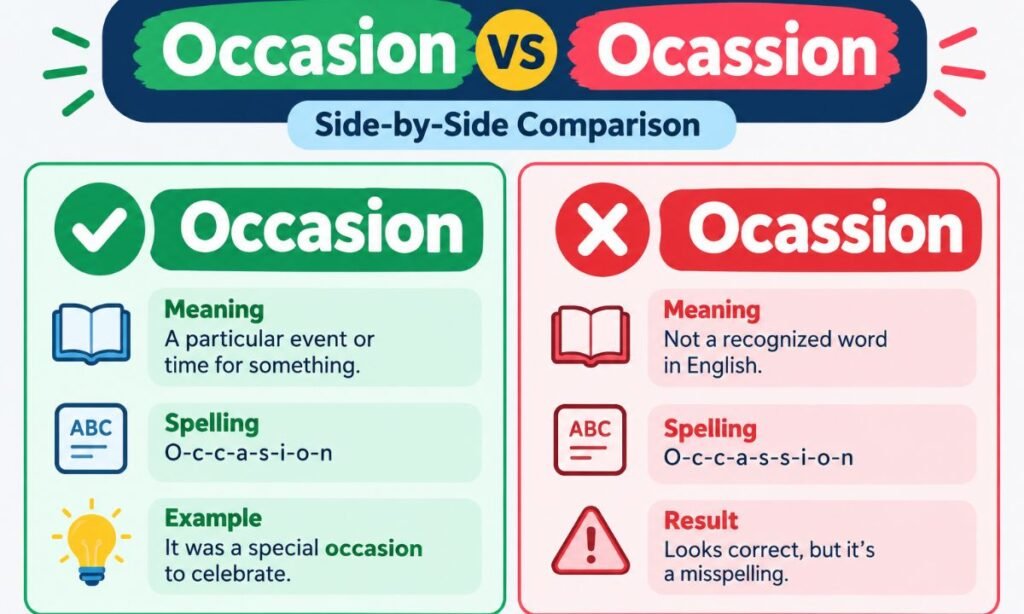
| Feature | Occasion | Ocassion |
| Correct spelling? | Yes | No |
| Letters | o-c-c-a-s-i-o-n | o-c-a-s-s-i-o-n |
| Number of Cs / Ss | Two Cs, one S | One C, two Ss |
| In dictionaries? | Yes | No |
| Part of speech | Noun (rarely a formal verb) | None |
| Safe for formal writing? | Yes | No |
“Ocassion” has no meaning, no definition, and no correct use. It is simply a typo that many people repeat.
Why “Ocassion” Looks Right but Isn’t
You can’t hear the double C. Say “occasion” out loud and it sounds like uh-KAY-zhun. Nothing in that sound signals two Cs, so your fingers type one.
Double letters move around. English has no sound rule that tells you where a doubled consonant belongs. Writers often place the double in the wrong spot, which is how “ocassion” ends up with two Ss instead of two Cs.
So if you have typed “ocassion” before, you are in very good company. Your brain followed the sound instead of the spelling.
Easy Ways to Remember the Spelling
Try these tricks:
- The cake trick: Every occasion needs Company and Cake, but only one Slice. Two Cs, one S.
- The chant trick: Say it in rhythm as you type: “O, double C, A, S, I, O, N.”
- The family trick: Link it to “occasional” and “occasionally.” They share the same double C, so learning one teaches you all three.
- The cousin trick: Many words that start with “oc” also carry a double C, such as occur and occupy. It is not a perfect rule (think of “ocean” and “octopus”), but it makes a solid first guess.
Word Forms of Occasion
| Word | Part of Speech | Example |
| Occasion | Noun | The party was a happy occasion. |
| Occasions | Noun (plural) | We meet only on rare occasions. |
| Occasional | Adjective | She takes an occasional walk. |
| Occasionally | Adverb | He visits us occasionally. |
| Occasioned | Verb (formal) | The delay occasioned some complaints. |
The verb form is rare and formal. In everyday writing, you will almost always use the noun.
How to Use Occasion in a Sentence

Seeing the word in real sentences is the fastest way to lock in the spelling.
Daily life
- Her birthday was a great occasion for the whole family.
- I only wear this suit on special occasions.
Education
- Graduation is a proud occasion for students and parents.
- The teacher used the occasion to review the lesson.
Business
- The product launch was an important occasion for the team.
- We have had occasion to review this policy several times.
Technology
- On rare occasions, the app may crash after an update.
Conversation
- “Is this a formal occasion?” “Yes, so bring a tie.”
Each of these would look wrong with “ocassion,” and any spell checker would underline it in red.
Common Phrases With Occasion
Native speakers use occasion in many set phrases. Learning them makes your English sound natural.
- Special occasion: an important or celebrated event.
- On occasion: now and then; from time to time.
- Rise to the occasion: perform well when it matters.
- For the occasion: suited to a specific event.
- On the occasion of: at the time of a particular event.
- Have occasion to: have a reason or need to do something.
- Take the occasion to: use a moment to do something.
A small tip: “on occasion” and “occasionally” mean nearly the same thing, but “on occasion” reads a bit more polished in writing.
Occasion vs Opportunity vs Event
| Word | Best Used For | Example |
| Occasion | A specific time or the moment itself | The occasion called for a toast. |
| Event | A planned or notable happening | The event starts at noon. |
| Opportunity | A chance to do something | This is an opportunity to learn. |
They overlap, but they are not always swappable. “Occasion” leans toward the moment or reason. “Event” is the happening itself. “Opportunity” stresses the chance.
Other Common Misspellings
“Ocassion” is not the only wrong version out there. Watch for these too.
| Wrong Spelling | What Went Wrong | Correct Spelling |
| Ocassion | One C, two Ss | Occasion |
| Occassion | Extra S | Occasion |
| Ocasion | Missing one C | Occasion |
| Occation | Wrong letters near the end | Occasion |
| Occassional | Extra S | Occasional |
| Ocassionally | One C, two Ss | Occasionally |
The fix is always identical: two Cs, one S.
Occasion in Formal and Academic Writing

In formal writing, a spelling slip can cost you credibility fast. A typo in a résumé, essay, or business email can make a careful writer look rushed, even when the ideas are strong.
A few habits help:
- Run a spell check, then proofread. Most tools catch “ocassion,” but a human read catches what they miss.
- Be specific when you can. Instead of “a special occasion,” name it: “the annual meeting” or “the awards ceremony.”
- Skip the regional worry. Unlike “color” and “colour,” occasion is spelled the same in American and British English.
Quick Practice: Fill in the Blanks
Pick the correct spelling for each sentence.
- The wedding was a joyful ______ for both families. (occasion / ocassion)
- We only use the good china on special ______. (occasions / ocassions)
- She rose to the ______ and gave a brilliant speech. (occasion / ocassion)
- He ______ visits the library. (occasionally / ocassionally)
- Choose an outfit that suits the ______. (occasion / ocassion)
Answers: 1. occasion, 2. occasions, 3. occasion, 4. occasionally, 5. occasion.
Missed one? Repeat the rule: two Cs, one S.
Frequently Asked Questions
Which is correct, occasion or ocassion?
Occasion is correct. “Ocassion” is a misspelling that uses one C and two Ss. The right pattern is o-c-c-a-s-i-o-n.
What does “occasion” mean?
Occasion means a particular time or event, such as a wedding or holiday. It can also mean a suitable moment or a reason for something, as in “She had no occasion to complain.”
Is “ocassion” ever acceptable?
No. It is not an accepted variant in American or British English and does not appear in standard dictionaries. Always correct it to “occasion.”
How do British people say occasion?
British speakers say it much like Americans: uh-KAY-zhun. The spelling is identical in both varieties of English, so there is no separate British form
.Final Verdict
The occasion or ocassion debate has a clear winner. Occasion is the only correct spelling. “Ocassion” is a typo with no place in emails, essays, invitations, or any other writing. Keep the double C in mind, connect it to “occasional,” and you will spell it right every time. It is a small detail, but small details are what make writing look clean and confident.