
You are signing a school form, and the line reads, “Please bring your parents permission slip.” Something looks off, but what? Parents or parent’s or parents’ is one of the most common apostrophe puzzles, and a single mark can change who owns what.
Get it wrong and your writing looks sloppy right where it counts: emails, notices, and applications. Good news: two quick questions sort it out every time, and you can learn them in about five minutes.
What Each Form Means
Each spelling does a different job, so it helps to see them one at a time.
Parents is the plain plural of “parent.” It names more than one parent and shows no ownership.
- “Her parents live in Ohio.”
- “Both parents are invited.”
Parent’s is the singular possessive. It shows that one parent owns or is linked to something.
- “My parent’s phone number is on the form.”
- “The parent’s signature is required.”
Parents’ is the plural possessive. It shows that two or more parents own or are linked to something.
- “We stayed at my parents’ cabin.”
- “The school asked for both parents’ signatures.”
Parents vs Parent’s vs Parents’ at a Glance
| Form | Type | Number of parents | Shows ownership? | Example |
| parents | Plural noun | 2 or more | No | My parents are visiting. |
| parent’s | Singular possessive | 1 | Yes | My parent’s car is blue. |
| parents’ | Plural possessive | 2 or more | Yes | My parents’ car is blue. |
Notice that “parent’s car” and “parents’ car” mean different things. One tiny apostrophe changes the number of people involved.
The Two Question Test
You do not need to memorize a chart. Ask yourself two questions, in this order.
Question 1: Does the parent (or parents) own or have something? If the answer is no, you want plain parents (or “parent” if there is just one). No apostrophe needed.
Question 2: How many parents are there? If the answer to Question 1 was yes, count them.
- One parent: parent’s
- More than one: parents’
Here is a bonus check. Rewrite the phrase with “of.” If “the house of the parents” makes sense, the word is possessive. Then count the parents to place the apostrophe.
| Phrase | “Of” test | Answer |
| my parents house | the house of my parents | parents’ |
| the parent signature | the signature of the parent | parent’s |
Why the Apostrophe Moves
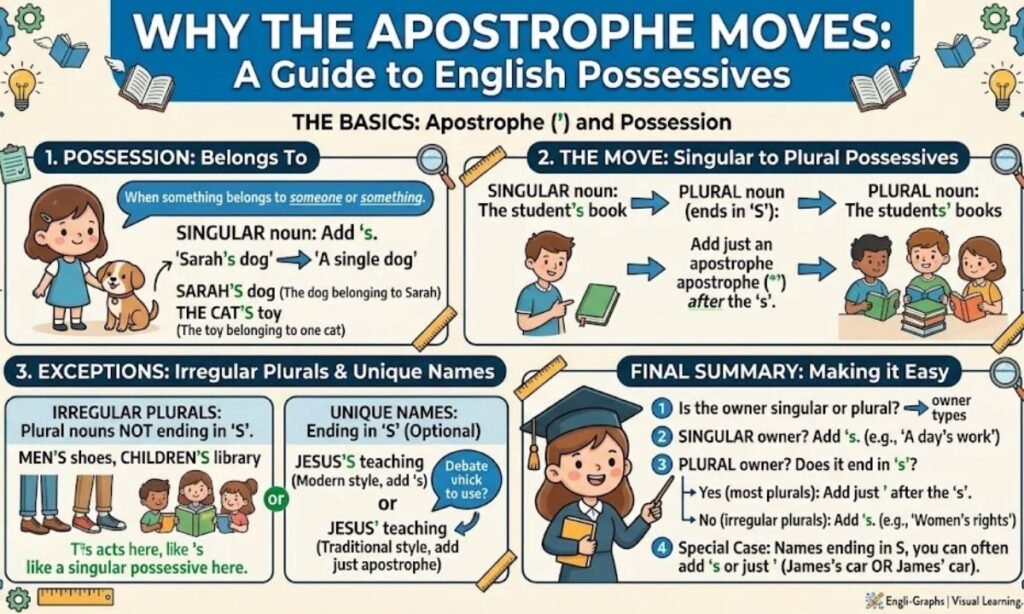
English has one simple rule for possessives, and it explains everything here.
- For a singular noun, add ’s: parent → parent’s.
- For a regular plural that already ends in s, add just an apostrophe: parents → parents’.
“Parent” is a regular noun, so its plural ends in s. That is why you do not write “parents’s.” Adding another s after an apostrophe that already follows an s sounds clumsy, so English drops it.
Irregular plurals work differently. Words like “children” and “women” do not end in s, so they take ’s: “children’s books,” “women’s team.” “Parents” is regular, so it follows the first pattern.
Real Life Examples
Seeing these forms in everyday writing makes the pattern stick.
In emails
- “Please ask your parents to confirm the date.”
- “Could you send me your parent’s contact details?” (one parent)
- “Thank you for your parents’ support.” (both parents)
In school notices
- “Parents are welcome to attend.”
- “A parent’s permission is required for the trip.”
- “All parents’ questions will be answered at the meeting.”
On social media
- “Finally visiting my parents this weekend!”
- “Raiding my parents’ fridge again.”
- “My parent’s advice was right. Again.”
In daily conversation
- “Your parents sound great.”
- “Is that your parent’s dog?”
- “We met at my parents’ anniversary party.”
When Parent’s Is Not Possessive
Here is a trap many guides skip. The ending ’s can also be a contraction of “is” or “has.” In that case it shows no ownership at all.
- “My parent’s a nurse.” (parent is)
- “Her parent’s been traveling all week.” (parent has)
You will mostly see this in casual writing. In formal writing, spell it out: “My parent is a nurse.” If you are unsure which meaning you have, try swapping in “is” or “has.” If the sentence still works, it is a contraction. If it breaks, it is possessive.
One House or Two? Shared vs Separate Ownership
When two parents own something together, you mark possession once, on the last name or word.
- “My parents’ house” (they own it together)
- “Mom and Dad’s house” (shared)
When each parent owns something separate, mark each one.
- “Mom’s and Dad’s cars” (two cars)
This does not change the basic spelling of “parents.” It only matters when you name each parent individually. For most sentences, “parents’” is all you need.
Another useful case is one parent versus both. If a form says “a parent’s signature,” one signature is enough. If it says “parents’ signatures,” it wants more than one. Reading that apostrophe carefully can save you a rejected form.
Common Mistakes to Avoid
These errors show up everywhere, even in professional writing.
1. Skipping the apostrophe.
- Wrong: “my parents house”
- Right: “my parents’ house”
2. Using an apostrophe for a simple plural.
- Wrong: “Both parent’s came to the game.”
- Right: “Both parents came to the game.”
3. Putting the apostrophe in the wrong spot.
- Wrong: “my parent’s house” (when you mean both parents)
- Right: “my parents’ house”
4. Adding an extra s.
- Wrong: “my parents’s car”
- Right: “my parents’ car”
5. Writing the apostrophe before the s for a plural. Using “parent’s” because it “looks right” is the most common slip. Always count the parents first.
Related Forms: Grandparents, Step-Parents, and In-Laws
The same rules apply to similar words, so one skill covers many situations.
| Word | Plural | Plural possessive | Example |
| grandparent | grandparents | grandparents’ | my grandparents’ farm |
| step-parent | step-parents | step-parents’ | my step-parents’ wedding |
| parent-in-law | parents-in-law | parents-in-law’s | my parents-in-law’s house |
| single parent | single parents | single parents’ | single parents’ support group |
The in-law form is the exception worth remembering. The plural is “parents-in-law,” which ends in “law,” not s. So the possessive takes ’s.
Also watch for fixed phrases such as “parents’ night” and “parents’ evening.” The apostrophe goes after the s because the event belongs to the parents as a group.
Memory Tricks and Practice
Short tricks help when you are writing fast.
- The apostrophe trick. Think of the apostrophe as a pointer. It sits right after the owner. One owner, it sits before the s. Many owners, it sits after the s.
- The count trick. Before you type the apostrophe, say “one or more?” out loud.
- The “of” trick. Rewrite the phrase with “of” to confirm ownership.
Now try these. Pick the correct form, then check your answers below.
- My (parents / parent’s / parents’) are visiting next week.
- I borrowed my (parents / parent’s / parents’) camper for the trip.
- The school needs a (parents / parent’s / parents’) signature on this page.
- Both (parents / parent’s / parents’) opinions matter to me.
- We spent the holiday at my (parents / parent’s / parents’) place.
Answers: 1. parents. 2. parents’ (one camper owned by both parents), or parent’s if you mean only one parent. 3. parent’s. 4. parents’. 5. parents’ (or parent’s if one parent).
Question 2 and question 5 depend on your family. That is the point. The apostrophe tells readers how many parents you mean.
Frequently Asked Questions
Which is correct: parents or parent’s?
Both are correct, but they do different jobs. Parents is a plural noun with no ownership. Parent’s shows that one parent owns something or is linked to something. If nothing belongs to the parent, use “parents.”
What does parents’ mean?
Parents’ is the plural possessive. It shows that two or more parents own or have something, as in “my parents’ house.” The apostrophe goes after the s because the word is already plural.
Is it my parents house or my parents’ house?
The correct form is my parents’ house. The house belongs to the parents, so the word needs an apostrophe. If only one parent owned it, you would write “my parent’s house.”
Can parent’s mean both parents?
No. Parent’s points to one parent. If you mean both, use parents’. The exception is “parent’s” as a contraction of “parent is” or “parent has,” which has nothing to do with ownership.
Final Thoughts
The choice between parents or parent’s or parents’ comes down to two checks. First, ask whether anything is owned. Second, count the parents. No ownership means “parents.” One owner means “parent’s.” Many owners means “parents’.” Keep those two questions in your head and the apostrophe will land in the right spot every time.
Pingback: Labelling or Labeling (2026): Which Spelling Is Correct?