
You’ve typed it a hundred times, but that little red squiggly line under one version still makes you second-guess yourself. Is it “in fact” or “infact”? The confusion is common, and it’s not just you. Confusing in fact or infact can quietly chip away at your credibility in emails, essays, and social posts. The good news is the answer is simple, and once you see the logic behind it, you’ll never mix them up again.
What “In Fact” Means
At its core, “in fact” is a phrase used to add emphasis, confirm something, or introduce a detail that strengthens what was just said. It often signals that what follows is more precise, surprising, or important than the previous statement.
Think of it as a verbal spotlight. It tells your reader: pay attention, this part matters.
In fact meaning, in simple terms: “in truth” or “actually.” It’s used when you want to back up a claim with something concrete or when you’re correcting a mild misconception.
Is “Infact” a Real Word?
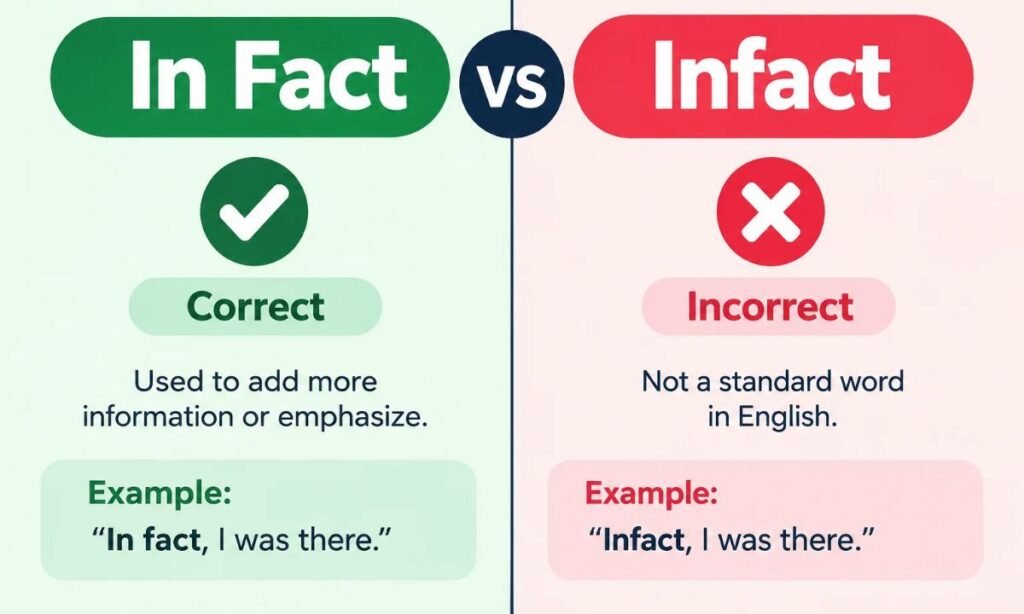
No. “Infact” is not recognized as a standard word in English. You won’t find it listed as a legitimate entry in major dictionaries like Merriam-Webster or Oxford. It exists only because people naturally merge short, frequently used words when typing quickly, the same way “alot” shows up instead of “a lot.”
This makes “infact” one of the more common misspellings floating around casual writing, especially on social media and in text messages, but it hasn’t earned a place in formal English grammar.
In Fact vs Infact: Side-by-Side Comparison
| Feature | In Fact | Infact |
| Word count | Two words | One word (incorrect merge) |
| Dictionary status | Standard, recognized | Not recognized |
| Formal writing | Correct | Incorrect |
| Casual writing | Correct | Still incorrect, just common |
| Grammar function | Adverbial phrase | Not applicable |
This comparison makes the difference between in fact vs infact easy to see at a glance. One is standard English. The other is simply a typo that stuck around.
Why “In Fact” Is the Correct Spelling
English has plenty of compound words that started as two separate words and eventually merged, like “today” or “cannot.” But “in fact” never went through that shift. It has always functioned as a preposition (“in”) combined with a noun (“fact”), and that structure has stayed intact through standard usage.
Because “in” and “fact” each carry their own grammatical role, splitting them apart isn’t optional. Squeezing them into one word breaks that structure, which is exactly why “infact” doesn’t hold up under grammar rules.
How to Use “In Fact” in a Sentence
“In fact” usually appears in one of these spots:
- At the start of a sentence, followed by a comma
- In the middle of a sentence, set off by commas
- Right after a statement you want to strengthen or clarify
Sentence structure tip: treat “in fact” the way you’d treat “actually” or “indeed.” If a comma feels natural around those words, the same rule applies here.
Example pattern: “[Statement]. In fact, [supporting or surprising detail].”
In Fact Examples in Real Sentences
Seeing the phrase in context makes it click faster than any rule ever could.
- She said she wasn’t tired. In fact, she’d only slept three hours.
- The plan wasn’t just good, it was, in fact, the best option we had.
- I thought the meeting would run long. In fact, it ended early.
- He’s not new to this. In fact, he’s been coding for over a decade.
- The restaurant wasn’t crowded at all. In fact, we were the only table there.
These in fact sentence examples show how the phrase adds weight to a claim without changing the sentence’s basic meaning.
In Fact Synonyms and Alternatives
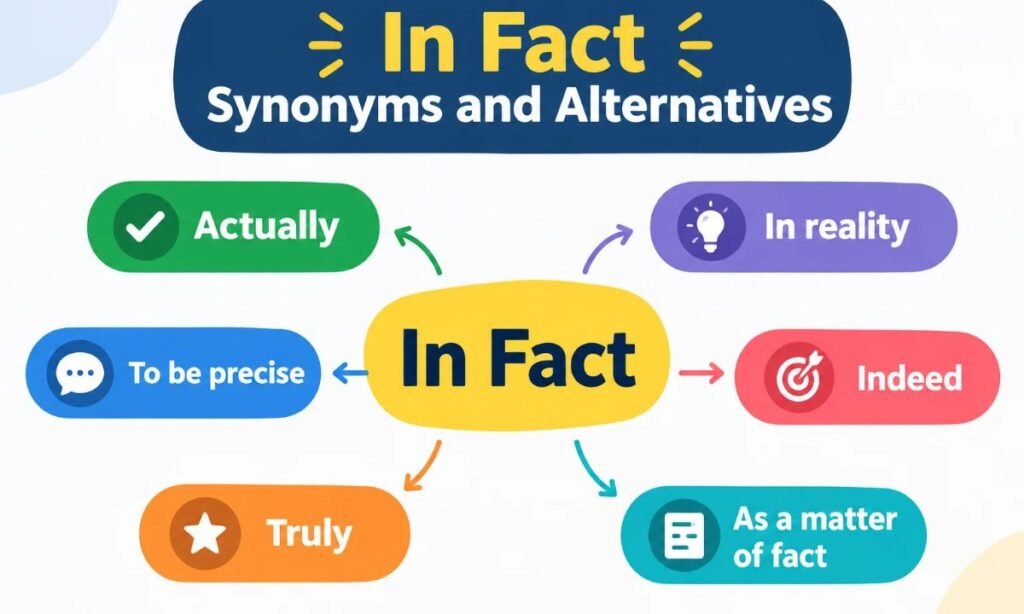
Sometimes you want variety instead of repeating “in fact” throughout a piece of writing. A few natural swaps include:
- Actually
- Indeed
- As a matter of fact
- Truthfully
- Really
Actually vs in fact comes up often because the two are nearly interchangeable. The small difference is tone. “Actually” tends to feel slightly more conversational, while “in fact” leans a bit more formal and confident. Either works in most everyday writing, so pick whichever fits the rhythm of your sentence.
Punctuation Rules for In Fact
Commas matter here more than people realize. Here’s the simple version:
- Starting a sentence: “In fact, she left early.” (comma after)
- Mid-sentence: “The results, in fact, surprised everyone.” (commas on both sides)
- End of a clause before more detail: use a comma before it, not after
Skipping the comma is one of the smaller mistakes writers make, but it can make a sentence feel rushed or run-on.
Common Mistakes to Avoid
Beyond the spelling itself, a few related slip-ups show up often:
- Merging the words: writing “infact” instead of “in fact”
- Dropping the comma: “In fact she was right” instead of “In fact, she was right”
- Overusing the phrase: repeating “in fact” in every paragraph, which weakens its impact
- Confusing it with “in effect”: these two phrases mean different things and aren’t interchangeable
Being aware of these spelling mistakes helps clean up writing fast, especially in formal documents like resumes, reports, or academic essays.
Formal vs Informal Writing: Does It Change?
The spelling itself never changes based on tone. Whether you’re texting a friend or writing a business proposal, it’s always in fact, never “infact.”
What does shift a little is frequency. In formal writing, “in fact” tends to show up when building an argument or presenting evidence. In informal writing, it often pops up in casual conversation to add a bit of extra emphasis, closer to how people use “actually” out loud.
Frequently Asked Questions
Is infact two words?
No. “Infact” as written is one merged word, and that form isn’t correct. The proper version is always two separate words: “in fact.”
What is the meaning of infact?
“Infact” itself has no independent meaning because it isn’t a recognized word. People who write it are almost always trying to write “in fact,” which means “actually” or “in truth.”
What is the difference between “in fact” and “infact”?
“In fact” is the grammatically correct, dictionary-recognized phrase. “Infact” is simply a misspelling that merges the two words together, and it has no standing in formal English.
How do you say “in fact”?
It’s pronounced as two distinct words: “in” (rhymes with “pin”) followed by “fact” (rhymes with “act”). There’s a brief natural pause between them, reflecting that they’re separate words, not one.
Can “in fact” start a sentence?
Yes. Starting a sentence with “In fact,” followed by a comma, is common and grammatically correct. It’s often used to introduce a detail that reinforces or clarifies the sentence before it.
Final Takeaway
The debate between in fact or infact really comes down to one simple fact: only “in fact” is correct. “Infact” is a typing habit that never earned a real place in English grammar, no matter how often it shows up online. Keep the two words separated, mind your commas, and you’ll use this phrase with total confidence every time you write.