
Your class trip is next week, and you are typing the permission slip. Outting or outing? You write one, then the other, and suddenly both look strange. A single extra letter can make a flyer, email, or school notice look careless, and parents notice.
English does love to double letters, so the confusion is fair. This word, though, follows a clear rule. Here is the correct spelling, why it works, and how to stop second-guessing it.
Is “Outting” a Word?
No. “Outting” does not appear in standard dictionaries, and spell checkers will flag it. It is a typo that comes from a very reasonable guess.
Many English words double their last letter before “-ing.” Think of “cut” and “cutting,” or “put” and “putting.” Both end in “-ut,” just like “out,” so the brain assumes “out” should do the same. It does not, and the reason is easy to learn in the next few sections.
The spelling is the same in American, British, Canadian, and Australian English. You never need to adjust it for your audience.
What Does “Outing” Mean?
“Outing” is a noun with a few related meanings. The one you want depends on the sentence.
- A short trip for fun or learning: The school planned an outing to the science museum.
- A public appearance or performance, especially in sports: It was the team’s third outing of the season.
- Revealing private information about someone: This usually means publicly sharing that a person is gay or has another private identity, without their permission. The magazine was criticized for the outing of a private citizen.
The first meaning is by far the most common. The word grows out of the verb “out,” and “-ing” turns it into a noun for the act or event of going out.
The third meaning is a serious one. Outing someone without consent can cause real harm, so the term is used carefully in news and everyday conversation.
Why “Outing” Has Only One T
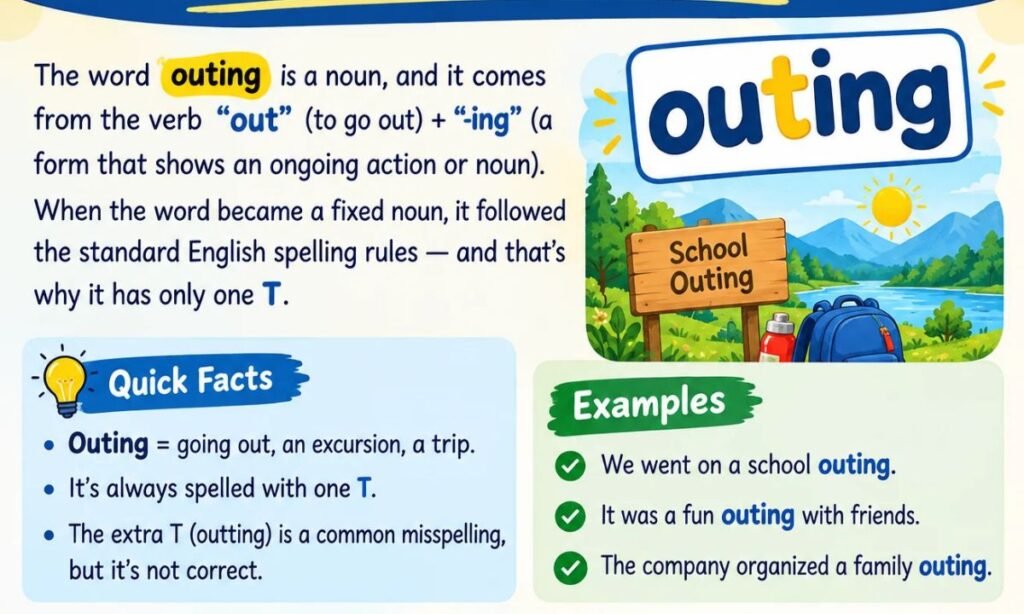
English has a doubling rule, and it helps to see exactly when it applies. A word usually doubles its final consonant before “-ing” when all three of these are true:
- The word has one syllable (or a stressed final syllable).
- It ends in one consonant.
- That consonant comes right after one vowel.
Now test two words.
| Word | Letters at the end | Single vowel before the consonant? | Result |
| cut | c-u-t | Yes, only “u” | cutting |
| out | o-u-t | No, two vowels “ou” | outing |
“Cut” has one vowel before the “t,” so the “t” doubles. “Out” has two vowels in a row, so the rule does not apply, and the “t” stays single.
That is the whole secret. When two vowels sit before the final consonant, do not double it.
Words That Follow the Same Pattern as Outing
“Outing” is not an oddball. Many words with a vowel pair before the last letter add “-ing” without doubling.
| Base word | Correct -ing form | Common mistake |
| out | outing | outting |
| shout | shouting | shoutting |
| scout | scouting | scoutting |
| route | routing | routting |
| doubt | doubting | doubtting |
| wait | waiting | waitting |
| meet | meeting | meetting |
| boil | boiling | boilling |
| eat | eating | eatting |
Each of these has two vowels, or a vowel plus another consonant, before the last sound. That blocks the doubling rule every time.
When the Final Letter Does Double
To avoid overcorrecting in the other direction, here are words that really do double, because they have a single vowel before the last consonant.
| Base word | Correct -ing form |
| cut | cutting |
| put | putting |
| sit | sitting |
| run | running |
| hit | hitting |
| stop | stopping |
Notice the pattern: one short vowel, then one consonant. The doubled letter keeps the vowel sound short. Without it, “cuting” would look like it rhymes with “cute.”
Outing, Outings, and Other Word Forms
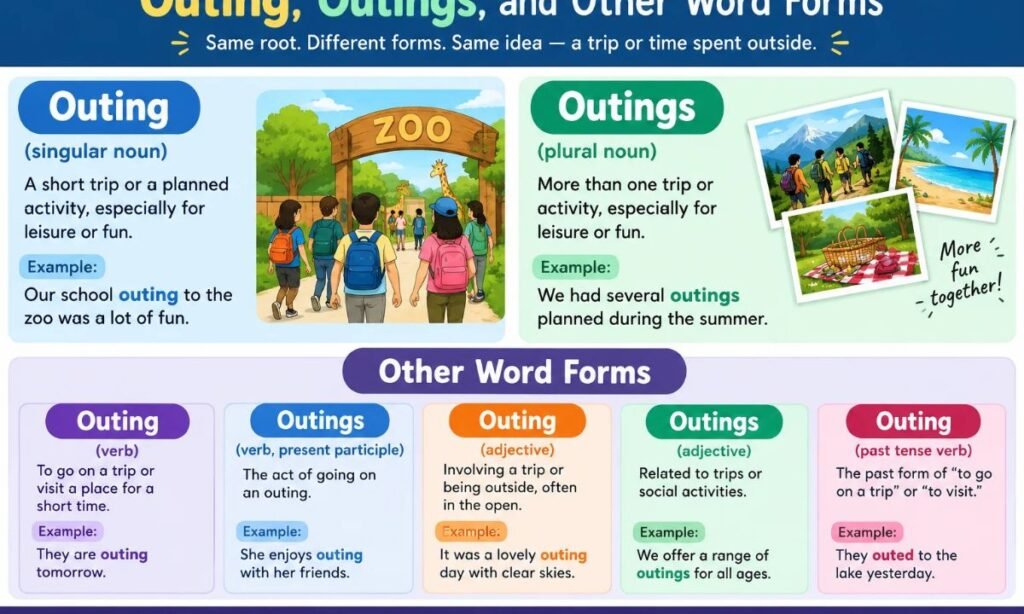
Here is how the word changes in different uses.
| Form | Example |
| outing (singular noun) | We planned an outing for Sunday. |
| outings (plural noun) | The club organizes monthly outings. |
| out (verb, to reveal) | They refused to out the source. |
| outed (past tense) | She was outed against her wishes. |
| outing (verb, -ing form) | The article is outing a private detail. |
The plural of “outing” is simply outings. You add an “s,” and nothing else changes.
As for pronunciation, “outing” is said OW-ting, with two syllables and the stress on the first.
Outing in Real Sentences
Seeing the word in context helps it stick. Here are examples for common situations.
Family and friends
- We planned a picnic outing at the park.
- Their weekend outing included a boat ride and ice cream.
School and work
- The fifth graders are going on an outing to the zoo on Friday.
- Our team enjoyed a bowling outing after the big project.
Sports and performance
- The pitcher had a strong outing in the second game.
- It was her first outing in the new role.
Reveal of private information
- Friends said the outing of his private life was unfair.
Common phrases
- A family outing is a trip planned for the whole household.
- A day outing is a trip that starts and ends on the same day.
- A group outing is an event for a team, club, or class.
Outing vs. Trip, Excursion, and Field Trip
Sometimes you want a different word, and these are close cousins of “outing.”
- Outing: A casual, short trip, usually for fun.
- Trip: A general word for travel, short or long.
- Excursion: A short organized trip, often for sightseeing.
- Field trip: An educational trip planned by a school.
“Outing” works well for relaxed plans like picnics, movies, and walks. For a school visit to a museum, “field trip” is more precise.
Common Mistakes With Outing
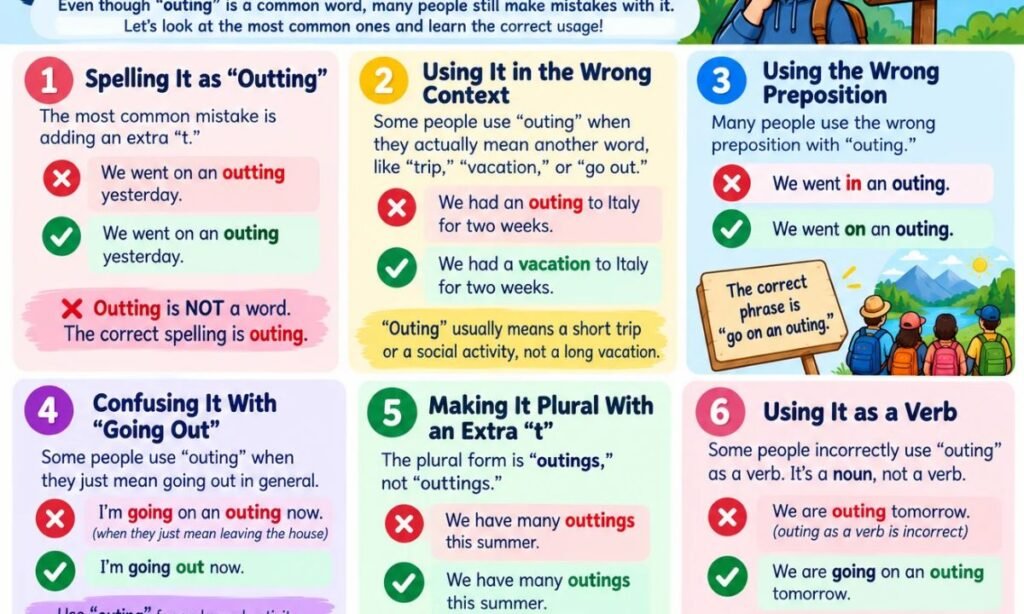
Most errors involve the extra “t” or the plural form.
| Mistake | Why it is wrong | Correct |
| outting | The “t” should not double | outing |
| outtings | Same extra “t” in the plural | outings |
| out-ing | Hyphen is not needed | outing |
| outting trip | Misspelled before “trip” | outing or trip |
| shoutting | Same doubling error | shouting |
One more small point. The word “outing” is a noun, so it often pairs with words like “family,” “school,” or “weekend.” You do not need extra punctuation between them.
Easy Ways to Remember the Spelling
A few small tricks can make this automatic.
- Count the vowels. In “out,” you have “o” and “u.” Two vowels mean no doubling.
- Match it with “shouting.” You would not write “shoutting,” so skip it here too.
- Think “out” plus “ing.” Say the pieces separately and join them as they are.
- Compare with “cutting.” Only words with a single vowel before the last consonant double.
- Say it slowly. “OW-ting” has one clear “t” sound.
Frequently Asked Questions
How do you spell outing?
It is spelled o-u-t-i-n-g, with one “t.” The word is made from “out” plus “-ing,” and the final letter does not double.
Is “outting” a word?
No. “Outting” is not a word in standard English. It is a common misspelling caused by applying the double consonant rule to a word that does not follow it.
Why is outing spelled with one T?
The doubling rule only works when a single vowel comes before the last consonant. “Out” has two vowels, “o” and “u,” so the “t” stays single.
What is the plural of outing?
The plural is outings. Add an “s” to the end, and keep the single “t,” as in “The class took two outings this spring.”
Conclusion
The answer to “outting or outing” is simple. Outing is correct, and “outting” is a mistake. The “t” stays single because “out” has two vowels before it, and the doubling rule only applies when a single vowel comes before the final consonant.
Keep that one idea in mind and you will also spell “shouting,” “scouting,” and “meeting” without a second thought. Save the doubled letters for words like “cutting” and “running.”